
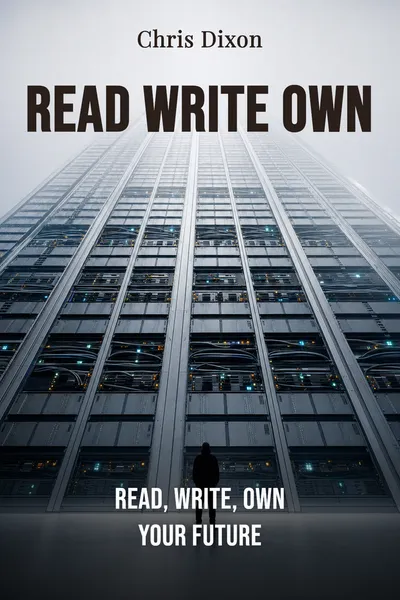
Read Write Own
Read, write, own your future
Description
There is a version of the internet almost nobody uses anymore, and it is the one the internet was built on. Email, the web, the underlying plumbing that moves data around — these ran on open protocols that no company controlled. Anyone could build on them, and the value created flowed out to whoever built. Chris Dixon, a longtime software founder turned venture investor at Andreessen Horowitz, opens Read Write Own with a simple observation: that internet quietly lost. What replaced it is a handful of platforms — Google, Meta, Amazon, Apple — that now sit between us and almost everything we do online.
Dixon's book, published in early 2024, is not a nostalgia trip. He is a partisan, one of the most visible backers of crypto in Silicon Valley, and he knows the word carries baggage after years of scams, meme coins and spectacular collapses. His argument asks us to look past the casino and at the machinery underneath. Blockchains, he claims, are not primarily about money. They are a new way to build networks that behave like the old open protocols — but that can also hold value and hand it back to their users, rather than to the company that happens to run the servers.
The title names his frame. The first internet let us read. The second let us write, and publish, and post — but on land we rent. The third, he argues, could finally let us own the thing we help build. Whether that promise is real, or another pitch dressed in the language of freedom, is the tension the book lives inside.
The question we’re asking : If the open internet was better, why did the corporate one win — and can anything actually reverse it?What we’ll see : How a venture capitalist reads the last thirty years of the web as a fight over who owns the network we all live on.
Table of contents
01Chapter 1 — The three eras of the internet
Dixon organizes the whole history around a single verb per era. The first stretch, roughly the 1990s, was the read era. Built on open protocols — the ones behind the web, email, and the flow of data itself — this internet let anyone publish and anyone read, but doing much beyond that was clumsy. Crucially, no company owned the rails. If you built something on top of email, the value you created was yours to keep. The network was a commons, closer to a public road than a private mall.
The second era, which he dates to the mid-2000s, is the write era, and it is the one we still live in. Facebook, YouTube, Twitter and their kin made publishing effortless. Suddenly anyone could write, post, sell, and reach an audience without knowing a line of code. But the tradeoff was ownership. These platforms are what Dixon calls corporate networks: private services that look open while you build on them and turn into landlords the moment you have something worth taxing. The rails were no longer public. They belonged to a company.

02Chapter 2 — Protocols lost, corporations won
Before making his case, Dixon has to explain a defeat. If open protocols were so good, why did they stall out while corporate networks swallowed the internet? His answer is unsentimental. Protocols are hard to fund and hard to improve. Nobody owns email, so nobody had the incentive — or the money — to keep pushing it forward, add features, or build the slick experience users came to expect. Open standards are governed by committees moving at the speed of consensus. Corporations move at the speed of a well-paid engineering team with a war chest.
So the two models competed on wildly uneven terms. A company like Facebook could raise billions, hire the best people, and iterate weekly. The open alternative had volunteers and goodwill. It was never a fair fight, and the outcome — polished corporate platforms crushing clunky open ones — was close to predetermined. Dixon is careful here: he is not claiming the corporations cheated. They simply had a funding model and the protocols did not.
03Chapter 3 — Blockchains as computers that make commitments
Dixon's core reframing is to strip the word blockchain of its financial glitter and describe what it actually is: a computer. A strange one, run by many machines at once rather than sitting in a single company's data center, but a computer nonetheless — one that can run software and store data. Its defining trait is not speed or cheapness. It is that it can make promises it cannot break. Once a rule is written into a blockchain, no one, not even its creators, can quietly change it later.
He calls this the ability to make credible commitments, and he treats it as the whole point. A corporate network cannot truly promise to stay open, because the promise is only as durable as the current management and the next quarterly target. A blockchain can. The rules — who gets what, what the fees are, how the network is governed — are enforced by code that runs whether or not the founders feel like honoring it. This, in Dixon's view, is what dissolves the attract-then-extract trap. If the terms can't be rewritten against you once you're locked in, there is nothing to fear from building on the network.
04Chapter 4 — The stakes of the next architecture
Step back from the tokens and the technical vocabulary, and Read Write Own is really a book about power — specifically, about who holds it in the spaces where more and more of life now happens. Dixon's deepest claim is that architecture is destiny. The shape of a network determines who captures its value and who sets its rules, and those decisions, once baked into infrastructure, are extraordinarily hard to undo. We are, in his telling, living inside choices made two decades ago by a handful of companies, and we mostly forgot we ever had a say.
What gives the argument weight beyond crypto is the timing. As he was writing, generative AI was concentrating power even faster, into even fewer hands — the companies with the data, the chips and the capital to train the largest models. The corporate-network logic that captured the write-era internet is now running again, at higher stakes. A future in which a few firms mediate not just what we post but what we can create and know is, for Dixon, the default outcome unless someone builds a different kind of rail. Ownership networks are his proposed counterweight, however uncertain.
05Conclusion
The book ends where it began, with a road and a mall. The early internet was a road: public, open, owned by no one, valuable to everyone who used it. What we have now is closer to a set of private malls — beautiful, convenient, and governed entirely by their owners, who can change the terms or show you the door whenever the numbers demand it. Dixon's wager is that we do not have to choose between the road's freedom and the mall's polish, that a network can be open and well-built and owned by its participants all at once.