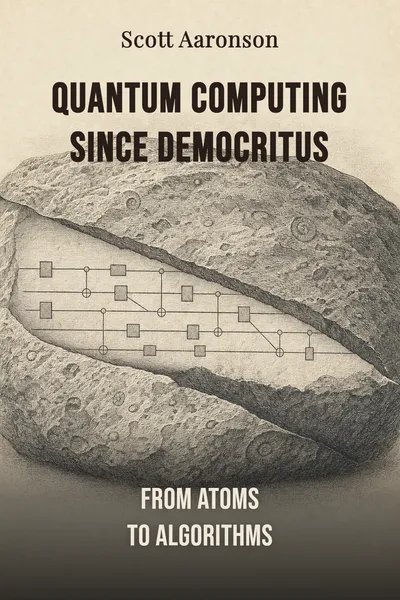
Quantum Computing Since Democritus
From atoms to algorithms
Description
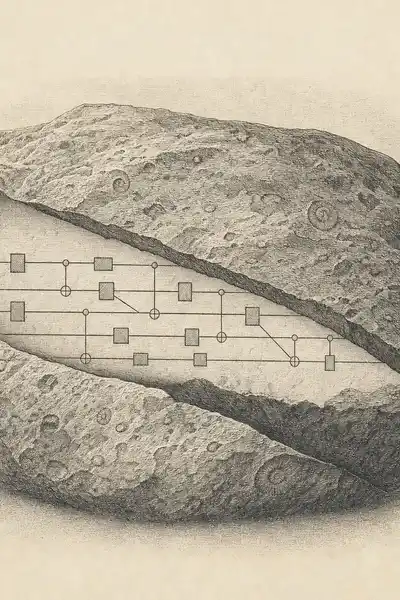
Around 400 BC, Democritus of Abdera made a guess that turned out to be one of the best guesses anyone ever made. Cut a stone in half, he reasoned, then keep cutting; you can't keep going forever, so somewhere down there sits an indivisible piece — an atomos. He had no microscope, no experiment, nothing but the refusal to accept an infinite regress. He was also, in one surviving fragment, honest enough to stage a little quarrel between the intellect and the senses: the mind tells the senses the world is made of atoms and void, and the senses snap back that without them the mind would have nothing to think about. It's a two-thousand-year-old argument that still hasn't been settled.
Scott Aaronson, a theoretical computer scientist who spends his days on the strange arithmetic of quantum machines, opens Quantum Computing Since Democritus with exactly that fragment — and not for decoration. His wager is that the questions Democritus was poking at are the same ones running through logic, set theory, computability, complexity, cryptography and quantum mechanics. They only look like separate subjects because universities file them in different buildings. Follow one thread far enough and you land on another.
The book grew out of a graduate course and keeps that texture: quick, opinionated, willing to argue with the reader and with famous physicists alike. It is not a gentle tour of pretty results. It is closer to watching someone think out loud about what a computation actually is, what a proof can and can't reach, and why a machine built on quantum weirdness might do something a normal one can't — while refusing to pretend any of it is settled.
The question we’re asking : What links a Greek atomist to the mathematics of quantum computers, and why does Aaronson insist they belong in the same conversation?What we’ll see : How a book stitches ancient metaphysics, the hard edges of logic and computation, and the physics of quantum machines into one continuous line of questioning.
Table of contents
01 Chapter 1 — A dead Greek and a stubborn question
Aaronson does not start with qubits or circuits. He starts with a hunch about how to think, and Democritus is his patron saint for it. The atomist got the big picture roughly right by pure reasoning — matter comes in discrete lumps, the rest is empty space — long before anyone could check. What Aaronson takes from him is not the specific answer but the move: when you refuse to accept that something goes on forever, or that a paradox is fine to live with, you're forced toward a real structural claim about the world. Good theory is disciplined stubbornness.
From Democritus the book jumps, cheerfully, across a couple of millennia to the tools modern mathematics built for the same job. Set theory is the first stop, and it is not treated as dry bookkeeping. Georg Cantor's discovery that there are different sizes of infinity — that the real numbers are, in a precise sense, more numerous than the whole numbers, even though both are endless — is exactly the kind of result Aaronson loves. It's counterintuitive, it's provable, and it came out of taking an old philosophical worry about the infinite and forcing it to be exact.

02 Chapter 2 — Machines, and the limits of what they can do
The book's spine is computation, and here Aaronson is on home ground. In 1936 Alan Turing described an imaginary machine — a strip of tape, a head that reads and writes symbols, a short list of rules — and argued that this stripped-down gadget could carry out any procedure a human calculator could follow step by step. That claim is the reason we can talk about computers in general rather than particular contraptions. It also handed us a sharp knife: some things this universal machine can never do.
The famous casualty is the halting problem. There is no program that can take any other program plus its input and reliably decide whether it will eventually stop or run forever. Turing proved it with a self-referential twist that rhymes with Russell's paradox — feed the deciding program a version of itself and it contradicts its own answer. Aaronson likes that the limits of computation were mapped before the first real computer was built. We knew what machines couldn't do before we finished building one that could do anything.
03 Chapter 3 — When physics gate-crashes computer science
The pivot of the book is a claim that sounds like a category error until you sit with it: what a computer can efficiently do depends on the laws of physics. For most of the twentieth century, computer scientists could ignore this, because every reasonable machine seemed to have the same rough powers. Quantum mechanics broke that comfort. A machine that stores information in quantum states is not just a faster classical computer; it works by different rules, and Aaronson's whole trade is figuring out exactly how much that buys you.
He is careful, almost pedagogically stern, about what those rules are. A quantum bit isn't simply 'a zero and a one at the same time,' the phrase that launched a thousand bad headlines. It's described by amplitudes — numbers that can be negative, even complex, and that combine so that some possibilities cancel each other out. Interference, not mere parallelism, is the point. A quantum algorithm is choreography: you arrange for the amplitudes of wrong answers to destroy one another and right answers to reinforce. Aaronson frames quantum computing as, in effect, probability theory done with numbers that can go negative.
04 Chapter 4 — The universe as a computation we can question
Step back from the individual results and a method comes into focus. Aaronson keeps converting questions about physics into questions about information and computation, and finds that the translation loses almost nothing. What is a measurement? What does it mean for two events to be causally connected? Can the universe secretly solve hard problems for free? Each time, he reaches for the toolkit of complexity and computability rather than metaphysical intuition, and each time the reformulated question turns out to be sharper than the original.
The interpretations of quantum mechanics are his best example of this attitude. The Copenhagen view, the many-worlds picture, the various flavors of hidden variables — Aaronson refuses to treat these as a menu to pick from on taste. He asks instead what, if anything, would compute differently under each, and is candid when the honest answer is 'not much that we can test.' He has his leanings, but the discipline he insists on is the same he credited Democritus with: don't accept a story just because it's comforting or dramatic; ask what it actually commits you to.
05 Conclusion
The book ends more or less where it began, with the sense that these are all one conversation. Democritus argued his way to atoms; Cantor argued his way to bigger infinities; Turing drew a line around the computable; Shor found a crack in it that only a quantum machine can slip through. Aaronson's achievement is to make those feel like moves in a single game rather than trophies from different fields, without smoothing away the parts nobody has solved.
Related books