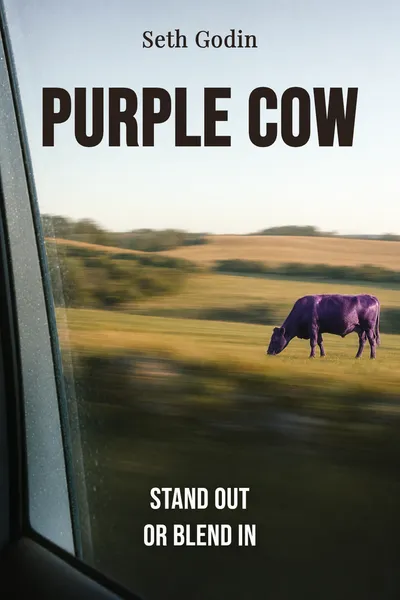
Purple Cow
Stand out or blend in
Description
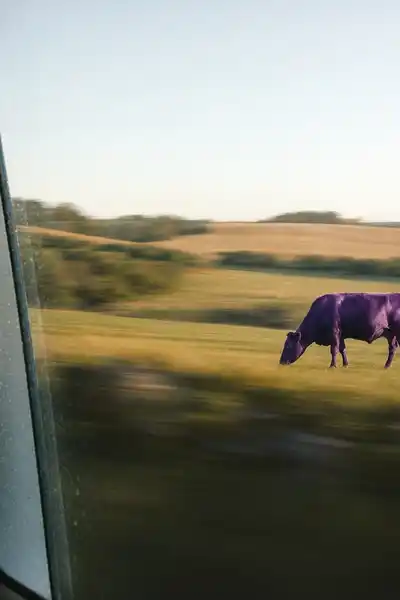
Picture a long drive through the French countryside. The first few cows are charming — black and white, grazing, postcard material. By the twentieth field, they have all blurred into the same beige hum of scenery, and nobody in the car looks up anymore. This is the image Seth Godin opens with in his 2003 book Purple Cow, and it is doing more work than it seems. A purple cow, he says, would make us stop the car. Brown cows, however well-fed, however ethically raised, are invisible the moment there are enough of them.
Godin wrote the book at the tail end of the era he calls the TV-industrial complex: decades in which a company could build something perfectly ordinary, buy enough advertising to shout about it, and watch it sell. That machine worked because attention was cheap and channels were few. By the early 2000s, both of those things had stopped being true. Consumers had too much money to need everything, too little time to research anything, and too many choices to care. The ad you bought no longer reached the people you wanted, and the people you reached were no longer listening.
So the book is short, blunt, and a little uncomfortable on purpose. It argues that the thing most businesses do — make something good, market it hard — has quietly become the thing most likely to fail. Not because it is bad work, but because it is safe work, and safe now hides in plain sight. The question is what to do instead, and who actually carries an idea once you have made it worth carrying.
The question we’re asking : In a market drowning in good-enough products, what actually gets noticed — and who does the noticing?What we’ll see : How a children's-book image became a working theory of why average is the new invisible.
Table of contents
01 Chapter 1 — The cow on the side of the road
The purple cow is a deliberately silly image carrying a serious claim. Godin's word for it is remarkable — not in the loose sense of "very good," but in its literal sense: worth making a remark about. Something a person would mention, unprompted, to someone else. A brown cow is fine. A purple cow gets talked about. And in Godin's reading, being talked about is no longer a nice bonus on top of a product. It is the product's only reliable route to anyone's attention.
To make the case, he reaches back to what he calls the TV-industrial complex, the postwar arrangement that quietly governed how things got sold for half a century. A company made an average product for average people, bought television advertising to interrupt them, and used the resulting sales to buy more advertising. The loop fed itself. It worked spectacularly for brands like Procter & Gamble and the big car makers, and it taught two generations of marketers that the path to growth ran through media spend, not through the thing itself.

02 Chapter 2 — What the P's left out
Every marketing student learns a list of P's — product, price, promotion, place, packaging, and a few more depending on who is teaching. Godin's move is not to throw the list out but to argue it is missing the one that now matters most. To the familiar P's he adds Purple Cow, and he insists it cannot be an afterthought bolted on at the promotion stage. By the time a thing reaches the marketing department, its fate is largely sealed. Remarkability has to be designed into the product itself, from the start, or it does not exist.
This is the quiet pivot of the whole book. Marketing, in the old model, was something you did to a finished product — a layer of cleverness applied after the engineering was done. Godin relocates the work. The interesting thing must be the offering, not the campaign about it. A great ad for a dull product is a waste; a dull ad for a genuinely remarkable product barely needs the ad, because the people who encounter it do the describing for you. The budget moves from buying attention to earning a reason for attention.
03 Chapter 3 — Sneezers, otaku, and the people who do the spreading
Making something remarkable is only half the machinery. The other half is the people who carry it. Godin borrows a vocabulary partly from the diffusion-of-innovations work that predates him — the idea that adoption spreads through a population in a curve, from early adopters out toward the cautious majority. His version focuses on the front of that curve: the small group who try new things and, crucially, who tell others. He calls the most active of them sneezers, because they spread ideas the way a sneeze spreads particles.
The strategic consequence is counterintuitive. You do not aim a remarkable product at the broad, skeptical mass in the middle. They are not listening, and they will not adopt anything until people they trust already have. You aim it at the sneezers — the enthusiasts who are actively looking for the next interesting thing and who derive social pleasure from being the one who found it. Win them, and they do the diffusion you used to pay an ad agency to fake. Ignore them, and no amount of spend reaches the middle at all.
04 Chapter 4 — When remarkable becomes the only safe bet
Step back from the cow and the sneezers, and Purple Cow is really a book about a change in the weather of attention itself. Godin's deeper claim is not a marketing tip; it is a diagnosis of scarcity. For most of the industrial era, the scarce resource was production — making enough good things and getting them in front of enough people. That problem has been solved almost everywhere. What is scarce now is attention and willingness to care, and no advertising budget manufactures either. That single shift reorganizes everything else.
Once you accept that, the book's most provocative line stops sounding like a slogan and starts sounding like arithmetic: safe is risky. In an environment saturated with competent, well-made, perfectly reasonable products, the well-made and reasonable product is the one that disappears. Average is no longer a stable middle ground between bold and foolish. It is the failure mode that feels responsible. The brands Godin admires are not braver as personalities; they have simply read the conditions correctly and acted as if blending in were the actual danger.
05 Conclusion
The drive through the countryside, then, is not just a charming opener but the whole argument in miniature. Field after field of brown cows is what most markets look like to most customers: a uniform blur that the eye slides over without registering. Godin's purple cow is the one thing in that landscape that makes someone slow down and say, out loud, did you see that. Everything else in the book — the extra P, the sneezers, the otaku, the niche you serve before the mass — follows from the simple demand that you give people something worth the remark.
Related books