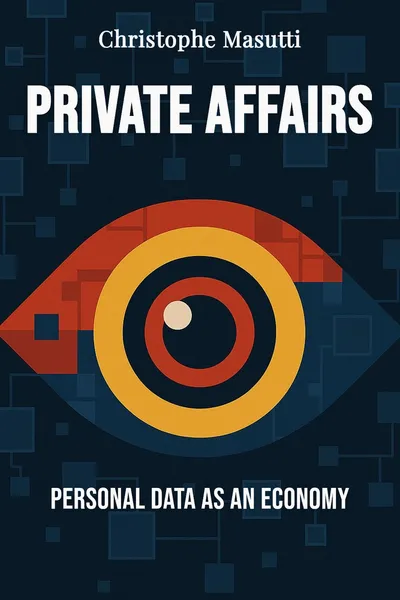
Private Affairs
Personal data as an economy
Description
Sometime in the nineteenth century, in the towns of the American Midwest, a shopkeeper who wanted to know whether a customer was good for credit could write to a small agency that kept files on the local population. The agency sold him an answer. The customer never saw the file, never consented to it, and often never knew it existed. This is roughly where Christophe Masutti begins in Private Affairs — not with Facebook, not with smartphones, but with the unglamorous machinery of commercial trust. The idea that a stranger's reliability could be turned into a product, bought and sold on a market, is much older than the internet. It is, in fact, one of the founding gestures of the world we now live in.
Masutti, a historian of computing and of surveillance, is after something more precise than the usual complaint that companies know too much about us. His argument is that personal data was built as an economy — a system of production, valuation and exchange — long before the technology existed to make it total. What changed with the digital age was scale and speed, not the underlying logic. The file the shopkeeper bought and the profile an ad platform builds today belong to the same lineage. Seeing that lineage clearly changes what we think the problem actually is.
That reframing matters because most of the debate treats data collection as a recent accident, a side effect of free apps we could regulate away with better settings. Masutti suggests the roots go deeper, into how modern capitalism and the modern state learned to manage populations by turning people into records. Follow that thread far enough and it leads somewhere uncomfortable — to the most intimate information a person carries.
The question we’re asking : How did the details of private lives become a commodity that others produce, price and trade?What we’ll see : How an ordinary commercial practice grew into a full economy, and where its logic runs into the most personal ground of all.
Table of contents
01Chapter 1 — The credit bureau came first
Before there were data brokers, there were credit-reporting agencies. Masutti traces the market in personal information back to the nineteenth-century United States, where firms like the Mercantile Agency, founded in 1841, began compiling reports on the character and finances of merchants across the country. Local correspondents — sometimes lawyers, sometimes ordinary citizens — sent in observations, and the agency turned them into files that subscribers could consult. A young Abraham Lincoln was among those correspondents. The product being sold was not a good or a service in the usual sense. It was knowledge about people, assembled without their involvement.
What makes this the origin story rather than a curiosity is the structure it established. Information about a person was gathered by one party, held by a second, and sold to a third — while the person themselves remained outside the transaction entirely. That triangular shape, Masutti argues, is the enduring skeleton of the data economy. The subject of the file is never the customer. The customer is whoever wants to make a decision about the subject: to lend, to hire, to insure, to sell.

02Chapter 2 — The state and the market, hand in hand
One of Masutti's central moves is to refuse the neat story in which the state watches for control and companies watch for profit, as if these were separate worlds. The techniques of counting, sorting and filing populations developed together, and they borrowed from each other constantly. The census, the tax roll, the identity document and the commercial file are cousins. Each rests on the same premise: that a population can be made legible, broken into records that can be searched, matched and acted upon.
The twentieth century turned this into infrastructure. Governments built registries to administer welfare, conscription, taxation and public health, and in doing so produced enormous quantities of standardized personal data. Private firms drew on the same statistical and bureaucratic methods to segment customers and manage risk. Insurers, in particular, sit at the hinge between the two worlds, since pricing risk means classifying people — by age, by geography, by behavior — in ways that look a great deal like governing them.
03Chapter 3 — Surveillance became the business model
The digital shift, in Masutti's account, did something the credit bureau could only dream of: it made data collection automatic, ambient and cheap. Every search, purchase, click and location became a trace that could be captured at the moment it happened, without a correspondent filing a report. The cost of observing a person collapsed toward zero, and with it the old constraint that had kept the industry modest. When watching costs almost nothing, the temptation is to watch everything.
Crucially, the data was not merely a byproduct to be stored. It became the core of the business model itself. A great deal of the modern web is offered for free precisely because the user is not the customer — the user is the source of the raw material. Advertisers and other decision-makers are the customers, buying access to the profiles that behavior generates. The triangular structure from the credit bureau returns intact, only now the subject of the file feeds it constantly and voluntarily, one interaction at a time.
04Chapter 4 — The health frontier
If the logic of the data economy is to reach ever more predictive information, then health is its natural destination. Nothing anticipates future behavior, cost and vulnerability as reliably as the state of a body. Masutti follows the market's arrival at this frontier, where the traces of illness, medication, fitness and genetic risk become another category to be gathered, priced and exchanged. The wearable that counts steps, the app that tracks a cycle or a mood, the pharmacy loyalty card — each converts a private bodily fact into a record that flows into the same triangular market that began with the credit bureau.
What unsettles him about the health frontier is not novelty but continuity. The same actors are present: insurers who price risk by classifying people, employers who screen, platforms that profile. Health data simply raises the stakes, because a mistaken credit score can be corrected while a body cannot be un-known. When the record of a life includes its medical vulnerabilities, the imbalance built into the market from the start — the subject outside the transaction, the decision-maker inside it — becomes something closer to power over the person's future.
05Conclusion
The shopkeeper who bought a file on a stranger in a Midwestern town would not recognize a fitness tracker or an ad exchange. But he would recognize the deal. Someone gathered facts about a person, someone else paid for them, and the person in question was never in the room. Masutti's achievement in Private Affairs is to hold that continuity steady across nearly two centuries, so that the smartphone stops looking like a rupture and starts looking like a culmination. The market did not appear when the technology did. The technology arrived and found a market already waiting for it, complete with its habits, its customers and its exclusions.
Related books