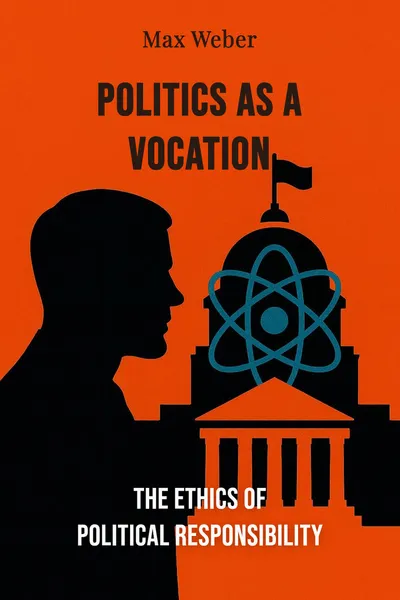
Politics as a Vocation
The ethics of political responsibility
Description
In January 1919, a German university town was living through the wreckage of a lost war. The empire had collapsed two months earlier, the streets of Munich were full of soldiers who no longer knew whom they served, and revolution was breaking out in one city after another. Into that scene stepped Max Weber, a fifty-four-year-old sociologist with a formidable reputation and a reluctance to speak in public, invited by a student group to give a talk on politics as a career. What he delivered instead was one of the strangest lectures ever given on the subject: not a pep talk for aspiring statesmen, but a cold, almost brutal account of what political life actually asks of a person.
The lecture became the essay we now call Politics as a Vocation. Weber refused every consolation his young audience might have wanted. He would not tell them that good intentions were enough, that the righteousness of a cause guaranteed anything, or that a clean conscience and clean hands could be kept together in political action. Politics, he said, means working with a specific and dangerous instrument — the state's monopoly on legitimate force — and anyone who touches that instrument enters into a bargain with consequences they cannot fully control.
A century later the essay has outlived its moment. The revolutionary Munich Weber was speaking to is gone, but the problem he named has not moved. Whenever someone acts in the name of a cause and has to weigh what their action will actually produce against what they believe is right, they are standing exactly where Weber left his students standing. The essay is uncomfortable precisely because it refuses to let anyone off the hook.
The question we’re asking : What does Weber say a person genuinely takes on when they choose to make politics their vocation?What we’ll see : We follow a reluctant lecturer through a defeated city as he strips politics of its comforts and hands his listeners a demand most of them did not want to hear.
Table of contents
01Chapter 1 — The lecture in a defeated city
The setting matters. Weber was not writing calmly at a desk; he was speaking to students of the Free Student Union in Munich in the winter of 1918-1919, weeks after Germany's surrender and the Kaiser's abdication, in a country where the ground was still shifting daily. Some in the room were drawn to the revolutionary left, others to nationalist despair, and many wanted a older, respected figure to tell them that idealism had a future. Weber, who had followed the war closely and been bitterly disappointed by Germany's leadership, was in no mood to flatter them.
He opened not with vision but with definition. The state, he argued, cannot be defined by what it does, because there is almost nothing it has not at some point done. It has to be defined by its means: the state is the human community that successfully claims the monopoly of the legitimate use of physical force within a given territory. Politics, then, is the striving to share power or to influence how power is distributed. Everything else in the lecture follows from that unsentimental starting point.

02Chapter 2 — Who gets to live for politics, and who lives off it
The distinction between living for and living off politics sounds like a moral judgment, but Weber treated it first as a matter of economics. To live for politics without depending on it for income, a person must be economically independent — sustained by wealth, property or a profession that runs itself. That independence is what lets someone speak and act without calculating every move against their next paycheck. It is also, Weber noted plainly, unevenly distributed. The demand that politicians be disinterested amateurs quietly hands politics to those who already have means.
So the alternative develops: people who make a living from political activity, whether as party officials, paid functionaries or professional representatives. Weber did not sneer at this. A modern mass state, he argued, simply cannot run on gentleman amateurs. It needs a permanent apparatus of trained, salaried people who do the ongoing work of administration and organization. The rise of the professional politician and the disciplined party machine was, for him, not a corruption of politics but a structural feature of the modern world.
03Chapter 3 — Two ways to be moral in politics
Here the essay reaches its core. Weber argued that all ethically oriented action can follow one of two irreconcilable maxims. There is the ethic of conviction — Gesinnungsethik — and there is the ethic of responsibility — Verantwortungsethik. The distinction is not between good people and bad people. Both are held by serious, sincere individuals. But they answer to different masters and can lead to opposite conduct in the same situation.
The person guided by pure conviction acts on principle and leaves the consequences to God, or history, or fate. If they tell the truth, oppose an injustice or refuse a compromise, and the world burns as a result, that is not their responsibility — the fault lies with the world, or with the stupidity of others, or with the order of things. Their concern is that the flame of their conviction be kept pure; the outcome is not part of their moral accounting. Weber saw genuine nobility in this stance, and also a hidden irresponsibility.
04Chapter 4 — The man who can say: here I stand
What Weber asks of a person, by the end, is close to superhuman, and he knew it. Three qualities, he said, are decisive for the politician: passion, a sense of responsibility, and a sense of proportion. Passion means devotion to a cause, a matter-of-fact commitment rather than the sterile excitement of the intellectual who is merely in love with his own agitation. Responsibility means answering for what one does. And proportion — the hardest — means the ability to let reality act upon one with inner calm and distance, to keep a cool head in the face of the world while still caring intensely about the cause.
The enemy of all three, in his diagnosis, is vanity. The politician's deadliest sin is the need to be personally seen and admired, because it pulls attention away from the cause and toward the self, and it substitutes the appearance of power for the responsible use of it. Weber had watched this failure closely in the leaders who brought Germany to catastrophe. The person who craves the feeling of power without the burden of consequence is, in his blunt phrase, working with the wrong instrument for the wrong reason.
05Conclusion
Weber ended the lecture not with triumph but with something bleaker and steadier. Politics, he told the students, is a strong and slow boring of hard boards, done with both passion and perspective. It takes everything a person has and rewards them with little. The world will disappoint anyone who expected their goodness to be repaid, and the times ahead, he warned in that ruined winter, were not the flowering of summer but a polar night of icy darkness. Only someone who could face all of that and still say "nevertheless" had the calling.
Related books