Political Theology
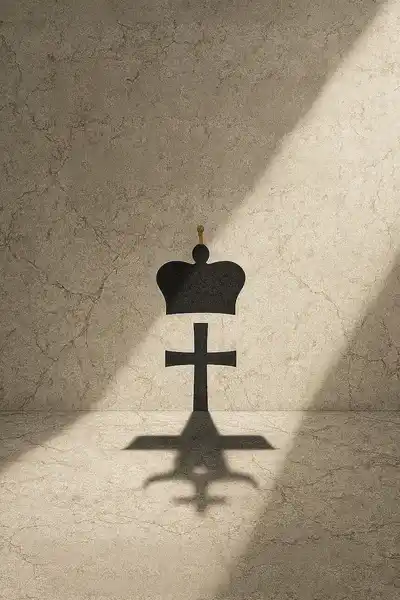
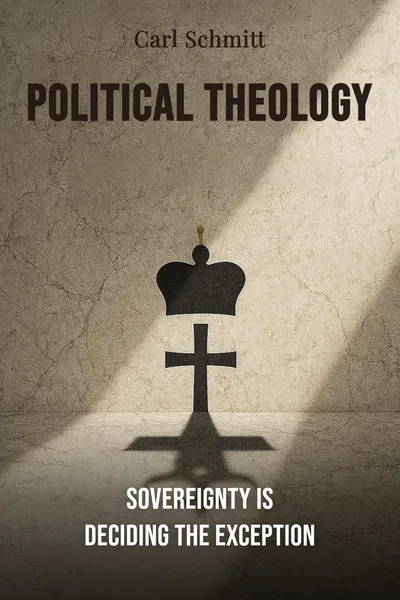
Sovereignty is deciding the exception
Description
In 1922, a German jurist named Carl Schmitt published a short book called Political Theology, barely a hundred pages, four dense chapters that opened with a sentence people are still arguing about a century later. "Sovereign is he who decides on the exception." No preamble, no gentle setup — just that. Weimar Germany was three years old, wobbling between hyperinflation, street violence, and a constitution nobody quite trusted. Legal scholars of the day preferred to talk about norms, procedures, the tidy machinery of the rule of law. Schmitt wanted to talk about the moment the machinery jams.
Most theories of the state, back then and now, describe how power works when things run smoothly — a bill passes, a court rules, a clerk stamps a form. Schmitt found that boring, and worse, evasive. The interesting question, for him, was what happens when the rulebook meets a situation it never anticipated: an emergency so severe that following the rules could destroy the very order the rules were meant to protect. Who gets to say the normal law no longer applies? Whoever can answer that, he argued, is the one who actually holds sovereignty — no matter what the paperwork says.
It's a cold, unsettling idea, and Schmitt built it with a jurist's precision and, oddly, a theologian's instinct. He kept noticing that the concepts lawyers used to describe the state looked suspiciously like concepts theologians had used to describe God. That resemblance wasn't decoration. For Schmitt, it was the whole point — the buried structure of how modern politics thinks about ultimate authority.
The question we’re asking : What does it mean to say that sovereignty lives not in the everyday running of the state but in the power to suspend it — and where does that power actually come from?What we’ll see : How a jurist rebuilt sovereignty around the emergency, and why he insisted the state was theology in disguise.
Table of contents
01Chapter 1 — A definition that ignores the calm
Schmitt opens Political Theology by picking a fight with the entire legal tradition he'd been trained in. The dominant school of his day, associated with the jurist Hans Kelsen, wanted to purify law of everything messy — no politics, no morality, no personality, just a self-contained system of norms validating other norms all the way up. In that picture, the state is basically a legal order and nothing more. There's no one behind the curtain; there's only the rulebook, running itself. Schmitt thought this was a fantasy dressed up as rigor.
His counter-move is to change the question. Don't ask how sovereignty operates on an ordinary Tuesday, when the courts sit and the statutes apply. Ask where sovereignty shows itself. And it shows itself, he says, precisely where the ordinary law goes silent — in the borderline case, the emergency, what he calls the state of exception. Sovereignty is a concept that only becomes visible at the limit, the way a fault line only reveals itself in an earthquake. Study the calm and you'll miss it entirely.

02Chapter 2 — The exception the norm can't reach
The word doing all the heavy lifting is exception, and Schmitt is careful about what he means. He isn't talking about a routine emergency provision, the kind of clause a constitution includes so the government can raise taxes during a war or impose a curfew after a flood. Those are anticipated exceptions — the rulebook expanded to cover them in advance. What interests him is the genuine exception: the situation no legislator foresaw, so extreme that no existing norm fits it, where the very survival of the political order is at stake.
In that situation, he argues, the norm has nothing to say. Law is general by nature; it speaks in advance, in typical cases, about what usually happens. But a real emergency is by definition atypical — that's what makes it an emergency. You cannot deduce the right response from the statute, because the statute was written for a world where this wasn't happening. The decision has to fill the gap the norm leaves open. And crucially, the person who fills it isn't misapplying the law; they're acting in a space the law simply doesn't reach.
03Chapter 3 — The decision that comes from nothing
This is where Schmitt names his position: decisionism. Against the idea that law is a seamless web of norms, he insists that at the foundation of any legal order there is not another norm but a decision — a concrete act of will by a concrete authority. The order doesn't start with a rule. It starts with someone deciding that this shall be the order, and making it stick. Norms come afterward, operating inside a frame the decision has already established.
The most provocative part of his claim is that this founding decision, viewed from within the legal system, emerges from nothing the system can justify. He borrows a striking phrase and speaks of the decision as born out of a normative void. It cannot be derived from a prior rule, because if it could, the prior rule would be doing the deciding, and you'd only push the question back a step. At some point you reach an authority that decides without being authorized by anything above it. That's not a flaw to be patched; for Schmitt it's the unavoidable structure of political order.
04Chapter 4 — The secularized theology of the state
The book's most famous line comes in its third chapter, and it names the resemblance Schmitt had been circling all along: all significant concepts of the modern theory of the state are secularized theological concepts. He doesn't mean this loosely. He means it structurally and historically. The concepts didn't just happen to sound alike; the political ones were carried over from the theological ones as Europe moved from a religious to a supposedly secular understanding of authority. The vocabulary changed owners without changing shape.
The parallels are exact once you see them. The omnipotent God of the theologians becomes the omnipotent lawgiver of the jurists. The miracle — God's power to interrupt the ordinary laws of nature — becomes the exception, the sovereign's power to suspend the ordinary laws of the state. In both cases, an ultimate authority stands outside the system it governs and can break its regularities without ceasing to be legitimate. When the Enlightenment abolished the miracle from nature, Schmitt argues, it abolished the sovereign exception from politics at the same time — and the deism that pictured God as a watchmaker who set the world running and then withdrew is the theological twin of the liberal state that runs on procedure with nobody deciding.
05Conclusion
A century on, that opening sentence still does what Schmitt wanted it to do: it refuses to let us describe the state as a machine that runs itself. His wager was that if you want to understand power, you shouldn't study the calm afternoon when the courts sit and the forms get stamped. You should study the emergency, the moment the rulebook falls silent and someone has to decide, out of nothing the rulebook can supply, that this is the exception. Whoever can make that call, and make it stick, is where sovereignty actually lives.
Related books