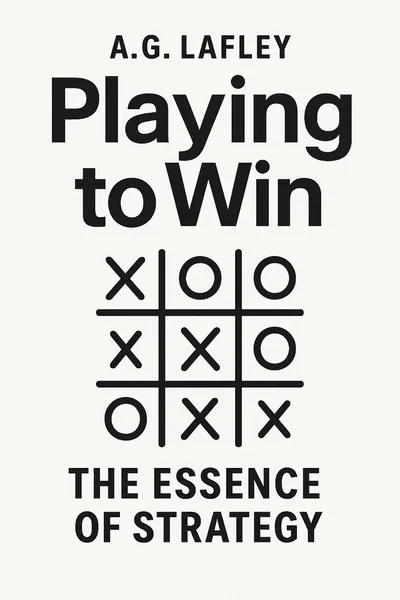
Playing to win
The essence of strategy
Description
Strategy is a detailed plan that positions a company to gain advantage over competitors. It comes down to making choices about aspirations, target markets, capabilities, and management systems. All choices must align. Strategy can be iterative as new insights emerge. It need not be mysterious - five questions can guide strategic choices:
- What is the aspiration? - Where to play? - How to win? - What capabilities are needed? - What management systems are required?
With courage and creativity, strategy can be demystified into a cascade of choices captured on one page to drive shared understanding and united action towards success. Strategy is about hard thinking and personal leadership to make choices that position a company to offer superior value.
Table of contents
01 Defining your purpose
To develop a winning strategy, the first step is to clarify the purpose and mission of your organization. Defining what winning looks like for you is crucial, as it can mean different things to different people.
While most companies have lofty vision statements, these are often too vague for strategy development. To create a winning strategy, you need to precisely describe your desired future state. Thoroughly detailing what winning entails is essential before developing a robust strategy. Envisioning a brilliant future for your company is the starting point.
Starting with customers and working backwards can be helpful. Articulate the problems you aim to solve for them in engaging language. State what winning means to your clients, as satisfying customers is the ultimate goal. This is where you can have ambitious, noble aspirations.
After describing the winning vision, it is important to identify where you can achieve it. No company can be everything to everyone and succeed, so narrowing your focus by choosing target markets, segments, channels, etc. is necessary to win.

02 Selecting your playing field
Once you've determined what winning looks like for your company, the next crucial step is identifying where you can achieve that vision. No organization can be all things to all people and still win, so making strategic "where to play" choices about your target markets, customers, channels, and offerings focuses your efforts. This focus is required for success.
As business gurus A.G. Lafley and Roger Martin explained, "Where to play is about selecting regions, customers, products, channels, and stages of production that fit well together—that are mutually reinforcing and that marry well with real consumer needs."
Rather than trying to serve everyone everywhere or just accepting your current position, thoughtfully choose a strong set of where-to-play options based on a deep understanding of your customers, competitors, and capabilities. While a bit of luck never hurts, this generally requires significant effort and imagination.
Deciding where to compete defines your overall playing field. You figure out your core business, where you'll compete, and equally importantly, where you won't. Making strategic where-to-play choices is essential because you can't determine how to win until you do. This applies to organizations of all sizes from startups to large enterprises. Even huge multinational corporations must make explicit decisions about where to compete and where not to.
03 Determining your approach
Your company's intended competitive advantage stems from the specific activities that underpin your business strategy. This is the recipe for success in your chosen market segments and geographies. Your “how-to-win” approach is closely linked to your “where-to-play” focus – you are not trying to win everywhere, but only in your selected domains.
When deciding where-to-play, there may be several key dimensions to consider. However, when determining how-to-win, there are ultimately two main strategic choices: cost leadership or differentiation.
Keep in mind there are always multiple ways to succeed in any market, and no market is truly winner-takes-all. Nor is there one perfect strategy that lasts forever. Even in a single market, it is possible for one company to thrive as the cost leader while others excel as differentiators. To think strategically, you need to consider the full range of options broadly and deeply.
That said, once you make a how-to-win choice, you must take actions consistent with that direction. In other words, what you need to do to succeed as the cost leader is very different from what is required to compete as a differentiator. After deciding which path to take, it is vital to undertake activities aligned with that choice.
If you decide cost leadership – having lower costs than competitors – gives you the best chance of a winning strategy, you need to relentlessly focus on eliminating costs throughout the value chain. You will devote most resources to initiatives that standardize and systematize everything. Cost leaders do not always charge less than competitors, but may use the extra profits in other ways. For example, Mars holds a significant cost advantage over Hershey’s in candy bars, but sells at similar retail prices. Mars uses the additional revenue to secure the best shelf space in every convenience store, growing from a niche player into a contender for overall market leadership.
04 Building essential capabilities
Defining your core capabilities is a crucial step in developing a winning strategy. Once you have chosen where to play and how to win in the marketplace, you need to identify the key competencies and skills that will enable you to deliver on that strategy.
Visualizing your core capabilities on an “activity system map” is an effective approach. This single page diagram depicts the core capabilities of your firm as large nodes, with links between them representing reinforcing relationships. The overall system should be greater than the sum of its parts, with the interconnections making each capability stronger. Additional activities can be added as smaller nodes.
When designing your activity map, ask whether it is distinctive from competitors and defensible against replication. Most importantly, does it support your specific where-to-play and how-to-win choices? If not, you may need to revisit those strategic choices and refine them until your capability map enables a winning position.
For a single product company, the map may be simple. For a diversified corporation, you may need separate maps for each business unit or brand that link together. The goal is to show how each layer reinforces competitive advantage for the levels above and below.
Once you have defined the few differentiated capabilities required for competitive advantage, you can focus resources on strengthening them. This may involve training, investment, systems, or reorganization. The activity system guides your priorities, time, and attention to what matters most.
05 Designing supporting systems
Strategy is an ongoing process of making choices to gain a sustainable competitive advantage. It starts with clarifying your aspirations - where you want your business to get to. With a clear vision, you can then determine where to play and how to win in the marketplace.
Choosing where to play involves segmenting the industry landscape to identify the most attractive spaces. Look at rising demand, ability to capture value, and supplier power. Analyze what channel partners and end consumers value most. This highlights potential opportunities.
Determining how to win requires assessing your relative positioning and capabilities versus competitors. Can you meet customer needs in a distinctive way? Do you have cost and capability advantages to gain a competitive edge? Anticipating competitive responses is also key. How will rivals react if you enter a market segment? You want a strategy competitors won't easily replicate.
With where-to-play and how-to-win options, reverse engineer to stress test choices. Start with the end in mind - the winning aspiration. Work backwards to pressure test if the where and how will achieve it. This leverages diverse perspectives to enrich the strategy.
Related books