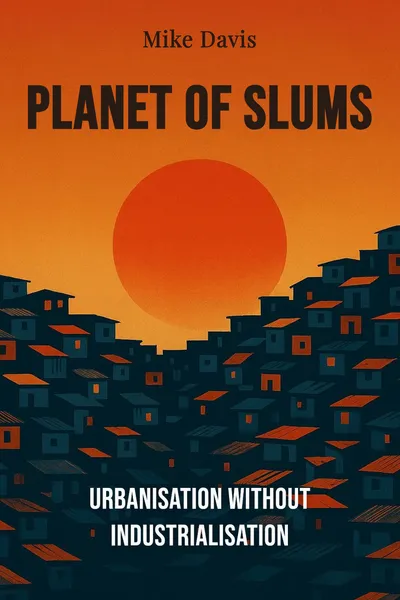
Planet of Slums
Urbanisation without industrialisation
Description
Sometime around 2007, according to United Nations demographers, the human species crossed a line it had been approaching for two centuries: for the first time, more of us lived in cities than outside them. The moment passed without ceremony. There was no single city that tipped the balance, no census clerk who recorded the decisive birth. But the threshold was real, and it marked the end of the rural world as the default human condition. In the essay that gives this book its title, the historian Mike Davis takes that statistic and asks a harder question than the celebration usually allows: where, exactly, are all these new urbanites living, and on what do they live?
His answer is unsettling. The cities absorbing the great migration of our time are not, for the most part, the tidy industrial metropolises of nineteenth-century Europe, where the factory and the tenement grew together. They are Lagos, Dhaka, Kinshasa, Lima, sprawling outward at speeds Manchester never dreamed of, and much of that growth is happening in settlements the authorities call informal and everyone else calls slums. By Davis's reckoning, drawing on a landmark UN-Habitat report from 2003, roughly a billion people already lived in such conditions, with the number climbing fast.
What makes the pattern strange, and what the book sets out to decode, is the missing half of the old equation. The classic story of urbanization was also a story of industrialization: people left the land because the mills needed hands. This time, the mills are largely absent, or automated, or on another continent. The migrants keep coming anyway.
The question we’re asking : How did the world end up with cities that swell by the million while offering almost no formal work to the people arriving?What we’ll see : How the great migration outran the factories, the wages, and the states that were supposed to house it.
Table of contents
01Chapter 1 — The century the countryside emptied into the city
For most of human history, cities were rare and small, tethered tightly to the farmland that fed them. Davis begins by insisting on the sheer speed of what changed. In 1950 there were around eighty-six cities in the world with more than a million people; by the time he was writing in the mid-2000s there were well over four hundred, and the count kept rising. The urban population of the developing world was doubling roughly every generation, adding tens of millions of new residents a year — the equivalent, he notes, of building a new metropolis the size of a European capital every few months, somewhere in Asia, Africa, or Latin America.
The scale is easier to grasp through single cases. Lagos, a modest colonial port at Nigerian independence in 1960, was pushing toward becoming one of the largest urban agglomerations on the planet within two generations. Dhaka, Kinshasa, Karachi, and dozens of others followed similar curves. What Davis stresses is that this was not a repeat of the European nineteenth century at a larger volume. It was a different phenomenon, running on different fuel, and the older vocabulary of progress fit it badly.

02Chapter 2 — Growth without the factories that once justified it
The heart of Davis's argument is a decoupling. In the standard account of how societies modernize, farmers become factory workers: the countryside sheds labor, industry absorbs it, wages rise, and cities become engines of mobility. This is roughly what happened in Britain, then in the American Midwest, then in postwar Japan and later South Korea. Urbanization and industrialization moved together, and the misery of the early industrial slum was, at least, misery attached to a growing wage economy that eventually paid part of its debt back.
The cities Davis describes broke that link. Across much of sub-Saharan Africa and South Asia, urban populations exploded during exactly the decades when manufacturing employment stagnated or shrank. The structural-adjustment programs of the 1980s, pushed by the International Monetary Fund and the World Bank in exchange for debt relief, tended to shutter state industries, open markets to cheaper imports, and freeze public hiring. Formal jobs did not multiply to meet the arriving millions. They contracted.
03Chapter 3 — When the state stopped building and the poor built everything
If governments were not creating jobs, they were also, increasingly, not building homes. Davis devotes considerable attention to the retreat of the state from public housing, a retreat that accelerated with the same austerity policies that hollowed out industry. Where midcentury governments in the developing world had at least gestured toward slum clearance and subsidized construction, the newer orthodoxy handed the problem to the market and to the poor themselves.
The result was self-built urbanism on an epic scale. People arriving in the city occupied whatever ground they could — hillsides, floodplains, garbage dumps, the strips beside railway tracks and open sewers — and constructed their own shelter out of scavenged brick, corrugated iron, plastic, and cardboard. Davis maps the grim geography of this: the floating slums of Lagos, the ravine settlements of Caracas, the vast peripheral districts that ring nearly every Southern megacity. Often these homes sat precisely on the land nobody else wanted because it was dangerous, which is why disasters in these cities kill the poor first.
04Chapter 4 — The surplus humanity nobody planned for
Step back from the individual cities and Davis wants us to see a systemic condition, one he names bluntly. The people accumulating in the slums of the Global South are, from the standpoint of the world economy, a surplus — labor for which formal capitalism has no assignment. This is what makes the moment genuinely new. The nineteenth-century slum was terrible, but it was integrated into an industrial system that needed its inhabitants and, over decades, was forced to concede them wages, rights, and eventually a share of the city. The twenty-first-century slum, in Davis's reading, is not obviously needed by anything.
This is where the book's argument turns its darkest and most contested. If global capitalism no longer requires these hundreds of millions as workers, then the old bargain — endure the misery now, inherit the prosperity later — no longer holds. Manchester's slum-dwellers were the ancestors of a middle class. The residents of the informal megacity may have no such trajectory available, because the ladder they are supposed to climb was dismantled before they arrived. Davis refuses the consoling assumption that development is simply slow to reach them; he suggests it may not be coming at all in the form once promised.
05Conclusion
The book closes roughly where the statistic that opened it points: a world in which the majority of people are urban, and a growing share of those are informal, unhoused by any plan, unemployed by any formal reckoning. Davis does not offer a program of solutions, and he has been criticized for that. His purpose is diagnostic — to strip the word urbanization of its automatic hopefulness and force us to look at what is actually being built out there beyond the ring roads, on the hillsides and the floodplains.
Related books