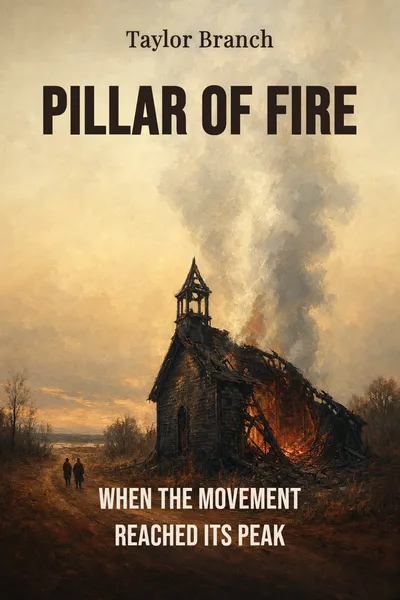
Pillar of Fire
When the movement reached its peak
Description
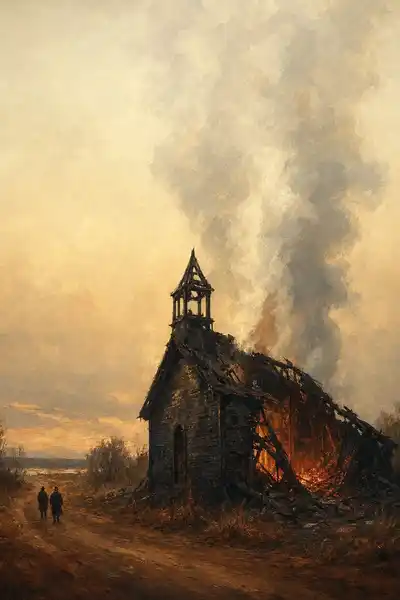
On June 21, 1964, three young civil rights workers — James Chaney, Andrew Goodman, and Michael Schwerner — drove out to investigate a burned church near Philadelphia, Mississippi, and did not come back. For forty-four days the country waited while the FBI dragged rivers and ponds, and Mississippi sheriffs offered the theory that the men had staged their own disappearance. When the bodies were finally found in an earthen dam that August, the discovery landed in the middle of the movement's most ambitious summer. It is here, in the years 1963 to 1965, that Taylor Branch sets the second volume of his history of the King era — the book he called Pillar of Fire.
Branch had opened the trilogy with Parting the Waters, which won the Pulitzer Prize and carried the story up to 1963. This middle book covers a shorter span but a heavier one. In roughly two years the movement pushed through the Civil Rights Act, mounted Freedom Summer, went to the ocean floor of Mississippi violence, and reached a peak of national attention it would never quite have again. Branch's subject is not a single march or a single man. It is a whole movement at full stretch, when the cause finally commanded the front page and the country could no longer pretend not to see.
The word Branch reaches for is zenith — the highest point. But a peak in a mountain range is also where the ground falls away on every side. The years he documents were the years of the greatest legislative wins and the years the coalition that produced them began to strain against itself, when the distance between Martin Luther King and Malcolm X, between patient federal courtship and burning impatience, grew impossible to paper over.
The question we’re asking : What does it look like when a movement reaches its highest point — and why does a peak carry the seeds of the fracture that follows?What we’ll see : How Branch's middle volume tracks the civil rights struggle at full national volume, through the summers, the killings, the leaders, and the legislation that arrived together.
Table of contents
01 Chapter 1 — The years the country could not look away
Branch built Parting the Waters around a slow accumulation — Montgomery, the sit-ins, Birmingham — the movement forcing its way from the margins toward the center. Pillar of Fire begins where that momentum finally arrives. By late 1963 the struggle was no longer a Southern story that the rest of the country could file under regional trouble. It was the national story, and Branch's method is to show how it got there: not through one speech or one law, but through a relentless sequence of events that gave the country nowhere to look but at itself.
The book's frame is deliberately wide. Branch moves between the marchers and the men listening to them on wiretap. He follows Lyndon Johnson, who inherited the presidency after Dallas in November 1963 and made the Civil Rights Act his first great cause, working the Senate with a mix of flattery and menace that finally broke the Southern filibuster in June 1964. He follows J. Edgar Hoover, whose FBI had bugged King's hotel rooms and was building a file meant to destroy him. These are not background figures. In Branch's telling, the movement's zenith is inseparable from the machinery of power turning to face it — some of it to help, much of it to watch and undermine.

02 Chapter 2 — Freedom Summer and the price of a single county
The centerpiece of the book is the summer of 1964, when the movement made a calculated bet. Mississippi had the lowest Black voter registration in the country and the most entrenched machinery of terror to keep it that way. The Council of Federated Organizations decided to flood the state with volunteers — many of them white college students from the North — to run freedom schools and voter drives. The strategy was partly moral and partly cold: the country had learned to ignore violence against Black Mississippians, but it might not ignore violence against the children of Northern voters.
The bet was proven almost immediately, and at terrible cost. Chaney, Goodman, and Schwerner disappeared in the first days, and Branch reconstructs the weeks that followed with unbearable patience — the searches, the false leads, the discovery in August that Klansmen with the cooperation of local law enforcement had murdered the three and buried them in a dam. The national attention the organizers had gambled on arrived exactly as they feared it would arrive. Branch does not let the reader miss the arithmetic: it took the deaths of two white Northerners alongside a Black Mississippian to command the coverage that a hundred earlier deaths had not.
03 Chapter 3 — Two leaders the same movement could not hold
Branch's title comes from the Book of Exodus — the pillar of fire that led the Israelites by night — and much of the book turns on the men trying to lead a people out of bondage without agreeing on the road. At the center stands Martin Luther King, whom Branch refuses to render as a monument. The King of these pages is exhausted, hunted, doubted by younger activists who found his gradualism too slow, and privately tormented by the FBI's campaign against him, which culminated in an anonymous letter, mailed to him in late 1964, that seemed to urge him toward suicide.
The Nobel Peace Prize came that same December, when King was thirty-five, the youngest recipient to that point. Branch places the honor beside the harassment with no comment needed. The government that would soon send troops to protect his marchers was simultaneously trying to break him. To lead the movement at its zenith was to be celebrated by the world and stalked by one's own country in the same season.
04 Chapter 4 — Malcolm, Selma, and the sound of the ceiling breaking
Branch ends the volume in early 1965, on two events days apart. On February 21, Malcolm X was assassinated in the Audubon Ballroom in Harlem, gunned down by members of the Nation of Islam he had left. Weeks later the campaign in Selma, Alabama, produced the march across the Edmund Pettus Bridge — Bloody Sunday, March 7 — where state troopers clubbed and gassed voting-rights marchers on national television, and the outrage carried the Voting Rights Act toward passage that summer. The book closes at a threshold, one leader dead and one law about to be won.
This is where Branch's larger idea comes into focus, and it is an idea about the shape of movements rather than about this one alone. A zenith, in his account, is not a summit where everyone rests. It is the point of maximum pressure, where the very success that gathers the crowd also strains the seams that held it together. The Civil Rights Act and the murder of three workers came in the same summer. The Nobel Prize and the suicide letter came in the same season. Malcolm's death and Selma's triumph came in the same few weeks.
05 Conclusion
The three men pulled from the earthen dam in August 1964 open the volume, and by the time it ends the country has passed the Civil Rights Act, watched Fannie Lou Hamer testify, given King a Nobel Prize, buried Malcolm X, and crossed the bridge at Selma. Branch compresses barely two years into a book of that density because the years themselves were dense — the movement operating at a volume it would never reach again, every gain shadowed by a cost delivered at the same hour.
Related books