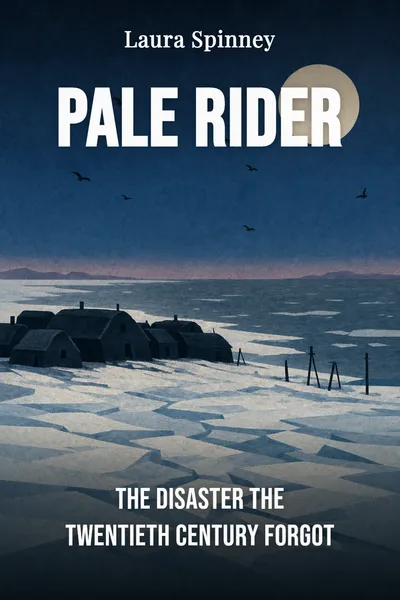
Pale Rider
The disaster the twentieth century forgot
Description
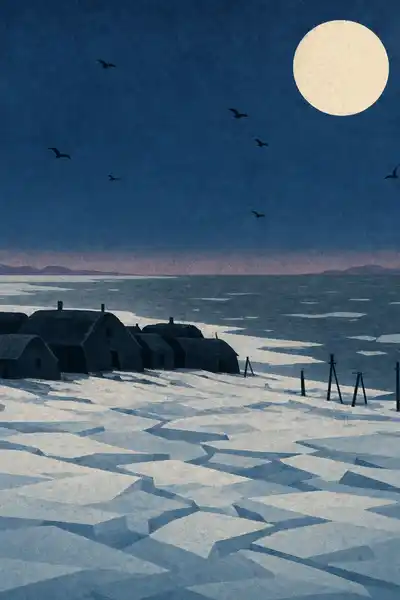
Sometime in the autumn of 1918, in a sealing camp on the edge of the Bering Sea, an entire Yupik village stopped sending word. When a relief party finally reached it, they found the dogs had broken into the houses and the dead lay where the sickness had left them. In the same weeks, half a world away, the Persian city of Mashed was burying its dead by the cartload, and in Manhattan the Italian families of the Lower East Side were nailing crepe to their doorframes. These places shared no language, no trade route, no common idea of what was killing them — only a strain of influenza that, in a single year, would reach almost every inhabited corner of the planet.
Laura Spinney's Pale Rider is the story of that virus and the world it moved through. The 1918 flu killed somewhere between fifty and a hundred million people — more than both world wars combined, by most reckonings — and it did so faster than anything before or since. Yet for most of the century that followed, it was the disaster nobody talked about. It produced no monuments worth the name, slid out of the textbooks, and survived mostly as a footnote to the war that happened to be ending as it peaked. A catastrophe of that size simply went missing from the way we remember the modern age.
Spinney's wager is that the flu was not a footnote at all. It pressed on demographics, on politics, on science and on the inner lives of the people it spared, and the marks it left are still legible if we know where to look. The puzzle she keeps returning to is less about the biology of the virus than about us — about why a thing that touched everyone left so little trace in our collective story.
The question we’re asking : How did a single year of influenza reshape the twentieth century, and why did we manage to forget it?What we’ll see : How one virus travelled the whole world at once, who it struck and why, the strange arithmetic of counting its dead, and the quiet rearrangements it left behind.
Table of contents
01 Chapter 1 — The pandemic that history wrote out
The numbers are hard to hold in the mind. The 1918 flu is thought to have infected something like a third of the people alive at the time, and to have killed between fifty and a hundred million of them — Spinney leans toward the higher estimates, which would make it the deadliest event of the twentieth century. It moved in roughly three waves across 1918 and into 1919, the second of them in the autumn being by far the most lethal. Most of the dying happened in a span of about thirteen weeks. No war, no famine, no other epidemic has concentrated that much death into so short a window.
And yet it almost disappeared from view. Spinney points out that for decades there was no serious history of it in English, no day of remembrance, no canonical novel or painting that fixed it in memory the way the trenches were fixed. People who lived through it often mentioned it only in passing, folded into family stories about the war. A grandmother lost, a father who never came home from the front and a mother who died of the flu the same month — the second loss quietly absorbed into the first.

02 Chapter 2 — A virus that read the map of the world
What made the 1918 flu so frightening was partly who it killed. Ordinary influenza takes the very old and the very young; this one cut hardest into people in their twenties and thirties, the healthiest cohort, often within days of the first symptoms. Spinney follows the science that explains it: the virus could provoke the strong immune systems of young adults into a violent overreaction, a storm that flooded the lungs and drowned the patient in their own fluids. The fitter the body, in some cases, the more dangerous the response. Soldiers in the prime of life turned blue and died in field hospitals while older men beside them recovered.
But the virus did not strike evenly across the globe, and Spinney's most striking move is to read it as a kind of X-ray of the world it passed through. Wherever it went, it exposed the fault lines already there. In colonial India, where the British administration was geared to extraction rather than care, the death toll may have run to twelve or eighteen million — the heaviest of any country, falling overwhelmingly on the poorest. Crowding, hunger and the absence of any health infrastructure turned a flu into a massacre.
03 Chapter 3 — Counting the uncountable
One of the quiet dramas of Pale Rider is simply the struggle to know how many died. The figure has crept upward over the decades, from an early estimate of around twenty-one million to the fifty-to-a-hundred-million range demographers now work with. The reason for the uncertainty is that the flu killed hardest exactly where nobody was counting. In Europe and North America there were death registries and newspapers; in much of Asia, Africa and the Pacific there was neither, and millions of deaths left no paper at all.
Spinney walks through how historians have tried to reconstruct the toll from fragments — parish records, military reports, the sudden gaps in a census, the testimony of survivors gathered decades later. The work is part detective story, part act of restitution, because to leave the uncounted uncounted is to let the pandemic shrink to the size of the places that kept records. A great deal of the book is an argument that the real centre of gravity of the disaster lay not in the cities of the West but in places the West rarely thought about.
04 Chapter 4 — What a forgotten flu rearranged
If the 1918 flu vanished from memory, Spinney argues, it did not vanish from history. Its fingerprints are on the century that followed, often in places we credit to other causes. The most direct mark is demographic: tens of millions of people in their reproductive prime were removed in a single year, leaving a notch in the population curve and, in some regions, a generation of orphans whose absence shaped the decades after. Whole communities — the Yupik, certain Pacific island peoples — were knocked back so far they never fully recovered.
The pandemic also pushed medicine and the state in a particular direction. It helped discredit the patchwork of private and charitable care that had failed so visibly, and strengthened the case for centralised public health — the idea that protecting populations from disease was a job for governments. Several countries built or reformed their health ministries in its wake. The virus that no one could see helped make epidemiology a serious science, and researchers spent the following decades hunting the killer, an effort that bore fruit only when the 1918 strain was recovered and sequenced from frozen bodies near the end of the century.
05 Conclusion
The Yupik village on the Bering Sea, the burial carts of Mashed, the crepe-hung doorways of the Lower East Side — Spinney's achievement is to hold these scattered scenes in a single frame and show that they belonged to one event, the largest of its kind in modern history. The virus that linked them was indifferent to the borders it crossed, but the world it crossed was not indifferent at all: it sorted the living from the dead along the lines of wealth, empire and isolation that were already drawn. The 1918 flu did not change those lines so much as reveal them.
Related books