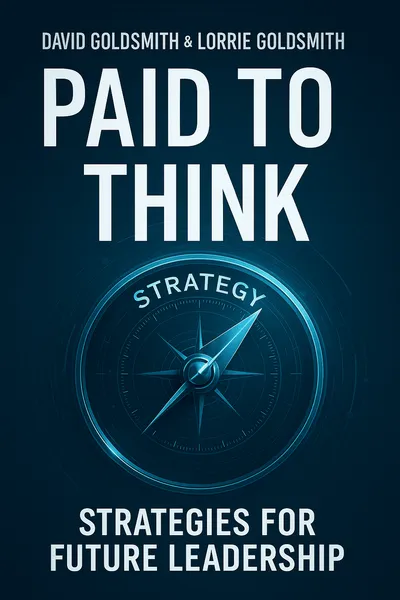
Paid to think
Strategies for future leadership
Description
As a manager, your value to the organization is encapsulated in strategic thinking, learning, performing, and forecasting. You strategize by crafting new directions and innovations, forming partnerships, and integrating technology.
Learning involves gaining knowledge, understanding global trends, and monitoring competitors. Performance is leading effectively, fostering empowerment, and driving creativity, while also focusing on sales.
Forecasting requires anticipating future trends accurately. Enterprise Thinking equips you with the tools for effective leadership, enhancing your ability to think critically and act decisively.
Table of contents
01 Strategic planning
Strategic planning is a vital part of any organization's success. Whether you realize it or not, you engage in this process when you think about ways to improve your company's performance and gain a competitive advantage. To excel in strategizing, it is crucial to master the art of creating superior strategic plans, innovating profitable products and services, forging stronger partnerships, and harnessing technology to expedite your organization's operations.
To propel your business forward, it is essential to devise exceptional strategic and tactical plans that clearly define your goals and outline the methods you will use to achieve them. This planning typically includes three key elements:
1. The development of your strategy is paramount as it sets the course for your organization's future trajectory. In the past, managers would determine a strategy and then identify the tactics needed to implement it. However, this approach can lead to efficiently moving in the wrong direction. A more effective method involves a five-step process that ensures a robust direction for the enterprise.
2. Choosing the most advantageous projects is vital. These projects will modernize your organization and keep it at the forefront with the latest capabilities, positioning it for future success. Projects are the fundamental units for maintaining competitiveness. Ongoing project selection is necessary to continually enhance your operational capabilities and evolve in alignment with your chosen strategy. Factors such as the number of people involved, time commitment, potential impact on performance, expected return on investment, and required capital should be considered. A ranking chart based on these factors can help determine which projects are most beneficial for your company. It is crucial to select the right individuals to lead each project and avoid overburdening them with multiple simultaneous projects. Decision-makers are most effective when limited to two high-priority projects at any given time. Additionally, it is important to prevent your top talent from hopping between projects without seeing them through to completion.

02 Acquiring knowledge
In the realm of leadership, one is perpetually on the journey of either becoming acquainted with a new subject that demands their attention or delving deeper into the nuances of a familiar domain.
It has been observed that a significant portion of a leader's time is dedicated to the former, leaving a scant amount of time for the latter, which is the actual accumulation of expertise.
To alter this imbalance, it is crucial to comprehend the methodologies for acquiring new insights, broadening one's global perspective, and meticulously observing the strategies employed by competitors.
David Goldsmith eloquently points out a common misconception among many, which is the confusion between mere awareness of a subject and possessing a profound understanding of it.
This confusion often leads to frustration when initiatives fail to materialize or when meticulously planned strategies derail or fail to yield the anticipated outcomes.
While being aware of various topics is beneficial, it is the deep-seated knowledge that often acts as the catalyst for progress, not merely tactical plans, time, or financial resources.
The challenge for leaders lies in distinguishing between superficial awareness and the comprehensive knowledge necessary for the effective implementation of ideas.
Reading about an innovative concept in a trade journal does not equate to understanding the complexities involved in its execution.
True execution demands an in-depth understanding, underscoring the continuous responsibility of leaders to cultivate both awareness and knowledge.
03 Executing tasks
A leader's primary role is to facilitate the execution of plans within their team or organization in the most productive and efficient manner possible.
To enhance the effectiveness of plan execution, it is crucial for leaders to take the initiative in leading efforts, empower individuals to make informed decisions independently, seek innovative solutions in all aspects of the company's operations, and continuously promote both the organization's goals and its products or services.
Leaders are tasked with setting a positive tone and inspiring action among their team members. This involves a five-step process that begins with internal reflection, where leaders assess the current situation and identify how it can be leveraged to benefit the organization.
They then establish clear objectives for the company and outline the strategies and tactics necessary for success. The next steps involve recruiting and developing additional leaders, creating the necessary systems and assembling a competent front-line team to implement new strategies, and finally, leading by example in the field to ensure the successful execution of plans.
04 Predicting outcomes
As a leader, it is imperative to cast your gaze forward, to pave the way for a future that holds promise for your organization.
It is essential to grasp the overarching scenario and ensure that your decisions are precise and well-informed.
To enhance your predictive capabilities, it is crucial to understand how the dynamics of economics, politics, technology, as well as the shifting patterns of global trade, will influence your organization's trajectory in the forthcoming times.
The choices you make in the present are the architects of your organization's tomorrow. It stands to reason, then, that your proficiency in foreseeing the potential hurdles and prospects of the future will have a direct bearing on your strategic planning in the present. This, in turn, will shape how prepared your organization is to function and remain competitive in the future.
Reflect upon the current state of your organization; it is a direct consequence of the decisions that have been made in the past. To forge exceptional opportunities for the future, it is vital to make wise decisions now.
Predicting what lies ahead is not an insurmountable task – it simply involves synthesizing three elements: cycles, which are events that occur regularly and on schedule; trends, which indicate a steady direction of movement; and patterns, which are the repeated behaviors or activities. All of these can be projected with a reasonable degree of certainty and can be integrated into your vision for what's to come. As you undertake this task, be vigilant for triggers – specific events that signify a surge in a trend. By identifying these triggers early, you can predict the future with a fair amount of precision.
Related books