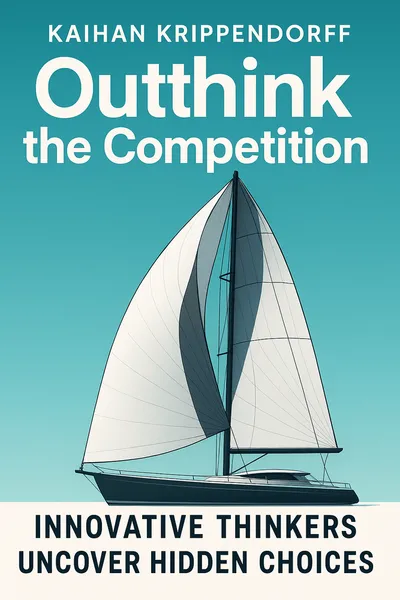
Outthink the competition
Innovative thinkers uncover hidden choices
Description
To truly outthink rivals in strategy games, business, or warfare, you must be innovative enough to confuse them, rendering their responses ineffective. Outthinking means not overpowering or outspending, but outsmarting them. However, to genuinely outthink, you must follow four key actions.
Currently, the business world is experiencing a revolution, discarding old rules for a new playbook that outthinkers use to unsettle traditional competitors. Initially, traditional thinkers may dismiss or mock outthinkers, but as outthinkers establish new methods, it's often too late for the old guard to catch up.
Outthinkers, like sailors harnessing the wind, will glide past the hard-rowing thinkers, adapting to and capitalizing on the new paradigm shift.
Table of contents
01 The outthinker strategy guide
The landscape of business is undergoing a significant transformation. The strategies that have been the cornerstone of corporate success in previous decades are now being replaced by a new, innovative playbook. It is essential for businesses to adapt their mindset to align with the strategies that are effective in the current market environment.
Historically, the majority of successful companies have relied on four key strategies to establish and maintain a competitive edge. However, the business environment is experiencing paradigm shifts across its entire spectrum, driven by at least nine emerging trends. These trends indicate that the traditional playbook is becoming obsolete.
For instance, economies of scale are no longer as significant as they once were, with platforms like Alibaba.com enabling even small players to find manufacturers without the need for massive capital investment. Product development cycles have become shorter, allowing for quicker launches of new products thanks to advancements in rapid prototyping and the availability of online service providers. The business landscape has become more fragmented, with the feasibility of outsourcing almost any task. Information is now widely accessible, empowering customers and diminishing the traditional power of marketers. The role of intermediaries in the value chain has diminished as customers learn to directly engage with manufacturers for better deals. Furthermore, customers are increasingly organizing themselves into groups and communities, sharing information among themselves.
The global economic landscape is also changing, with developing markets expected to contribute more to global growth than developed ones. The competition for talent has become global, offering individuals with impressive resumes a wide range of international employment opportunities. Additionally, the world's increasing interconnectivity has led to a more volatile global environment, where local issues can have worldwide repercussions.

02 Crafting outthinker routines and practices
At the core of achieving success as an innovative thinker lies a quintet of practices and a methodical five-step approach that empowers these thinkers to identify and then actualize unconventional solutions to the challenges faced by society. When these practices and this methodology are applied, they can lead to the generation of dynamic new strategic alternatives and a plan of action characterized by strategic clarity. By adopting an innovative and creative mindset, the possibilities for what one can accomplish are boundless.
The beauty of the Outthinker Process is its versatility; it can be utilized by individuals or within a team context and is equally effective in addressing both grand and minor challenges. This process not only aids in cultivating the associated five habits but also does so in a consistent and systematic manner. It is crucial to note, however, that the Outthinker Process is not designed to provide ready-made solutions. Instead, it facilitates the rapid development of unconventional strategic options, leaving the application of these solutions in the hands of the user.
The initial step involves imagining and envisioning the future that one aspires to create. More often than not, this entails visualizing a new and dynamic future that significantly surpasses the current reality. The most effective method for imagining a hopeful future is to cultivate the habit of mental time travel. This involves projecting oneself and one's team or organization forward into that brighter future, contemplating the future circumstances one wishes to create for oneself, the environment in which one operates, and even for other stakeholders, including competitors. This forward-thinking approach allows one to then work backward, identifying the challenges that must be presently overcome to turn that vision into a tangible reality.
Imagining the desired future can best be achieved through a four-step process. The first step is to articulate and define the current complex situations one faces, considering what the future might hold if no changes are made. This involves extrapolating current operational bottlenecks and discussing with others the potential problems that could arise if the status quo persists. Ideally, this will instill a sense of urgency for change.
The second step involves spending time defining one's optimum long-term ideal, dreaming of what the preferred destination would look like. This includes specifying the long-term timeframe and visualizing one's activities, without forgetting to incorporate one's values and vision. Rather than focusing on exploiting new trends, the emphasis should be on achieving one's mission with whatever tools become available. Once the mission and desired outcomes are clearly defined, one can then consider the environment and other players, identifying the necessary pieces of the puzzle to achieve the ideal.
The third step is to define one's near-term ideal, typically within a 12-month timeframe, asking what must be true in the near term for one to feel confident in achieving the long-term ideal. This may involve building capabilities, acquiring resources, or effecting legislative changes. The final step is to articulate one's strategic question, making it specific, measurable, and time-bound, such as, "In the next twelve months, how do we...?" This process should leave team members feeling excited and energized, facing a clear, compelling strategic question and knowing that by answering it, they will be on a path to realizing their dreams. However, it's important to remember that the long-term ideal may seem daunting, and some team members may feel disheartened. It's crucial to remind oneself that the problem appears unsolvable only because a solution has not yet been found, which is precisely why it is worth dedicating time to find a solution.
03 Creating lasting outthinker traditions
To cultivate a company that consistently astonishes the market with its strategic prowess, it is imperative to navigate through a trio of sequential hurdles.
The initial step involves the establishment of multiple points of differentiation. This is followed by the creation of playbook asymmetry, and finally, the construction and embedding of an outthinker culture within the organization.
For a company to be truly disruptive, it must deploy winning strategies—those strategic decisions that the competition either cannot or chooses not to respond to—across eight distinct dimensions. The broader the spectrum of differentiation a company can establish across these dimensions, and the more enduring these distinctions prove to be, the quicker the company will ascend in growth and profitability. It is observed that outthinkers typically boast at least four points of differentiation or more.
Just as eminent chess players meticulously study their adversaries' strategic tendencies, it is possible to scrutinize your competitors' playbooks to forecast their future actions. This scrutiny enables the design of a unique playbook, one that embodies a distinct pattern of behavior. Such a playbook guarantees that with each strategic maneuver, your company further distances itself from its competitors. This strategic distancing is crucial for maintaining your disruptive influence as the game progresses, according to Kaihan Krippendorff.
The process to achieve this involves several steps. Begin by identifying your primary competitors. Next, select a specific operational aspect—or lens—through which to analyze each competitor. Organize your team by assigning members to gather information through the chosen lenses. Once the data collection phase is complete, consolidate this information to derive key insights about your competitor. Attempt to decipher the playbook they are currently employing. Subsequently, define your own playbook, ensuring it diverges from those of your competitors. To be asymmetrical means to adopt a strategy that is distinctively different, rather than mimicking your competitors. It is essential to develop and design your own optimal strategy playbook.
Related books