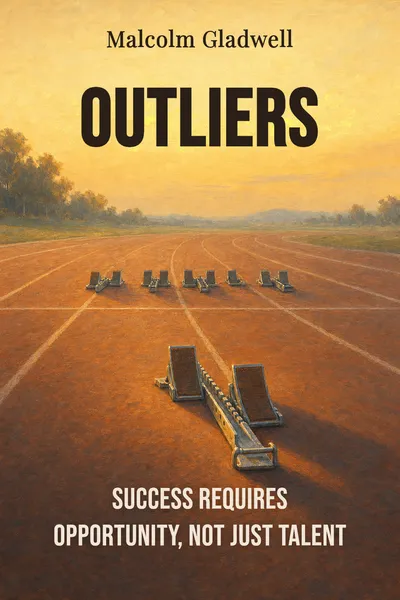
Outliers
Success requires opportunity, not just talent
Description
Pull up the roster of any elite Canadian junior hockey team and do something Malcolm Gladwell did in his 2008 book Outliers: read the birthdays instead of the names. A pattern jumps out fast. A wildly disproportionate share of the players were born in January, February, and March. Almost none were born in the last months of the year. These are the best teenage hockey players in a country obsessed with hockey, selected from millions, coached relentlessly, scouted from childhood. And the single strongest thing they have in common is not a gene or a work ethic. It is the month printed on their birth certificate.
It sounds like a fluke, the kind of coincidence that dissolves under scrutiny. It does not. The Canadian psychologist Roger Barnsley first spotted it in the early 1980s, and the effect holds across the sport, across age brackets, across decades. The eligibility cutoff for youth hockey falls on January 1, so a boy born in January is nearly a full year older than a teammate born in December of the same selection year. At eight, that gap is muscle, coordination, confidence. And once an adult mistakes that head start for talent, the machinery of advantage takes over.
Outliers is built on cases like this. Gladwell takes people we file under genius or grit, including Bill Gates, the Beatles, brilliant lawyers and pilots, and shows that behind each one sits a quieter story about timing, place, and access. The book does not deny that the successful work hard or that they are good at what they do. It asks where the chance to become that good actually comes from.
The question we’re asking : If talent and effort are real, why do they so reliably need a head start nobody earns?What we’ll see : How a hockey roster, a magic number of practice hours, and an accident of birth year expose the borrowed scaffolding under every story of individual success.
Table of contents
01 Chapter 1 — The hidden logic of a birthday
Gladwell calls it the Matthew Effect, borrowing the line from the Gospel that says to those who have, more will be given. In Canadian youth hockey it works with almost mechanical clarity. The cutoff date for the age classes is January 1. A child born on January 2 and a child born the following December 31 compete in the same bracket, which means at the youngest ages one of them has been alive nearly twelve months longer. In a nine-year-old's body, those months show up as size, speed, and reach.
A coach watching a peewee game is not thinking about birthdays. He sees a bigger, faster, more coordinated kid dominating the puck, and he reasonably concludes the kid is gifted. So the gifted-looking child gets pulled onto the all-star team, gets the better coaching, the longer practices, the tougher games against tougher opponents. The smaller December-born child gets less ice time and less attention. Within a few seasons the head start that was pure chronology has hardened into a real, measurable difference in skill.

02 Chapter 2 — The ten thousand hours nobody had alone
The second engine of Outliers is a number that became famous because of the book: ten thousand hours. Gladwell draws it from research associated with the psychologist Anders Ericsson, whose studies of violinists at a Berlin music academy found that the elite performers had, by their early twenties, accumulated roughly ten thousand hours of deliberate practice, far more than the merely good. The figure recurs, Gladwell argues, across chess, composition, sport, and software. Mastery is not a bolt of lightning. It is an enormous, almost inhuman quantity of focused repetition.
The catch is that nobody banks ten thousand hours by willpower alone. Those hours require time, money, equipment, and circumstance, which is exactly where opportunity sneaks back in. Bill Gates is the book's cleanest example. As a teenager in Seattle, he had access in 1968 to a computer terminal with real-time programming, an extraordinary rarity for the era. Through a chain of lucky arrangements at his private school and then a nearby university, he could program through the night for years before most of his future competitors had touched a keyboard at all. By the time he dropped out to start Microsoft, he had logged his ten thousand hours while almost no one his age in the world could have.
03 Chapter 3 — The right year to be born
If a birth month can tilt a hockey career, Gladwell argues, a birth year can tilt a whole life, because being the right age when a door opens is its own kind of luck. The book lingers on the founders of the digital revolution and notices something odd: an unusual number of them were born in a tight window around 1955. Bill Gates in 1955. Steve Jobs in 1955. Paul Allen in 1953, Steve Ballmer in 1956, Eric Schmidt in 1955. Not a coincidence, Gladwell says, but a sweet spot.
The reasoning is precise. The personal computer revolution effectively began in early 1975, with the Altair. To seize it, you wanted to be young enough to be unattached and obsessed, but old enough to have already accumulated serious programming experience. Born much before 1952, and you were likely locked into a stable job at IBM, too invested to gamble. Born much after 1958, and you missed the opening wave. The men who were about twenty in 1975, hungry and already fluent, were positioned to ride a transformation they did not create and could not have timed.
04 Chapter 4 — What success keeps forgetting about itself
Step back from the hockey rinks and the all-night coding sessions and Outliers is doing something quietly subversive to a story most of us carry around: the self-made individual. Western culture, and American culture especially, loves to explain success as the triumph of personal qualities, talent, drive, vision, a kind of inner fire that burns brighter in some people than others. The successful tend to tell it this way themselves, and we believe them, because it flatters everyone. The winners look deserving and the rest of us get a clean recipe to follow.
Gladwell's accumulated cases dismantle that recipe without ever calling the achievers frauds. The hockey star really is fast. Gates really is brilliant. The Beatles really did get tight. What the book insists on is that none of these qualities was sufficient on its own, and that the missing ingredient is always some inheritance the person did not choose: a birth date, a family with a computer terminal, a city with all-night clubs, a generation that turned twenty in the right year. Success, on this reading, is a deeply collaborative event that we have agreed to describe as solitary.
05 Conclusion
Go back to that hockey roster and the January birthdays no longer read as a curiosity. They read as a confession. The best teenage players in Canada are, in part, the boys who happened to be born early enough in the year to look gifted at eight, and were treated as gifted ever after until they became gifted in fact. The talent is genuine; the head start that grew it was free, arbitrary, and invisible to everyone who handed it out.
Related books