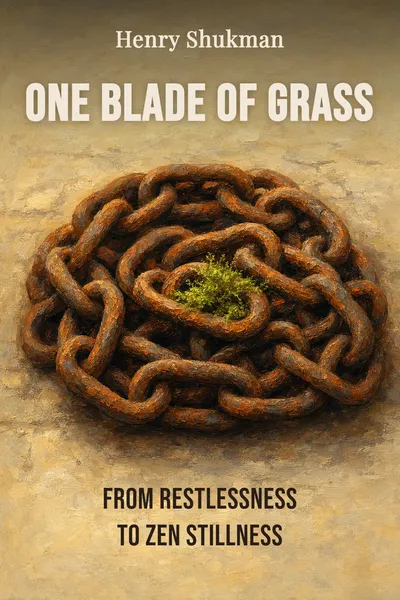
One Blade of Grass
From restlessness to Zen stillness
Description
Henry Shukman spent his twenties moving. He crossed South America on cargo boats and freight trains, worked as a deckhand, a fruit picker, a trekking guide in the Andes. He wrote poems on the road and won prizes for them back in England. On paper it was the life a restless young man is supposed to want: motion, distance, a horizon that kept receding. And yet the more ground he covered, the more he seemed to be running from something he could not name — a low, persistent unease that no amount of travel would burn off.
One Blade of Grass is the book he wrote decades later, once he had stopped moving. It is a memoir of how a poet and adventurer became a Zen teacher, but it refuses the neat arc that phrase suggests. There is no tidy conversion, no single mountaintop moment that fixes everything. Instead there is illness, relapse, doubt, years of sitting on a cushion staring at a wall and getting nowhere, and then — quietly, almost accidentally — something opening. Shukman brings a poet's attention to all of it, to landscape and breath and the small physical facts of a body in trouble.
What makes the book unusual is its honesty about the mechanics. Most spiritual memoirs report the destination and skip the labor. Shukman lingers on the labor, and on how strange it is that stillness — the thing he had spent a lifetime avoiding — turned out to be the road he was looking for all along.
The question we’re asking : How does a restless, adventuring young poet end up finding what he was chasing in the stillness of Zen?What we’ll see : A life told through motion, illness, and the long apprenticeship of sitting, until the everyday itself becomes the point.
Table of contents
01 Chapter 1 — A boy who could not sit still
Shukman grew up in Oxford in a bookish, secular family, the youngest of several children, marked early by a sense of not quite fitting the frame he was born into. He was clever and word-drunk, drawn to poetry, but also carrying a restlessness that reading could not settle. Something in him wanted to be elsewhere. As soon as he could, he left — not to another university or a career, but to the road, which for a certain kind of young man in the 1980s meant working passage across oceans and disappearing into countries where nobody knew his name.
The travels fill the early book with vivid weather and light: the Andes, the Amazon, the salt flats, the physical intensity of a body pushed hard through unfamiliar places. Shukman writes these passages with real craft, and you can feel why he chose them. Motion was a kind of medicine. As long as he kept moving there was always a next thing, a next port, a next range of mountains to cross, and the unease had less time to catch up with him. Adventure was the form his avoidance took.

02 Chapter 2 — The body keeps the account
The turn, when it comes, is not spiritual first. It is physical. Shukman falls seriously ill, and the illness will not resolve into a clean diagnosis or a clean cure. He describes years of compromised health, of a body that no longer cooperates, of the particular fear that arrives when the thing carrying you through the world starts to fail. For a man whose whole strategy had been motion, sickness is a closing door. He can no longer outrun anything. He has to stay where he is.
This is where the book earns its candor. Shukman does not present illness as a gift or a lesson delivered on schedule. It is frightening and disorienting and often just grim. But it forces a reckoning he had been postponing for two decades. Stripped of the ability to keep moving, he has to sit with himself — with the unease he had been fleeing since Oxford, with the memory of that early peace, with the plain question of what a life is for when the adventuring is over.
03 Chapter 3 — Sitting through the wall
Zen practice, as Shukman describes it, is mostly unglamorous. You sit facing a wall. You follow the breath, or you work with a koan — one of those small, maddening riddles that resist the thinking mind. Your legs hurt. Your mind wanders and you bring it back and it wanders again. There are retreats of long days broken only by more sitting, and there are years, plural, in which nothing seems to happen. Shukman is honest about the tedium and the doubt, about wondering more than once whether the whole thing is a mistake.
He commits anyway, eventually deeply, training under teachers in the Sanbo Zen lineage that blends Japanese Rinzai and Soto traditions. The koan work matters to him: not as a puzzle to be solved cleverly, but as a pressure that slowly wears down the habit of standing apart from experience and commenting on it. The point is not to figure the riddle out. The point is to become the kind of person for whom the question dissolves.
04 Chapter 4 — The old road of the heart
Step back from the memoir and what Shukman is really arguing — quietly, never as a thesis — is that the contemplative life is far more ordinary than its literature usually admits. The phrase he returns to, the old road of the heart, is not pointing to a mystical elsewhere. It is pointing to the plainest possible thing: this moment, this breath, this blade of grass, met without the running commentary that usually stands between us and it. The whole trajectory of his life bends toward that unglamorous conclusion.
This matters because it inverts how spirituality is often sold. We tend to imagine awakening as an escape — from the body, from suffering, from the dull machinery of daily life into something purer and higher. Shukman's account runs the other way. His illness did not lift him out of embodiment; it pressed him deeper into it. His practice did not deliver him from the everyday; it returned him to it, more fully awake to the thing that had been there all along. The exotic seeker had to come home to find what the exotic could not give.
05 Conclusion
The young man on the cargo boat and the Zen teacher who wrote this book are the same person, and One Blade of Grass is the account of how the distance between them closed. Not through a single revelation, but through illness that stopped him, stillness that held him, and years of sitting that slowly turned looking-for into simply looking. The peace he glimpsed once as a traveler and could not hold onto returns, in the end, not as a rare visitor but as something woven into the fabric of an ordinary, imperfect, still-difficult life.
Related books