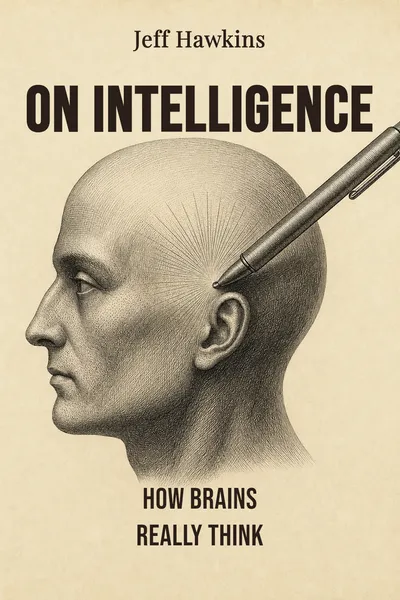
On Intelligence
How brains really think
Description
In the late 1970s, a young engineer named Jeff Hawkins wrote to the Intel research labs with an unusual proposal: he wanted to spend his career figuring out how the brain works. Intel passed. So did the MIT Artificial Intelligence Lab, where he was told, in effect, that brains were beside the point — the goal was to build intelligence, not to reverse-engineer the messy organ that already had it. Hawkins went off and did something else instead. He co-founded Palm Computing, invented the PalmPilot, and later Handspring, becoming one of the people who put a computer in everyone's pocket well before the smartphone. But the brain question never left him.
In 2004 he published On Intelligence, written with the science journalist Sandra Blakeslee. It is not a book about gadgets. It is a book that argues, calmly and stubbornly, that the entire field of artificial intelligence had been chasing the wrong thing for fifty years. Machines that beat chess champions or parsed sentences were not intelligent, Hawkins claimed — they were fast. Intelligence, he wanted to say, is not about behavior at all. It is about what happens inside, silently, before anything visible occurs.
The claim rests on a single organ, the neocortex — that wrinkled sheet a couple of millimeters thick wrapped around the rest of the brain. Hawkins thought its secret was hiding in plain sight, and that once we saw it, both neuroscience and the dream of thinking machines would look different. The wager of the book is that a working theory of intelligence was within reach, and that an outsider might be the one to state it plainly.
The question we’re asking : If intelligence isn't the clever behavior we can measure from the outside, then what is the brain actually doing when it thinks?What we’ll see : How a Silicon Valley engineer reframed intelligence around a single idea buried in the neocortex — and what it would take to build a machine that shared it.
Table of contents
01Chapter 1 — The engineer who wanted to study brains
Hawkins tells his own story without much ceremony, but it matters to the argument. He was an engineer by training and temperament, and he came to the brain the way an engineer comes to any black box: convinced there had to be a mechanism, a set of principles you could write down, and that the reason nobody had found them was that they were looking in the wrong place. Neuroscience, as he encountered it, was drowning in detail — thousands of papers on individual neurons, neurotransmitters, brain regions — without a framework to tie the details together. It had data and no theory.
Artificial intelligence had the opposite problem. Since the 1950s, its founders had bet that intelligence could be engineered directly, as a set of rules and computations, with no need to understand biology. Build a system that plays chess, translates languages, recognizes shapes, and you have built intelligence — or close enough. Hawkins thought this was a category error. A chess program that cannot recognize a cat, cross a room, or hold a conversation is not a little bit intelligent. It is not intelligent at all. It is a fast lookup table with no idea what it is doing.

02Chapter 2 — Prediction, not behavior
The heart of On Intelligence is a redefinition. For half a century, the working assumption was that intelligence shows up in behavior — the smarter you are, the cleverer the things you can do. Alan Turing's famous test enshrined this: a machine counts as intelligent if it can converse well enough to pass for human. Hawkins rejects the premise outright. Behavior, he argues, is a consequence of intelligence, not the thing itself. A person lying perfectly still in a dark room, doing nothing observable, can be thinking as hard as they ever have.
What the brain is really doing, all the time, is making predictions. Your cortex holds a model of the world, and it uses that model to anticipate what you are about to sense — the next note in a song, the feel of the doorknob your hand is reaching for, the word likely to end a sentence. Most of the time the prediction is right and nothing happens. When it is wrong, you notice: the missing step at the bottom of the stairs, the sock drawer someone rearranged, the friend's voice that comes out of a stranger. That flash of surprise is prediction failing, and it is one of the clearest windows into how constantly the machinery is running.
03Chapter 3 — The cortex runs one algorithm
The most striking claim in the book is anatomical. The neocortex looks, under a microscope, remarkably uniform — the same six layers, the same cell types, the same wiring, whether the patch you are examining handles vision, hearing, touch, or language. Hawkins leans hard on a piece of work by the neuroscientist Vernon Mountcastle, who proposed decades earlier that this uniformity is not an accident. If the tissue is the same everywhere, Mountcastle argued, then it must be doing the same thing everywhere. There is one cortical algorithm, applied to whatever inputs arrive.
The evidence is uncanny. In people blind from birth, the visual cortex gets repurposed to process touch and sound; the region built for seeing does perfectly good work on other senses because it was never really a "seeing" region — it was a general-purpose learner that happened to be fed by the eyes. What differs across the cortex is the wiring to the outside world, not the machinery itself. This is a profoundly hopeful thought for anyone hoping to understand intelligence: crack the one algorithm and you have cracked the lot.
04Chapter 4 — What thinking machines would actually be
If the memory-prediction framework is right, then the long-running dream of artificial intelligence has been aimed at the wrong target. The goal was never to imitate human behavior, Hawkins argues; it should be to build machines that run the cortical algorithm — that construct models of the world and predict from them. Such a machine would not need to look human, converse charmingly, or pass anyone's test. It would need memory arranged in hierarchies, a flow of predictions running downward, and a stream of experience to learn from over time.
This reframing carries a quiet liberation. We tend to picture intelligent machines as humanoid robots with human wants, and to fear them for the same reason we fear each other. But intelligence, on Hawkins's account, is separable from the drives, emotions, and survival instincts that come from the older parts of our brain — the parts the cortex sits on top of. A machine could be brilliantly intelligent and have no appetite, no ego, no ambition at all. It would be a tool for prediction, not a rival species.
05Conclusion
The engineer who was turned away by Intel and MIT ended up making his case anyway, from outside the institutions that study the mind for a living. On Intelligence does not claim to have finished the job — it offers a framework, a bet about where the answer lies, and an invitation to test it. Its wager is simple: the neocortex is a memory system that predicts, one algorithm learning hierarchies of pattern across every sense, and everything we call understanding follows from that.
Related books