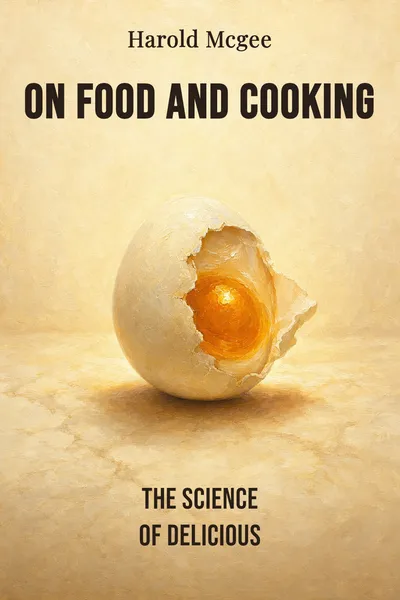
On Food and Cooking
The science of delicious
Description
In the late 1970s, a young American with a doctorate in English literature from Yale sat down to write a book about poetry and the stars. What he ended up writing, published in 1984, was a 684-page volume about why onions make us cry, how a custard sets, and what happens inside a steak when it hits a hot pan. Harold McGee had drifted from Keats to Keller by way of a simple, nagging observation: cookbooks told him what to do, never why it worked. Recipes were commands with no reasons attached. Boil the pasta in plenty of water — but why? Rest the roast before carving — but why? The instructions were everywhere; the explanations were nowhere.
So he went looking, and where he looked was chemistry and biology rather than the culinary tradition. On Food and Cooking treated the kitchen as a laboratory where reactions happen whether or not the cook understands them. Egg proteins uncoil and link up when heated. Sugars and amino acids collide at high temperature and turn brown and savory. Milk curdles because acid rearranges its suspended proteins. None of this was new to science, but nobody had gathered it and handed it to the person actually standing at the stove. Time called the result a minor masterpiece, and two decades later McGee rewrote almost the entire thing, expanding it by two-thirds.
The book became the reference that serious cooks and curious eaters reach for when a dish behaves in a way they can't explain. It doesn't tell us what to make for dinner. It tells us what our food is, where it comes from, and what cooking does to it at a level we usually can't see. That turns out to change how we cook — not by adding rules, but by removing the mystery behind the ones we already follow.
The question we’re asking : What does it actually mean to understand cooking rather than merely follow it?What we’ll see : How one book turned the stove into a place where chemistry becomes dinner, and the cook into someone who knows why.
Table of contents
01Chapter 1 — A physics student wanders into the kitchen
Harold McGee's path to the kitchen ran through the humanities, not the culinary school. He studied at Caltech before switching to literature, took his doctorate at Yale, and was teaching writing when the question that would define his life snagged him. He had been reading a poem — the story goes back to a line about a spinning apple seed — and wondered whether beans really do cause the effect their reputation claims. He couldn't find the answer in any cookbook. What he found instead was that cookbooks, as a genre, almost never explained themselves. They were manuals of technique passed down as ritual, tested by generations but rarely questioned.
This bothered him in a specific way. A recipe that works is a piece of accumulated knowledge, but knowledge with the reasoning stripped out is hard to adapt, hard to fix when it fails, and impossible to extend to new situations. If we know only that eggs should be added off the heat, we're stuck the moment we improvise. If we know that egg proteins overcook and curdle above a certain temperature, we can rescue a sauce, invent a variation, or diagnose a failure. The difference between the two cooks is not skill. It's understanding.

02Chapter 2 — Milk, eggs, meat — what heat actually does
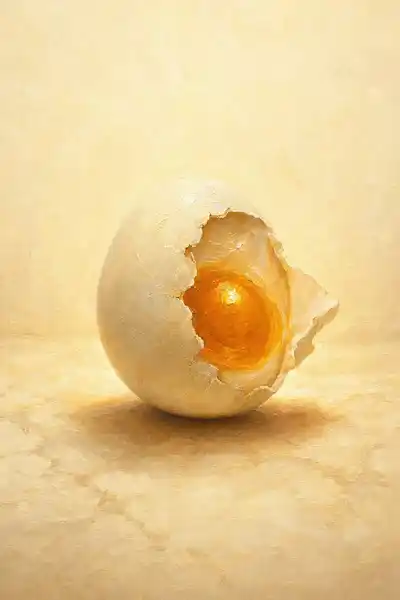
The core of On Food and Cooking is a patient account of what happens when we apply heat to the things we eat, and the recurring character in that account is protein. Proteins are long molecules folded into compact shapes, and heat makes them unfold and then bond to one another — a process McGee returns to again and again because it explains so much of what happens on the stove. An egg white is mostly water holding dissolved proteins; heat unfolds those proteins until they link into a mesh that traps the water, and the clear liquid turns into an opaque solid. Cook it too long or too hot and the mesh tightens, squeezing water out, which is why an overcooked egg turns rubbery and weeps.
The same principle, followed carefully, demystifies a whole shelf of kitchen behavior. A custard is a suspension of egg proteins in milk, and it sets into a smooth gel within a narrow temperature window; push past it and the proteins clump into curds swimming in liquid. Milk itself curdles when acid or heat destabilizes the casein proteins held in suspension, which is the entire basis of cheese-making rather than an accident to be avoided. Understanding this, McGee shows, converts a mysterious disaster into a controllable variable.
03Chapter 3 — Flavor is a molecule, browning is a reaction
If protein explains texture, chemistry explains taste — and this is where McGee's book delivers its most quietly radical idea: flavor is not a vague quality but a collection of specific molecules that we can name, track, and deliberately create. Aroma, which does most of the work we credit to taste, comes from volatile compounds light enough to reach the nose. A ripe strawberry, a roasting coffee bean, a crushed herb — each releases a distinct chemical signature. Cooking is largely the business of generating, concentrating, or preserving these compounds, and losing them is what makes reheated food taste flat.
The star of the flavor story is the Maillard reaction, named for the French chemist Louis-Camille Maillard, who described it in the early twentieth century. When amino acids and certain sugars are heated together above roughly 140 degrees Celsius, they begin a cascade of reactions that produces hundreds of new aromatic molecules and the brown color we associate with almost everything delicious: the crust on bread, the sear on a steak, the surface of a roasted onion, the shell of a coffee bean. It is not the same as caramelization, which is sugar breaking down on its own. McGee is careful about the distinction, because the two produce different flavors and demand different conditions.
04Chapter 4 — The cook as an amateur chemist
Step back from the individual lessons and the deeper move in On Food and Cooking becomes visible: it quietly dismantles the old wall between the person who follows recipes and the person who understands food. For most of culinary history those were separate castes. The tradition held the knowledge, transmitted it through apprenticeship and repetition, and the home cook received it as a set of instructions to obey. McGee's book proposes that the reasoning behind the tradition is not secret and not beyond us — it lives in chemistry and biology, and it can be read by anyone willing to think.
This is a genuinely different picture of what cooking is. It is not primarily an art of taste or a craft of the hands, though it is also those things. Underneath, it is applied science: heat and time and chemistry acting on the physical stuff of ingredients, whether or not we notice. The tradition arrived at good techniques by trial and error over centuries, testing what worked and keeping it. Science offers the explanation the tradition never needed to state. McGee's contribution was to show that the two accounts describe the same reality, and that having both makes a cook more capable than having either alone.
05Conclusion
The English student who couldn't find out why beans behave the way they do ended up writing the book that answers thousands of such questions, and answers them not with rules but with reasons. On Food and Cooking never tells us what to cook. It tells us what happens when we do — proteins unfolding and bonding, amino acids and sugars colliding into new flavors, collagen melting into gelatin over slow hours — and it trusts us to take it from there. The recipe, in McGee's world, is the surface. Underneath runs a chemistry that has been operating all along, patiently, in every kitchen, waiting to be noticed.
Related books