
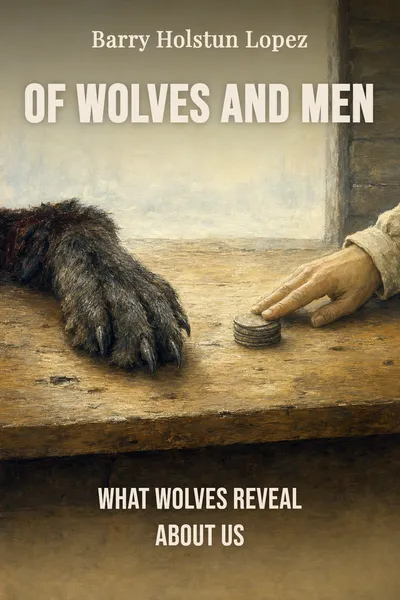
Of Wolves and Men
What wolves reveal about us
Description
In 1974, a young writer named Barry Lopez began spending time with wolves — captive ones in Alaska, wild ones tracked from small planes over the tundra, and the enormous archive of stories humans have told about them for centuries. He was not a biologist by training, and the book that came out of those years, published in 1978, refused to behave like a wildlife monograph. Of Wolves and Men opens with field observation and then keeps widening, until it takes in Inuit hunters, medieval bestiaries, werewolf trials, and the men who were paid, decade after decade, to shoot every wolf they could find.
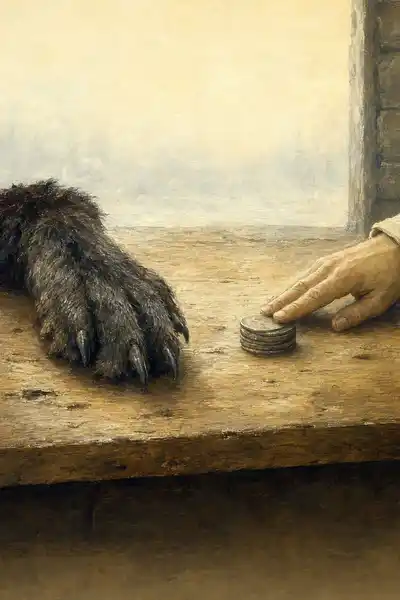
What Lopez noticed, and built the whole book around, is that almost nobody who has written about wolves has actually been writing about wolves. The animal on the page is usually a stand-in — for evil, for freedom, for the wilderness we've decided we love or need to destroy. The gray wolf of North America and Eurasia is a real creature with a real life: it hunts, it raises pups, it defends a territory. But the wolf in the human imagination is a far busier animal, doing centuries of symbolic labor the living one never signed up for.
That gap — between the wolf that exists and the wolf we keep inventing — is the spine of the book. Lopez treats it not as a mistake to be corrected but as something revealing in itself, a place where a culture shows its hand.
The question we’re asking : Why have humans spent centuries seeing something other than a wolf when they look at one?What we’ll see : How a lyrical classic moves from the biology of a predator to the far stranger story of what we've needed it to mean.
Table of contents
01Chapter 1 — The animal science could see
Lopez begins where a naturalist would, but with a naturalist's humility about how little was actually known. For much of the twentieth century, most of what appeared in scientific accounts of wolves came from carcasses, tracks, and scattered sightings rather than sustained observation of living packs. The wolf is elusive, ranges over vast distances, and had been hunted so relentlessly that studying it in the wild was genuinely hard. So even the science, Lopez argues, arrived carrying assumptions — the wolf as a wasteful killer, a threat to game, an animal defined mainly by what it took from us.
Against that, he sets what closer watching reveals. A pack is a social unit organized around a breeding pair and their offspring, held together less by raw dominance than by an intricate choreography of gesture, posture, and voice. Wolves communicate constantly. They defer, they solicit, they reconcile. The howl that curdled the blood of European peasants turns out to be, among other things, a way of locating one another and marking a territory across country too large to patrol on sight.

02Chapter 2 — The wolf a village needed
To find that somewhere else, Lopez turns to peoples who lived alongside wolves without wanting them dead. Among Inuit and various Native American hunting cultures, he finds a wolf regarded as a fellow hunter, a teacher, sometimes a kinsman. The Nunamiut of the Alaskan interior watched wolves closely because their own survival depended on the same caribou, and they spoke of the animal with a precision born of respect rather than dread. Here the wolf is a peer in the business of living off the land, and killing one carries obligation, not triumph.
Lopez is not sentimental about this. Hunting peoples did kill wolves, and their view was not uniform. But the relationship was reciprocal in a way that the European inheritance was not. The wolf was understood as an animal with its own competence, moving through a world the humans also inhabited, and worth learning from precisely because it was good at what both of them did.
03Chapter 3 — The century of the bounty
That inherited horror crossed the Atlantic, and in North America it turned into policy. Lopez devotes some of the book's hardest pages to the systematic destruction of the wolf across the United States, a campaign that ran for the better part of a century and was carried out with a thoroughness that still unsettles. Bounties were paid. Government agents were employed full-time to hunt wolves down. It was extermination organized as public service.
The methods were brutal and Lopez does not spare the reader. Wolves were shot, trapped, and poisoned with strychnine on a continental scale; dens were dug out and the pups killed; animals were roped, set on fire, or otherwise tortured in ways that had nothing to do with protecting livestock and everything to do with something darker. He records these acts without editorializing much, because the record accuses on its own. By the mid-twentieth century the wolf had been eliminated from nearly all of the lower forty-eight states.
04Chapter 4 — The mirror we keep pointing at the wild
Step back from the tundra and the bounty records and Lopez's true subject comes into focus: the wolf is a surface we project onto, and what we project tells us about ourselves rather than about the animal. This is why the book is called Of Wolves and Men and not simply Of Wolves. The men are always in the frame. Every account of the wolf — the peasant's terror, the hunter's respect, the exterminator's rage, and Lopez knows, the modern conservationist's love — is a self-portrait wearing the animal as a mask.
He is honest enough to turn this on his own moment too. The wolf that late-twentieth-century admirers celebrated as noble, free, a symbol of vanishing wilderness, is also a projection. It may be a kinder one, but it is still a story we tell about our own longing, not a report on the creature itself. The wolf does not know it is free. It is doing the difficult work of staying alive in a specific stretch of country, indifferent to whether we cast it as demon or hero.
05Conclusion
Lopez ends much as he began, with the living animal — the wolf on the tundra, moving through country most of us will never see, doing nothing to earn the meanings piled onto it. Between his opening field observations and his catalog of extermination lies the whole distance the book measures: the gap between a real predator and the crowded, contradictory figure we've made of it for centuries. He does not close that gap so much as ask us to notice it, and to hold our interpretations more loosely than our culture ever has.