
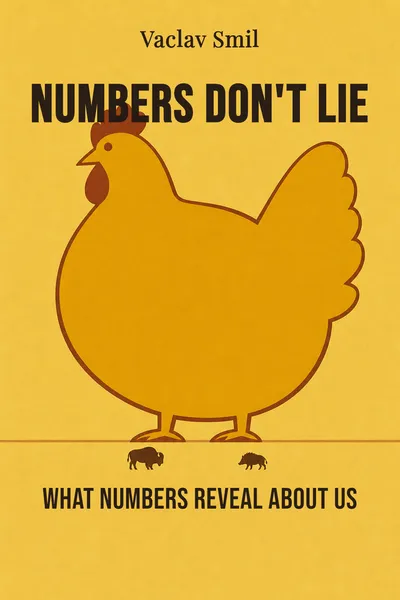
Numbers Don't Lie
What numbers reveal about us
Description
In 2020, a Czech-Canadian scientist named Vaclav Smil published a slim book with a blunt title, Numbers Don't Lie, gathering seventy-one short pieces he had written for the magazine of the IEEE, the engineering society. Smil was not a celebrity author. He was an emeritus professor at the University of Manitoba who had spent five decades writing dense, unglamorous volumes about energy, food, materials and the metabolism of modern civilization — books that Bill Gates had taken to reading and recommending, which is roughly how a man who avoids interviews ended up with a wide readership. Each chapter answers a plain question with a figure, then follows the figure to somewhere unexpected.
The questions themselves sound like bar-trivia. How much does all the livestock on Earth weigh? Is flying actually dangerous? Why do the French live longer than Americans despite eating butter and drinking wine? What Smil does with them is stranger than trivia. He treats a number not as a verdict but as an instrument — something you hold up to a claim to see whether the claim survives contact with arithmetic. Most claims don't. The gap between what we feel about the modern world and what the quantities actually say turns out to be enormous, and it runs in both directions.
The title is deliberately provocative, because Smil knows perfectly well that numbers get twisted, cherry-picked and dressed up all the time. His point is narrower and harder to argue with: the underlying magnitudes are what they are, and most of us carry around a badly scaled picture of them. We fear the wrong things, celebrate the wrong breakthroughs, and miss the quantities that quietly govern whether the lights stay on.
The question we’re asking : What happens to our sense of the modern world when we insist on checking it against the actual quantities?What we’ll see : How a lifelong measurer of civilization uses simple figures to resize the things we fear, admire, and never think to weigh.
Table of contents
01Chapter 1 — The world weighed in kilograms
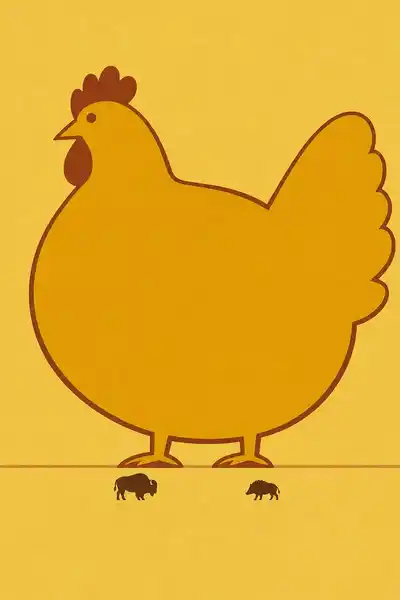
Smil likes to start with a question nobody asks because the answer sounds obvious until you try to produce it. Weigh all the mammals on Earth. Not count them — weigh them, in dry tonnage of living flesh. The result is one of the most quietly disorienting numbers in the book. Wild land mammals, the elephants and deer and wolves and everything else, come to a small fraction of the total. Human beings vastly outweigh them. And the domesticated animals we raise to eat — the cattle, pigs and sheep — outweigh us several times over. The planet's mammalian biomass is, overwhelmingly, us and our livestock.
This is the kind of figure that changes a picture without arguing a position. Smil is not delivering a sermon about meat. He is pointing out that a person who imagines Earth as a place teeming with wild animals, dotted here and there with cities, has the proportions almost exactly backward. The cattle alone represent an engineered layer of biology roughly on the scale of the entire human species. Once you have carried that ratio for a minute, documentaries about vanishing megafauna read differently: they are footage of the thin remainder.

02Chapter 2 — When the number contradicts the feeling
The chapter people remember is the one about flying, because it goes straight at a fear almost everyone recognizes. Smil does not tell nervous flyers to relax. He gives them the arithmetic. Commercial aviation is, per distance travelled, among the safest ways a human being has ever moved. The risk of dying on a given flight with a reputable airline is so small that the figure barely registers against the ordinary hazards of a day — the drive to the airport is the dangerous part. The feeling of danger and the quantity of danger have almost nothing to do with each other.
Smil is interested in that divergence as a general fact about us, not just about planes. We calibrate fear to the vividness of an event, not its frequency. A crash is catastrophic, filmed, replayed, and rare; the slow attrition of car accidents is constant and invisible. The number does not soothe the fear so much as expose the machinery that produces it. Once you see that your alarm is tracking drama rather than probability, the alarm doesn't disappear, but it loses its authority.
03Chapter 3 — Energy is the currency nobody prices
If one theme organizes Smil's fifty years of work and surfaces throughout the book, it is energy. Not energy as a commodity price, but energy as the thing everything else is secretly denominated in. Food is energy captured by plants and passed up a chain. A city is a standing arrangement for delivering energy to millions of bodies and machines. A steel beam, a bag of cement, a tomato flown across a continent — each carries a hidden cost in joules that no receipt records. Smil's habit is to translate a familiar object back into the energy it took to bring into being, and the translation is often startling.
Take food, the case he returns to with obvious affection. A modern diet feels like the product of farms and sunshine. Smil traces it back further, to the diesel in the tractor, the natural gas cracked into fertilizer, the fuel burned to transport and refrigerate. By the time a meal reaches a plate in a wealthy country, it has consumed far more fossil energy than it delivers in calories. We eat, in a real sense, a great deal of oil. The tomato that traveled thousands of kilometers to arrive out of season is a small monument to cheap energy nobody thought to charge for.
04Chapter 4 — The habit of asking how much
Step back from the individual figures and what Numbers Don't Lie is really teaching is a habit rather than a set of facts. Smil is not asking us to memorize the biomass of cattle or the safety record of aviation. He is modeling a reflex: when a claim arrives — a fear, a boast, a headline — the first move is to ask how much, compared to what. The number is less a conclusion than a check. It resizes an intuition that markets, media and our own nervous systems have quietly distorted.
This matters because the distortions are not random; they lean in predictable ways. Vividness beats frequency, so we overweight the dramatic. Novelty beats duration, so we overweight the new. Convenience hides its costs, so we underweight the physical foundations we live on. Each of these biases has a corresponding number that corrects it, and Smil's book is essentially a catalogue of such corrections. The value is cumulative: after enough of them, a reader starts supplying the correction unprompted.
05Conclusion
The title was always a small provocation. Numbers do get bent, and Smil, who spent a career watching figures deployed to sell reactors and diets and revolutions, knows it better than most. What he means is narrower and more durable: the magnitudes underneath the arguments are stubborn, and we carry a badly scaled version of them in our heads. We fear the safe flight, thrill at the transition that will actually take decades, and eat oil without noticing. The plain figure, held up against the claim, keeps catching us out.