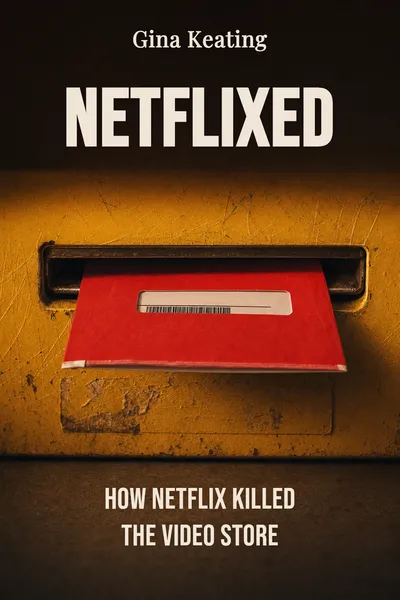
Netflixed
How Netflix killed the video store
Description
In 1997, a software executive named Reed Hastings returned a rented copy of Apollo 13 to a video store six weeks late and got hit with a $40 fine. That's the story Netflix told for years about why it exists — the late fee that launched an empire. Gina Keating, who spent years reporting on the company for Reuters, treats that origin story with a raised eyebrow. It's clean, it's memorable, and it conveniently leaves out the other founder. The real beginning, in her telling, is messier: two men, Hastings and Marc Randolph, carpooling to work in Silicon Valley, throwing business ideas at each other until one of them stuck. Mailing DVDs, a format barely on the market, seemed as good a bet as any.
What grew out of that carpool became one of the defining corporate stories of the digital era. Keating's book, Netflixed, follows the company from a scrappy DVD-by-mail startup through a bruising war with Blockbuster, a near-fatal self-inflicted wound, and its reinvention as a streaming service that would eventually make its own shows. Along the way she does something most Netflix accounts don't: she gives Blockbuster a fighting chance, and she gives Randolph his due, before Hastings became the sole face of the myth.
The version most of us absorbed is the tidy one — plucky underdog beats lumbering giant, streaming was inevitable, the disc was always just a stepping stone. Keating, reporting from inside the negotiations and boardrooms, tells a story with far more contingency in it. The giant nearly won. The pivot nearly failed. And the man who named the company was gone long before the credits rolled.
The question we’re asking : How did a DVD-by-mail startup outlast the video-store giant, and how close did it come to losing?What we’ll see : A reported account of the founders, the fight, the near-collapse, and the reinvention that turned a shipping company into a studio.
Table of contents
01Chapter 1 — Two founders and a $40 late fee
The late-fee anecdote is where Netflix likes to begin, and Keating lets it stand while quietly complicating it. Reed Hastings had already sold a software company, Pure Atria, for a small fortune, and he wanted his next act to be bigger. The problem was he didn't yet have the idea. Marc Randolph did the legwork of finding it. The two had met at Pure Atria, commuted together down Highway 17 to Santa Cruz, and used the drive as a rolling brainstorm — personalized shampoo, custom dog food, dozens of dead ends before they landed on renting movies by mail.
The timing mattered more than the fine. DVDs were brand new in 1997, thin and light enough to survive a stamp, unlike the bulky VHS tapes that would have made mailing a joke. To test the premise, the two men reportedly bought a used CD, mailed it to Hastings's own house in Santa Cruz, and waited to see if it arrived intact. It did. That crude experiment was the whole business hypothesis: a disc could travel through the postal system cheaply and come back in one piece.

02Chapter 2 — The war Blockbuster almost won
The heart of Keating's book, and its most surprising stretch, is the fight with Blockbuster — because for a stretch, Blockbuster was winning. By the mid-2000s Netflix had millions of subscribers and a beloved product, but it was still a mail-order company competing against a chain with a store in nearly every American strip mall. When Blockbuster finally decided to take the threat seriously, it moved with the kind of resources Netflix could only dream of.
In 2004 Blockbuster launched its own online DVD subscription service, undercutting Netflix on price and, crucially, offering something Netflix couldn't: the ability to return a mailed disc to a physical store and swap it for another on the spot. Blockbuster Total Access, as the integrated version was branded, gave customers both mail and in-store rentals in a single plan. Keating documents how it worked — subscribers churned away from Netflix in real numbers, and the two companies slid into a brutal price war that hammered both their finances.
03Chapter 3 — The pivot that nearly broke the company
Hastings had always said the disc was temporary. The company's own name pointed at the internet, not the mailbox, and Keating shows that streaming was on the roadmap long before the technology was ready. When Netflix launched its "Watch Instantly" streaming feature in 2007, it was a modest bonus bolted onto the DVD subscription — a thin catalogue, bundled free, almost an afterthought. Nobody mistook it yet for the main event.
The strategic bet underneath it was real, though. Streaming carried no postage, no warehouses, no discs to scratch or lose. If Netflix could get customers to shift their viewing online, its costs would fall even as its selection could, in theory, grow. The trouble was that the studios controlled the content, and licensing films for streaming was a different and far more expensive negotiation than buying discs to mail. Keating walks through the deal-making that kept the streaming library alive in those early years, much of it dependent on relationships that could be yanked away.
04Chapter 4 — When distribution becomes content
The broadest thread running through Keating's account is a company that refused to defend the business that was making it money. Netflix started as a shipping operation, got rich on discs, and then spent years deliberately steering customers away from the very thing paying the bills. Most companies protect their cash cow until a competitor slaughters it. Netflix kept trying to slaughter its own — first replacing per-rental fees with subscriptions, then pushing streaming over the mail, each time cannibalizing a working model before anyone else could.
That instinct explains the last act Keating's book gestures toward: the move into original content. Once Netflix realized its streaming library depended on studios that could raise prices or walk away, controlling its own shows stopped being a luxury and became a survival strategy. If distribution alone could be copied — and Blockbuster had proved it could — then owning what flowed through the pipe was the only durable moat. The logic that had pushed the company from stores to mail to streaming pushed it, inevitably, from renting other people's movies to making its own.
05Conclusion
The late fee, in the end, was the least interesting part. Keating's reporting replaces the tidy myth with something more human: two founders who stumbled onto the idea in a carpool, a giant that built the weapon to kill them and then dropped it, a pricing decision that nearly torched a decade of goodwill, and a founder who apologized on video after the worst month of his career. The company that emerged wasn't inevitable. It was contingent at almost every turn, saved as often by a rival's blunder as by its own vision.
Related books