
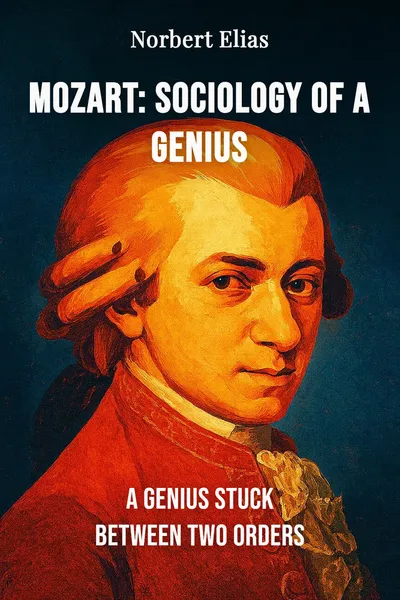
Mozart: Sociology of a Genius
A genius stuck between two orders
Description
In 1781, at the archbishop's residence in Vienna, a twenty-five-year-old court musician was literally kicked out the door — Count Arco delivered the boot to his backside, an insult Mozart would recount for years. He had just quit the service of the Archbishop of Salzburg, his employer and, in the language of the time, his master. He was not a rebellious artist claiming his freedom in any way we would recognize today. He was a domestic employee who ate at the servants' table, above the cooks and below the valets, walking out on a secure post with nothing lined up to replace it.
What makes that scene worth staying with is not the humiliation. It is that Mozart had almost nowhere to go. There was no music industry, no concert circuit that could pay a man's living, no public that bought tickets in the numbers a career would need. A musician of his era belonged to a patron the way a cook or a coachman did. Stepping out of that arrangement meant stepping into a market that barely existed yet. Mozart spent his last decade in that gap, brilliant and increasingly broke, and died at thirty-five in December 1791 with the accounts not adding up.
The sociologist Norbert Elias picked up this life not to add another portrait of the untouchable prodigy, but to ask a colder question about it. He wanted to know what a society does to a person of extraordinary gifts when that society is quietly changing its mind about what such a person is for. The romantic word 'genius' tends to end the conversation. Elias treats it as where the conversation should begin.
The question we’re asking : What happens to a person of rare talent when the world he was born into no longer knows what to do with him?What we’ll see : How a court servant's life, read through who paid him and who bought his music, turns the word 'genius' from an answer into a problem worth solving.
Table of contents
01Chapter 1 — A servant who wanted to be an artist
To read Mozart the way Elias does, we have to strip away the halo first and look at the job description. In the second half of the eighteenth century, a musician was an artisan in service. He wore a livery, or something close to it. He composed what his employer wanted, when the employer wanted it, and he did so as part of a household staff. The Archbishop of Salzburg fed Mozart, housed him, and paid him a modest salary, and in return owned his output the way one owns the work of any employee. Talent did not change the terms. It only made the servant more useful.
Mozart, though, had been raised on a different diet. As a child prodigy paraded across Europe by his father Leopold, he had been kissed by empresses and applauded in the great courts. He had tasted, very young, the sensation of being wanted for himself and not for a function. That early exposure planted something Elias thinks is decisive: an image of his own worth that the servant's role could never accommodate. The boy who had charmed Versailles could not, as a man, quietly accept eating between the cooks and the valets.

02Chapter 2 — The court that could not hold him
The Salzburg years read, in Elias's telling, like a slow-motion collision. Mozart chafed against his provincial post, against the archbishop who summoned him and dismissed him, against a court that valued him but on terms he found intolerable. Leopold, his father, understood the game far better. He had spent a lifetime inside the patronage system and knew its rules: keep the patron pleased, accept the hierarchy, secure the salary. He begged his son to be prudent. The father spoke from the logic of the world as it was; the son spoke from an appetite for a world that was not yet available.
What Mozart wanted, in effect, was a patron who would love him for his art and leave him free to make it — a contradiction in terms. Patronage was not admiration; it was employment. The prince who paid you expected obedience, table music, works to order, presence when summoned. The more Mozart insisted on being valued as a singular artist, the more he strained against the only mechanism that could actually pay him. Elias sees him caught between his own emotional needs and the impersonal machinery of court life, and losing.
03Chapter 3 — Vienna, and the gamble on the free market
Vienna in the 1780s was, for a moment, the best bet a musician could make. It had a large, moneyed public with a taste for music, and Mozart threw himself into supplying it directly. He gave subscription concerts, took students, sold and performed his own works, and for a few years the gamble paid handsomely. This is the crucial stretch for Elias: Mozart was living, briefly, as something almost new — a freelancer selling his art to a paying public rather than to a single lord. He was improvising the role of the independent artist in real time.
But the market he leaned on was thin and fickle. A public that pays by choice can also stop choosing, and it did. Fashions shifted, subscriptions dried up, the concerts that had filled fell off. The audience that had briefly sustained him was not an institution; it was a mood, and moods pass. Without a patron's guaranteed salary and without a stable market to replace it, Mozart's income became a matter of the season. The famous letters begging his fellow mason Michael Puchberg for loans belong to these years — not the pleas of a spendthrift alone, but of a man whose profession had no reliable floor.
04Chapter 4 — The genius the sociologist wants to explain
Step back, and Elias's real target comes into view. He is arguing against the whole habit of treating genius as a self-explaining miracle — a gift that descends on an individual and needs no further account. That picture, he thinks, is not just sentimental; it is lazy. It stops us from seeing that the very idea of the solitary, self-defining artist is itself a social invention, one that took shape at a particular moment for particular reasons. Mozart did not simply have that identity. He was among the first to try to live it, before society had made room for it.
What Elias offers instead is a way of holding two things at once. The talent is real and singular — he never denies that Mozart could do what almost no one else could. But talent alone explains nothing about a life. What a person can do with a gift depends entirely on the shape of the society around them: what positions are available, who pays, what counts as respect, what forms a career can take. Mozart's tragedy, in this reading, is that his individual sense of his own worth developed faster than the social structures that could have supported it. His inner life had modernized; his world had not.
05Conclusion
Mozart died in December 1791, thirty-five years old, his affairs unsettled and his standing uncertain — not the neglected pauper of legend, but not the secured, celebrated artist he had reached for either. He had walked out of the servant's role that Salzburg offered and staked everything on a public market that flickered on and off. Between the patron he refused and the profession that had not yet formed, he found no stable ground to stand on. The kick from Count Arco's boot, years earlier, turns out to mark the exact fault line his whole life ran along.
Related books