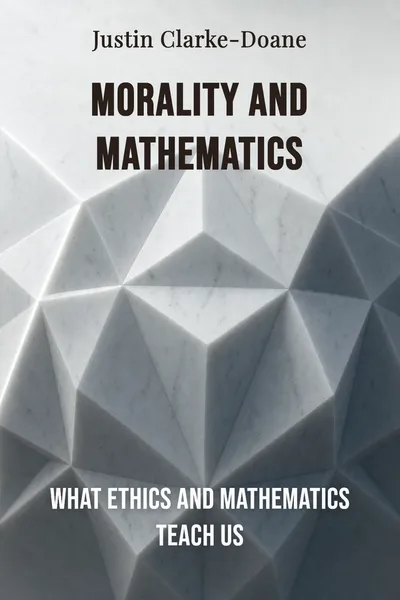
Morality and Mathematics
What ethics and mathematics teach us
Description
Two plus two makes four. Torturing a child for fun is wrong. Most of us would put these in very different drawers — one a cold fact about numbers, the other a warm conviction about how to live. But say them out loud, back to back, and something strange happens. Both feel true in a way that doesn't depend on us. Neither seems like a matter of taste. And if someone denied either, we wouldn't just disagree with them — we'd suspect they'd missed something. In his 2018 book Morality and Mathematics, the philosopher Justin Clarke-Doane takes that odd resemblance seriously, and follows it much further than it seems willing to go.
The move is deliberately provocative. Mathematics is the field we hold up as the model of objective knowledge — proofs, certainty, no room for opinion. Ethics is the field we're forever anxious about, the one people call subjective, cultural, up for grabs. Clarke-Doane's wager is that the two are far more alike than either camp would like. They face the same puzzles about disagreement, the same puzzles about how we could ever come to know their subject matter, the same puzzles about whether their objects are real at all. And if the puzzles are the same, the confident hierarchy between them starts to wobble.
What he does with that parallel is where the book earns its reputation as a hard, close piece of analytic philosophy. He isn't trying to reassure anyone. He's trying to see what actually follows — and the conclusion he lands on is stranger, and more unsettling, than a simple defense of moral truth.
The question we’re asking : If mathematics and ethics really face the same puzzles about truth and knowledge, does that rescue morality — or does it quietly undermine what we wanted from objectivity in the first place?What we’ll see : How a philosopher pushes the resemblance between numbers and values until it forces a rethink of what calling something 'real' is even worth.
Table of contents
01Chapter 1 — The parallel nobody wanted to draw
The starting intuition is easy to feel. Mathematical claims and moral claims share a texture. They present themselves as true or false, not as expressions of feeling. They don't seem to be about anyone's mind — that seven is prime, that cruelty is wrong, look like facts we discover rather than facts we make. And in both cases, the things they're apparently about are peculiar. Numbers aren't sitting anywhere. You can't bump into the wrongness of an act the way you bump into a table. Both domains, in other words, traffic in something abstract, something that doesn't push back on the senses.
Philosophers have a name for taking these appearances at face value: realism. The mathematical realist says numbers and sets exist independently of us, and mathematical claims are true because they get those objects right. The moral realist says the same about values — that there are moral facts holding whether or not we notice them, whether or not our culture approves. Clarke-Doane's book is built on lining up these two realisms and asking whether the arguments for and against them run in parallel. They do, more than expected. The considerations that tempt us toward realism about numbers tempt us toward realism about morals, and the considerations that make us nervous do the same on both sides.

02Chapter 2 — When agreement stops meaning truth
The obvious objection arrives fast. Surely mathematics and ethics differ in one glaring way: mathematicians agree, moralists don't. Walk into any university on earth and the calculus is the same. Walk into any two cultures and the ethics diverge. Disagreement, the thought goes, is what marks ethics as merely subjective and mathematics as objectively true. Clarke-Doane spends real effort taking this apart, because it's the intuition doing most of the quiet work in our confidence.
His response is careful rather than dismissive. First, moral agreement is more widespread than the loud disagreements suggest — that gratuitous cruelty is bad, that fairness counts for something, runs remarkably deep across cultures, and what we argue about is usually the application, not the principle. Second, and more importantly, agreement doesn't track truth in the way the objection assumes. People converge for all sorts of reasons that have nothing to do with getting things right: shared training, shared evolutionary pressures, the sheer usefulness of counting the same way. Mathematicians agree partly because the discipline is built to weed out anyone who won't. Convergence can be manufactured by a practice without that convergence certifying that the practice latches onto anything real.
03Chapter 3 — The knowing problem, doubled
If the objects are real but abstract, a harder question follows: how could we ever know anything about them? This is the puzzle that has haunted mathematical realism for decades, sharpened by the philosopher Paul Benacerraf in the early 1970s. Numbers, if they exist, are causally inert — they don't emit anything, don't interact with our brains, don't leave fingerprints on our beliefs. So how did our mathematical beliefs come to be reliably true about them? It can't be that the numbers caused us to believe rightly, because numbers cause nothing at all. The reliability looks like a miracle, and miracles are exactly what philosophy is meant to explain away.
Clarke-Doane's contribution is to show this challenge transfers, almost word for word, to ethics. Moral facts, if they exist, are just as causally inert. Whatever explains why we believe cruelty is wrong — our evolutionary history, our upbringing, our capacity for empathy — that explanation never mentions the moral facts themselves. Our moral convictions would presumably have come out the same whether or not there were any moral facts backing them, because the facts do no causal work in producing the convictions. This is the reliability challenge, and it bites the moral realist exactly as hard as it bites the mathematical one.
04Chapter 4 — Objectivity was never the prize
Step back from the machinery, and Clarke-Doane's book is pushing toward a conclusion most defenders of moral truth would find deflating. Suppose he's right that ethics is as objective as mathematics — that there are moral facts, mind-independent, real in whatever sense numbers are real. We'd expect this to be the metaethicist's dream, the vindication of morality against the relativists. It isn't. Because even a fully objective ethics, he argues, would leave us exactly where we started when we ask how to live.
The reason is subtle and worth sitting with. There isn't one moral reality; there are countless internally consistent ethical systems, each true of its own subject matter, much as there are countless consistent geometries or set theories. Discovering that some values are real doesn't tell us which values to care about, any more than discovering that non-Euclidean geometry is coherent tells us which geometry describes our lives. The realist has secured truth and lost the thing we actually wanted — guidance. Objectivity turns out to be almost beside the point. The practical question, what should I do, survives untouched by the metaphysical answer.
05Conclusion
We began with two sentences that sounded equally true: two plus two makes four, cruelty for fun is wrong. Clarke-Doane's book takes that shared ring of truth and refuses to let it be comforting. Trace the resemblance honestly and it doesn't crown ethics with the dignity of mathematics; it drags both into the same difficult light. The disagreement that seemed to separate them was never a clean test. The mystery of how we know abstract things haunts them equally. And the objectivity we hoped would settle everything settles remarkably little.
Related books