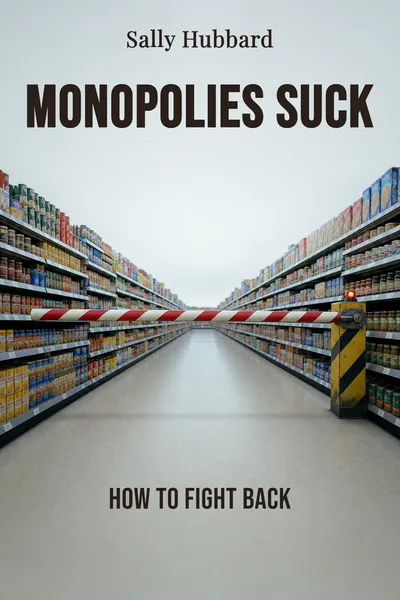
Monopolies Suck
How to fight back
Description
Sally Hubbard spent years as an enforcement attorney at the New York Attorney General's office, chasing companies that had grown large enough to bend markets to their liking. She later became an investigator of Big Tech and a widely quoted voice on competition. So when she published Monopolies Suck in 2020, it wasn't the complaint of someone standing outside the machine. It was the argument of someone who had been inside it, watched how the levers worked, and concluded that most of us have no idea how much of our daily lives is quietly organized by a handful of enormous firms.
Her subtitle promises seven ways to fight back, and that framing matters. Most books about monopoly power read like autopsies — here is how competition died, here is who killed it, the end. Hubbard writes the opposite kind of book. She wants to show that the concentration around us is not weather, not something that simply happened, but the result of choices — legal, political, deliberate — and that choices can be unmade. The tone is closer to a friend grabbing your arm than a lecture: this affects your paycheck, your groceries, your news, your kids, and here is what it would take to change it.
The book arrived at a moment when the mood was shifting. For decades, saying a company was too big drew a shrug. Bigness meant efficiency, and cheaper stuff, and who could argue with cheaper stuff. Hubbard's wager is that the shrug was a mistake — that we were sold a narrow story about what competition is for, and that the price of believing it shows up in places we rarely connect back to the source.
The question we’re asking : What is monopoly power actually costing us — not in the abstract, but in the ordinary transactions of a life — and can regular people do anything about it?What we’ll see : How a handful of firms came to sit between us and almost everything, why the rules stopped stopping them, and what it would take to push back.
Table of contents
01Chapter 1 — The tollbooths we don't see
Hubbard's opening move is to make the invisible visible. Walk through an ordinary day, she suggests, and count the moments where a dominant company stands between you and what you want. The phone in your hand runs on one of two operating systems. The searches you make go through one search engine. The things you buy online often pass through one marketplace. The book you're reading may reach you through the same company that ships your dog food. None of this feels like monopoly, because it feels like convenience. That, she argues, is precisely the trick.
The word she keeps circling is gatekeeper. A gatekeeper is a firm that controls a chokepoint — a place everyone has to pass through — and can therefore set the terms for everyone else. A small business that wants customers has to be findable on the search engine and sellable on the marketplace, which means it plays by rules it did not write and cannot negotiate. The gatekeeper can raise its fees, copy the seller's best product, or bury it in results, and the seller has nowhere else to go. That is not a market competing. That is a tollbooth collecting.

02Chapter 2 — Seven ways the giants reach into a life
The heart of the book is Hubbard's insistence that this is not one problem but many, threaded together. She organizes the harm around the ways concentrated power actually touches people, and the range is wider than the usual story about tech. Yes, the platforms are central — she was, after all, a Big Tech investigator — but she keeps pulling the lens back to industries most readers never think of as monopolized.
Consider health. A wave of hospital mergers has left many American regions with one dominant system, and the research she cites is blunt: consolidation tends to raise prices without improving care. The same pattern runs through pharmaceuticals, where a company can extend a drug's monopoly through legal maneuvering and keep cheaper generics off the shelf. Consider food. A handful of firms control the seed, the meatpacking, the grocery aisle — which squeezes farmers on one end and shoppers on the other, while the middle keeps the difference.
03Chapter 3 — The law forgot what it was for
To explain how it got this bad, Hubbard turns to history — and her account is more accusatory than nostalgic. America built strong antitrust tools more than a century ago, in the era of the railroad barons and Standard Oil, precisely because people understood concentrated economic power as a threat to self-government. The Sherman Act of 1890 and the laws that followed weren't written by economists. They were written by a public that had watched a few men gain the power to dictate terms to the whole country and decided that was incompatible with a republic.
Then, she argues, the meaning of those laws was quietly hollowed out. Starting in the 1970s, a school of thought associated with Robert Bork and the University of Chicago reframed the entire purpose of antitrust around a single question: does this practice raise prices for consumers in the short term? If a merger or a tactic could be shown to keep prices low or steady, it was presumed fine — no matter how much power it concentrated, no matter what it did to workers, suppliers, or would-be competitors. The consumer-welfare standard, as it came to be called, became the lens through which courts saw everything.
04Chapter 4 — Power is the point, not just price
Step back from the specific harms and Hubbard's larger claim comes into focus: monopoly is not fundamentally a pricing problem. It is a power problem. This is the argument that ties her book to the tradition she keeps invoking — the idea that antitrust was never a technical specialty for economists in windowless rooms, but a democratic tool, meant to keep private power from growing large enough to overwhelm public will. The narrowing of the law into a price calculator, in her reading, wasn't just a policy error. It was a category mistake about what the whole project was for.
This is why she resists treating the issue as inevitable or too complicated for ordinary people. The word she reclaims is antimonopoly — a citizen's word, not a lawyer's — and she places today's fights in a long American lineage of people who refused to accept that a handful of firms should set the terms of everyone else's life. When a company can shape what news you see, what a farmer earns, whether a rival ever gets built, it is exercising a kind of governance without a vote attached. That, more than any single overcharge, is what she wants readers to find unacceptable.
05Conclusion
Hubbard ends roughly where she began — with the ordinary day, the phone, the search, the grocery cart — but the walk feels different once you can see the corridors. What looked like a series of conveniences reveals itself as a structure with owners, and the owners have been collecting quietly for a long time. The book's wit and urgency serve a single purpose: to convert the shrug into attention, and attention into the sense that this is a fight with stakes, not a debate for specialists.
Related books