
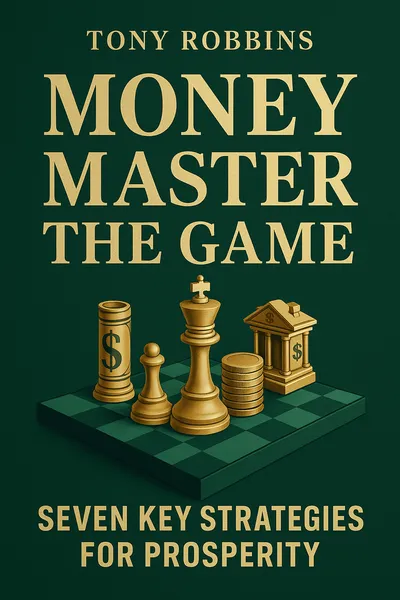
Money master the game
Seven key strategies for prosperity
Description
To achieve financial freedom, you must build your own "Money Machine" - a portfolio of investments that generates enough passive income to fund your ideal lifestyle.
This is accomplished by following seven simple, proven steps distilled from strategies used by the world's most financially successful people.
With the right mindset, knowledge, and discipline to adhere to these methods, you can master the game of money. You will no longer be at the mercy of financial forces beyond your control, but rather position yourself to benefit from them.
By implementing the timeless wisdom and principles outlined in these seven steps, you and your family can attain lasting prosperity and financial independence.
The path to wealth has been mapped out for you. Now is the time to step up, take control of your financial destiny, and start playing the game to win.
You have the power to become the chess player, not just another chess piece moved around by external circumstances. Begin your journey today.
Table of contents
01 Choose to invest, not spend
Achieving financial freedom is less about earning more than you spend and more about smart saving and investing. The allure of endless desirable purchases can deplete any income, leading even top earners to bankruptcy due to a lack of savings. The key to financial security is to become an investor, not just a consumer, and to harness the power of compound interest. Tony Robbins emphasizes the transformative potential of money, urging individuals to master it rather than be controlled by it. By creating income-generating assets, you establish a "money machine" that works for you, providing a lifetime income stream and freedom.
The decision to act, as Amelia Earhart pointed out, is the most challenging step, followed by the tenacity to see it through. Ogden Nash's witty observation highlights the paradox of work and the necessity to earn enough to gain the freedom not to work. Tony Robbins suggests reframing savings as a "Freedom Fund," advocating for a fixed percentage of income to be saved and invested each pay period. The exact percentage—be it 10%, 15%, or 20%—is a personal choice.

02 Learn basic investment principles
Achieving financial freedom is a journey fraught with misconceptions that can hinder progress. It's essential to distinguish between the accumulation phase, where you save and invest, and the de-cumulation phase, where you withdraw income in retirement.
Here are nine financial myths debunked to guide you on the path to financial independence:
1. Mutual fund managers often fail to outperform the market. Data indicates that a significant majority of actively managed mutual funds do not beat broad market indexes over extended periods. Instead of seeking out 'winning' funds, it's more effective to invest in low-cost index funds that track the market as a whole.
2. High mutual fund fees are not a trivial expense. The average mutual fund fee is substantially higher than that of index funds, which can drastically diminish long-term investment returns due to the compounding effect of these costs.
3. Advertised investment returns are not always what they seem. Wall Street is adept at presenting mutual funds in the most favorable light, but the returns advertised often exceed the actual results that investors experience, due to various factors like fees and the timing of investments.
03 Assess your financial status
Establishing practical financial goals is essential but often overlooked. Many people fail to define the financial means needed for independence or freedom. There isn't a single number that dictates this; instead, there are five levels of financial freedom:
Financial Security involves owning a home outright, covering lifelong utility bills, ensuring food for the family, basic transportation, and insurance. Financial Vitality goes a step further, allowing for desired clothing, better dining and entertainment, minor luxuries, and other discretionary spending. Financial Independence is reached when investment income is enough to live without needing to work, freeing one to engage in preferred activities. Financial Freedom is achieved when investments yield enough income to support a chosen lifestyle and major luxuries, such as significant donations, expensive toys like boats, cars, planes, and additional homes. Absolute Financial Freedom is the pinnacle, where one can afford anything they desire without limitations, enabling them and their family to realize dreams and make a positive global impact.
04 Decide on investment allocation
Asset allocation is a crucial strategy for investors, involving the division of investments among various asset classes such as stocks, bonds, and cash or money market securities. This approach is designed to minimize risk and potentially increase returns by balancing the portfolio according to one's financial goals, risk tolerance, and investment horizon. There is no one-size-fits-all formula for asset allocation; it varies from person to person based on individual circumstances and changes over time.
Investors are advised to consider their age when determining asset allocation, with a common recommendation being to invest a percentage equivalent to one's age in less risky assets like bonds, and the remainder in growth-oriented assets like stocks. For example, at age 40, one might allocate 40% to safer investments and 60% to riskier ones. This allocation should be reviewed and adjusted periodically to ensure it continues to meet the investor's needs.
05 Create a lifetime income plan
Investing wisely is crucial for achieving financial stability and growth. The All Seasons portfolio, created by Ray Dalio, is a prime example of a strategy designed to maximize returns while minimizing risks. This portfolio, which has generated nearly 10% annual returns from 1974 to 2013 with low volatility, is composed of 30% stocks, 15% intermediate-term Treasury bonds, 40% long-term Treasury bonds, 7.5% gold, and 7.5% commodities. Its diversified nature allows it to perform well in various economic conditions, providing both growth and stability.
Annuities are another tool for investors, particularly for retirement planning. Fixed indexed annuities offer a combination of a fixed interest rate and returns linked to a market index, with the principal being protected from market downturns. They come with benefits such as no annual fees, principal protection, flexible income options, and tax-deferred growth. Private placement life insurance (PPLI) is an option for those seeking tax-efficient growth. PPLI policies offer tax-deferred growth and tax-free access to gains, along with estate planning and asset protection benefits. While PPLI requires a significant investment and typically the guidance of an experienced insurance advisor, the tax savings can be substantial enough to justify the effort.
06 Begin investing with proven strategies
Successful investors are distinguished by their consistent habits, which have been instrumental in accumulating significant wealth over time. Although their investment strategies may vary, they share a common focus on maximizing returns while minimizing the risk of losses. They look for opportunities that offer the potential for substantial gains relative to the capital at risk. Despite their achievements, these top investors maintain a mindset geared towards continuous learning, diversify their investments across different assets and strategies, and strive to contribute positively to society.
One of the key principles they follow is concentrating on asymmetric risk-reward. They target investments that have the potential to yield returns of five times or more for every unit of risk taken. While seeking higher rewards does entail greater risk, the objective is to capture the upside while safeguarding the downside through thorough research, careful portfolio construction, and effective risk management.
07 Embrace the future by starting now
Financial freedom is the ability to live life on your own terms, free from financial constraints and worries. While money alone does not guarantee happiness or fulfillment, financial security provides the freedom to pursue your passions and leave a lasting legacy.
As we look ahead to a future of exciting new technologies and abundance, financial independence plays a crucial role in enabling you to live a rich, meaningful life and positively impact others. It's about taking control of your financial life to have real choices. This involves honestly assessing your current financial situation, setting S.M.A.R.T. goals, developing a plan to pay off debt, build savings, invest wisely, and generate multiple streams of income. Living within your means is essential, but so is not depriving yourself. Mastering personal finances requires discipline but offers peace of mind and options.
Related books