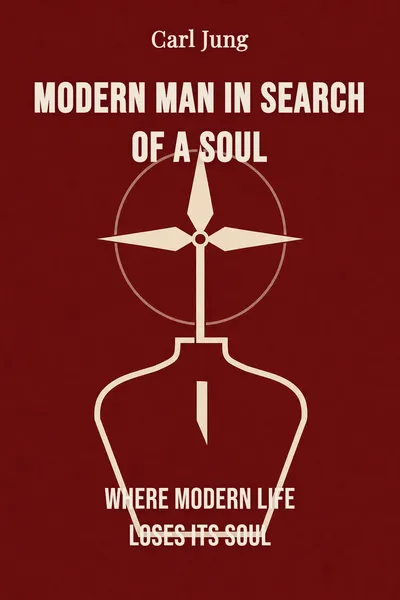
Modern Man In Search of a Soul
Where modern life loses its soul
Description
In the consulting rooms of Zurich in the 1920s, a middle-aged psychiatrist kept meeting a patient who did not fit the textbooks. This person was not neurotic in the old sense — no phobia, no hysteria, no obvious wound from childhood. They held a job, kept a marriage, functioned. And yet they arrived saying, in one form or another, that their life had gone flat, that nothing meant anything, that they were carrying an emptiness they could not name. Carl Jung, who by then had broken with Freud and built his own school of analytical psychology, began to notice how many of these people were showing up. Roughly a third of his cases, he estimated, suffered from no clinical illness at all — only from the senselessness of their lives.
Out of those encounters came a collection of essays published in English in 1933 as Modern Man in Search of a Soul. The book gathers Jung's thinking on dreams, on the difference between his method and Freud's, on the aims of psychotherapy, and on what he called the spiritual problem of modern man. It is not a system. It reads more like a seasoned physician stepping back from the clinic to ask a larger question about the age itself. Why, in a century of extraordinary progress, were so many capable people quietly starving?
Jung's answer was uncomfortable, and it still is. He thought modern civilization had solved almost everything except the one thing that had once given a person somewhere to stand. The essays circle that vacancy from several directions — through the dream, through the doctor's chair, through the wreckage of old certainties. What they describe is less a diagnosis than a condition we may recognize better now than his first readers did.
The question we’re asking : Why did Jung think so many outwardly healthy modern people came to him with an emptiness no illness could explain?What we’ll see : How a psychiatrist reading dreams in Zurich came to see spiritual hunger as the hidden disease of the modern age.
Table of contents
01 Chapter 1 — The patient who is not sick
The starting observation of the book is deceptively plain. Among the people who came to Jung, a large share could not point to any real neurosis. They were not paralyzed by fear or driven by compulsion. They had, by every measurable standard, arrived. And that was precisely the trouble — having arrived, they found nothing waiting. Jung described it as the general neurosis of the age, a suffering that had no name in the clinical manuals because it was not, strictly speaking, an illness at all.
What struck him was who these patients were. They tended to be adults in the second half of life, often successful, frequently in their forties or beyond. The younger patient, Jung noticed, usually came with a concrete problem to solve — a fear to conquer, a relationship to untangle, a place in the world to secure. The older patient came with something harder to hand over: the sense that the whole thing had been for nothing. The goals had been reached and had turned out to be empty vessels.

02 Chapter 2 — The dream as a message, not a symptom
To reach that hidden emptiness, Jung worked mostly through dreams, and here the book stakes out its sharpest disagreement. For Freud, the dream was a disguise — a coded concealment of a wish, usually shameful, that the mind could not face directly. Reading a dream meant decoding it backward to the repressed material it was hiding. Jung came to think this was too narrow, even a little cynical about the psyche. The dream, he argued, was not primarily hiding something. It was saying something.
He treated the dream as a natural product of the unconscious, no more deceptive than a plant is deceptive. It spoke in images because images were its native language, not because it was ashamed. And its function was compensatory: the dream tended to supply what the waking attitude lacked, to correct a one-sidedness the dreamer could not see. A person too certain of their own reasonableness might dream of chaos; a person who had abandoned some part of themselves might meet it, disguised, in the night.
03 Chapter 3 — The doctor who cannot stay neutral
From dreams the book turns to the practice of therapy itself, and Jung is unusually candid about how strange his profession is. Psychotherapy, he insists, is not a technique one applies to a patient the way a surgeon applies a scalpel. It is an encounter between two people, and both are changed by it. The doctor cannot hide behind method. Whatever they truly are enters the room and works on the patient as surely as any interpretation.
He mapped the process in rough stages — confession, elucidation, education, and finally what he called transformation — while warning against treating them as a fixed staircase. The point was that different patients needed different things, and different schools of psychology were each right for the cases that suited them. Jung was notably generous here toward Freud and toward Adler, whose emphasis on power and inferiority he thought illuminated a whole class of patients his own approach did not. No single theory owned the human soul.
04 Chapter 4 — The West that outgrew its own answers
Widen the lens from the single patient, and Jung's argument becomes a claim about a whole civilization. The West, he thought, had performed an extraordinary feat: it had turned its attention almost entirely outward, mastering matter, multiplying machines, extending its reach across the earth. And in doing so it had let the inner world atrophy. The great religious symbols that had once organized the interior life had lost their grip — not because people decided to abandon them, but because they no longer felt true. The forms remained; the current had gone out of them.
Jung did not respond with a call to march back into old belief. He thought that impossible; you cannot will yourself to believe what you no longer believe. But he also refused the confident modern assumption that the loss was pure gain, that reason had simply cleared away superstition and left us better off. Something real had been carried by those old symbols — a way of housing the parts of the psyche that reason cannot reach — and when the housing collapsed, those parts did not vanish. They went underground and returned in other forms: in restlessness, in the hunger for exotic wisdoms, and, he warned with unsettling foresight in the interwar years, in the mass movements that offered to fill the vacancy with a collective faith.
05 Conclusion
The patients who first walked into that Zurich office believing nothing was wrong with them turned out, in Jung's reading, to be the truest witnesses of their century. They had reached the ends of every road the age offered and found the destinations empty, and their bafflement was not weakness but a kind of honesty. Modern Man in Search of a Soul gathers the evidence of those encounters and refuses the easy consolations — neither prescribing a return to old faith nor pretending the loss of it costs nothing.
Related books