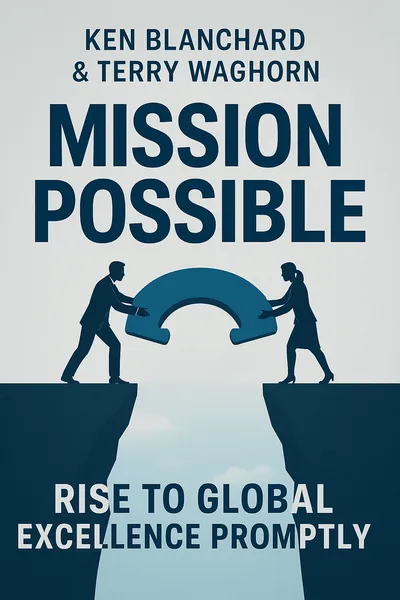
Mission possible
Rise to global excellence promptly
Description
The success of any organization hinges on its ability to simultaneously focus on enhancing quality, profits, and customer service in the short term, while also pioneering the innovations that will underpin its future. These two critical processes, though requiring distinct skill sets, generate significant synergy when pursued together. Organizations that effectively navigate and leverage this synergy can outpace their competitors and achieve unparalleled excellence.
Achieving world-class status in any field is challenging yet attainable, demanding leaders to foster an environment where individuals thrive by balancing immediate operations with visionary future planning. This approach emphasizes the importance of people and their interactions over products and technologies.
Table of contents
01 Traits of top organizations
In today's rapidly evolving business landscape, organizations face the dual challenge of refining their current operations while simultaneously pioneering future innovations. This delicate balance between continuity and innovation is crucial for any organization aspiring to achieve world-class status. The concept of operating on two interconnected S-curves offers a strategic framework for managing this balance effectively. The first curve represents the organization's current products and technologies, focusing on incremental improvements to enhance efficiency and profitability. Meanwhile, the second curve is about exploring new market strategies and business models, laying the groundwork for future success.
To navigate these curves successfully, world-class organizations deploy two specialized teams. Team 1 concentrates on present improvements, ensuring the organization's current offerings remain competitive and profitable. This involves evolutionary enhancements that refine and optimize existing products and technologies. On the other hand, Team 2 is tasked with future innovations, embracing a more revolutionary approach to rethinking the organization's line of business. This team's focus is on identifying and developing groundbreaking products and technologies that can open up new competitive arenas.

02 Initial stage enhancements
Enhancing a business to better serve its customers involves a strategic approach that can be broken down into three key initiatives. The first step is to have a clear vision and the ability to articulate the necessary changes within the organization. This means understanding that organizations exist primarily to fulfill a specific need, and they should focus on this need rather than on products or services that may become obsolete. Organizations define themselves through their core goals, values, strategy, business processes, structure, systems, people and skills, and corporate culture.
Once the organization has a clear understanding of its current state and the changes needed, the next step is to identify the most efficient path to achieve the desired state within a realistic timeframe, such as the next 18 months. This often involves learning from other successful organizations and emulating their key characteristics, which include having customers who are enthusiastic advocates, committed and empowered employees, financial success, organizational integrity, and a culture of continuous improvement. Identifying gaps between the current state and the vision allows for setting priorities and developing a focused plan of action. Employees should be involved in the improvement programs, ensuring a structured approach to change.
03 Advanced stage innovations
In the rapidly evolving business landscape, organizations are increasingly recognizing the importance of second-curve innovations to drive industry leadership and ensure long-term success. These innovations are not just about reacting to current market demands but about anticipating future needs in the face of technological advancements and shifting consumer behaviors. To effectively navigate this journey, companies must establish a solid foundation built on a clear vision, strategic planning, and a compelling value proposition.
A vision for the future is crucial for organizations aiming to out-think and out-perform their competitors. This vision involves not only understanding the current market dynamics but also predicting how these might change. Organizations can employ scenario planning to systematically explore potential futures and prepare for them. This approach involves creating detailed scenarios within defined boundaries, considering long-term trends, and gradually refining these scenarios to make informed decisions. Alongside scenario planning, intuitive thinking plays a vital role, allowing leaders to incorporate non-rational factors and their "sixth sense" into strategic planning. This combination of analytical and intuitive approaches enables organizations to develop a robust vision for the future.
04 Assembling superior teams
World-class organizations understand that the most innovative ideas emerge from a blend of contributions made by teams focused on improvement (First-Curve) and innovation (Second-Curve). The interaction between individuals with significantly different temperaments and perspectives can generate a substantial amount of synergy. Harnessing this synergy effectively is a hallmark of world-class organizations. Familiarity with the distinctions between left-brain and right-brain thinking is common in the business world. Left-brain thinkers are logical and rational, preferring to analyze thoroughly before taking action, while right-brain thinkers are intuitive and creative, acting on a sense of what feels right before considering the pros and cons.
In such organizations, individuals serve in four distinct roles, with two roles aligned with First-Curve activities that emphasize improvement and two roles aligned with Second-Curve skill sets that focus on innovation. The challenge for any organization aspiring to world-class status lies in leveraging the left-brain/right-brain strengths of its people and aligning their natural functional preferences with the appropriate areas of responsibility. This alignment is crucial for placing the right people in the right roles at various stages of the organization’s life cycle. For instance, entrepreneurial and marketing roles are emphasized in the early stages, while managerial roles become more prominent as the organization matures. To maintain world-class status over the long term, a balanced presence of all four roles is essential.
05 Executing dual curve strategies
World-class organizations distinguish themselves by their readiness and enthusiasm for change, which they achieve through several key practices. These include constantly seeking ways to enhance their group culture and integrating humor appropriately to foster a creative and enjoyable work environment. They prioritize building the self-esteem of their employees, listening to them attentively, recognizing their achievements, and promoting continuous personal development. This focus on people is crucial because they are the ones who can drive the organization forward, shaping its present and future.
When facing change, employees typically have concerns such as the need for information about the change, understanding its personal impact, what will be required for implementation, assessing the benefits versus the challenges, identifying who else is involved, and being open to refinements. Addressing these concerns effectively is vital for facilitating the change process. Leaders can play a significant role in this by fostering a culture that values continuous improvement, humor, self-esteem, attentive listening, recognition, and personal growth.
A culture that constantly seeks improvement is essential for organizations aiming to be world-class. This involves creating an environment where uncertainty is embraced, collaboration is encouraged, and excellence is pursued. Recognizing and praising employees for their achievements can motivate them to perform beyond expectations. Similarly, incorporating humor can lighten the atmosphere, stimulate creativity, and enhance productivity. Leaders with high self-esteem tend to be less anxious and more creative, setting a positive example for their employees. By choosing to focus on the positive, they can foster a workplace filled with confident and motivated individuals.
Related books