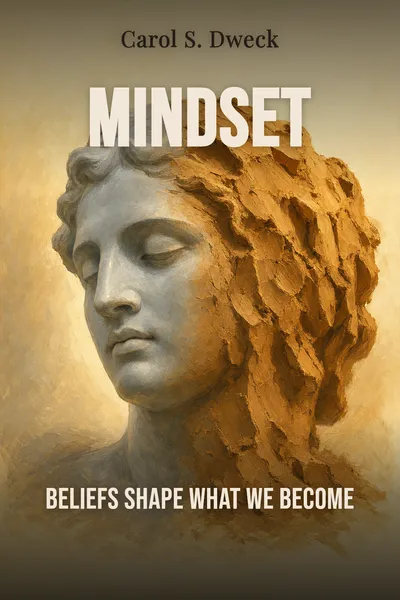
Mindset
Beliefs shape what we become
Description
In the late 1970s, a young psychologist named Carol Dweck was watching schoolchildren do puzzles, and one detail kept snagging her attention. She would hand a child a problem just beyond their reach, watch them fail, and then watch what happened next. Most of what she expected to see, she saw: frustration, a slumped shoulder, a quiet giving-up. But a handful of kids did something stranger. They rubbed their hands together, pulled the next puzzle closer, and said things like "I love a challenge." One boy looked up at the hard problem and announced, with apparent delight, that he was hoping it would be informative. Dweck had assumed children either coped with failure or didn't. These kids weren't coping. They were enjoying it.
That gap became the work of a career. Over decades at Columbia and then Stanford, Dweck and her collaborators kept circling the same question: why do two people of roughly equal ability respond to the same setback in opposite ways? The answer she arrived at wasn't about talent, or grit, or temperament exactly. It was about a belief — a quiet, often unspoken theory each of us carries about where ability comes from and whether it can change. In her 2006 book Mindset, she gave that belief a name and traced it through classrooms, marriages, boardrooms, and locker rooms.
The claim is deceptively small. Some people believe their qualities are carved in stone; others believe they can be cultivated. From that single fork, Dweck argues, two very different ways of moving through the world unfold — different relationships to effort, to criticism, to other people's success, to the word "failure" itself.
The question we’re asking : Why do two people with the same ability respond to the same setback in opposite ways — and what does the answer change about how we raise, teach, and manage each other?What we’ll see : How a single belief about where ability comes from quietly organizes the way people handle effort, failure, and the success of others.
Table of contents
01 Chapter 1 — Two ways to read a low grade
Picture a college student who gets a C+ on a midterm in a class they care about, and on the same afternoon gets a parking ticket on the windshield of the car they love. In Dweck's telling, one kind of student goes home and says the day is ruined, that they're hopeless, that maybe they don't belong in this field at all. Another student is annoyed, pays the ticket, decides to talk to the professor and study differently next time. Same C+, same ticket. The difference is not in what happened but in what the grade was taken to mean.
For the first student, the C+ is a verdict. Ability is a fixed quantity you either have or don't, and the test just measured how much you got. A bad result isn't information about your studying; it's information about you. Dweck calls this the fixed mindset, and its logic is airtight in the worst way: if your intelligence is set, then every challenge becomes a referendum on it, and the safest move is to avoid anything you might fail.

02 Chapter 2 — Where the belief comes from
A reasonable objection arrives quickly: surely this is just optimism with a new label, or surely some people really are more gifted than others. Dweck doesn't deny that people start with different aptitudes. Her point is narrower and more durable — that a belief about whether ability can grow changes how far any starting point can travel. The two mindsets aren't claims about how talented you are. They're claims about what talent is.
The roots of the research go back to a phenomenon Dweck studied early on called learned helplessness, the way some children, after repeated failure, simply stop trying even when success becomes available again. What puzzled her was that other children, facing identical failure, stayed engaged and even energized. The helpless ones, it turned out, read failure as a permanent statement about themselves. The resilient ones read it as a temporary statement about their approach. Same setback, two theories of what it meant.
03 Chapter 3 — The trap of being a natural
The most counterintuitive part of Dweck's argument is that the fixed mindset hurts the talented most of all. We tend to assume confidence and ability travel together, that the gifted are insulated from the fears that haunt everyone else. Her research keeps finding the opposite. The person told all their life that they're a natural has the most to lose the moment something gets hard, because being a natural is precisely the thing a struggle threatens.
She draws the contrast vividly in sport. John McEnroe, by his own later admission, treated talent as a thing he possessed rather than a thing he built; when matches slipped, the explanations were always external, and the work of relentless improvement felt beneath someone of his gifts. Set against that is the example of an athlete like Michael Jordan, famously cut from his high school varsity team, who built a legend largely out of obsessive practice and a hunger for the very weaknesses other stars preferred to hide. The talent was real. The mindset decided what was done with it.
04 Chapter 4 — Praise, and the thing it teaches
If mindsets can be taught, the obvious question is how we teach them — and Dweck's answer lands on something almost no one suspects of doing damage: praise. In a series of studies with hundreds of children, she and her colleagues had kids do a set of problems and then praised them in one of two ways. Some were told they were smart. Others were told they had worked hard. The wording differed by a single phrase. The consequences did not.
The children praised for being smart became cautious. Offered a choice between an easy task and a challenging one, they picked easy — because a hard task risked exposing that they weren't so smart after all. When later problems got difficult, their performance dropped and their enjoyment evaporated. Some even lied about their scores. The children praised for effort did the reverse: they chose the harder problems, stayed in the game when it got tough, and described the struggle as the part they liked. Telling a child she is smart, it turns out, teaches her that smart is a fixed thing she must now protect.
05 Conclusion
Decades after watching those children rub their hands together at the sight of a hard puzzle, Dweck had turned a small observation into a long argument about human potential. The puzzle hadn't changed between the child who loved it and the child who folded; the only difference was a belief about what failing at it would say. That belief, she showed, follows people out of the classroom and into their work, their relationships, their reading of every setback and every rival's win.
Related books