Million Dollar Consulting
Building a thriving consulting practice
Description
In 1985, an executive named Alan Weiss walked out of a firm that had just let him go and set up on his own with, by his own account, very little idea of how to find clients or what to charge them. He knew how to solve problems inside companies — he had spent years doing it — but the business of being paid to solve them, on his own terms, was a different thing entirely. What he built over the following decade became the material for a book, first published in 1992 and revised across several editions since, that has sold itself as a manual for anyone trying to turn expertise into a living without a payroll behind them.
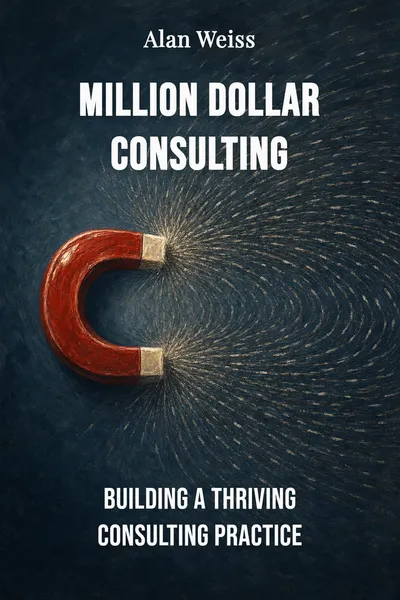
The book is called Million Dollar Consulting, and its promise is right there in the title, though the number matters less than the posture behind it. Weiss's argument is that most independent consultants fail not because they lack skill but because they price and market themselves like hired help — trading hours for money, chasing the next gig, competing on cost. The people who thrive, he says, do something structurally different. They sell the result a client wants, not the time it takes to produce it, and they build a practice that pulls clients toward them rather than one that runs after them.
That reframing sounds simple, and Weiss insists it mostly is. But it cuts against nearly every instinct a newly independent expert brings to the table — the instinct to be helpful, to be available, to justify the fee by the effort. Following it means rethinking not just the invoice but the whole relationship between what you know and what it's worth.
The question we’re asking : How does an independent expert turn what they know into a practice that pays well and lasts, instead of a treadmill of billable hours?What we’ll see : How Weiss reverse-engineers the economics, the marketing and the mindset of a consultant who charges for outcomes rather than time.
Table of contents
01Chapter 1 — Selling the improvement, not the hours
The engine of the whole book is a single move, and Weiss returns to it from every angle: a consultant should be paid for the value they create, not for the labor they expend. A client doesn't actually want twenty days of your presence. They want a problem gone, a team functioning, a launch that lands. The days are your cost, not their benefit — so pricing off the days, Weiss argues, is a category error that quietly caps your income and misaligns you with the client the moment you sign.
Value-based fees, in his framing, start from a different question. Not "how long will this take me" but "what is it worth to this organization to have this fixed." If a productivity problem is bleeding a company hundreds of thousands a year, a project that ends it is worth a serious fraction of that recovery — and a fee anchored to the improvement can be large while still being an obvious bargain for the buyer. Weiss is blunt that this requires diagnosing the real stakes before proposing anything, which means slowing down at the front end instead of rushing to a quote.

02Chapter 2 — The problem with the day rate
To see why Weiss is so insistent, it helps to sit with what the day rate actually does. On its face it feels fair and defensible: you worked, you charged, everyone can see the math. That transparency is exactly the trap. Once a fee is a rate times a quantity, the client's rational move is to shrink the quantity — fewer days, faster delivery, tighter scope — and the consultant's incentive quietly inverts. Efficiency, the thing you're supposedly selling, now costs you money. Solve the problem in three days instead of ten and you've just cut your own pay by seventy percent.
Weiss points out that the day rate also caps a solo practitioner in a way no amount of talent escapes. There are only so many days, and raising the rate has a ceiling before buyers balk at a number that, however earned, reads as absurd for a single day's presence. The billable-hours model is built for firms that leverage juniors; imported into a one-person practice it becomes a ladder with the top rungs sawn off. You can be excellent and still stall.
03Chapter 3 — Marketing as gravity, not chase
Pricing is half the book; the other half is how clients arrive in the first place. Weiss is dismissive of the cold-call, chase-the-lead hustle that many new consultants default to, not on principle but on economics — it's exhausting, it signals need, and need is the worst thing a high-fee advisor can radiate. His preferred model is gravitational: build enough visible authority that the right buyers come looking, already half-convinced you're the person for the job.
He builds this around what he calls the accumulation of credibility. Writing, speaking, publishing, referrals, a reputation that circulates in the rooms where buyers talk to each other — each one deposits proof that you know what you're doing before any sales conversation begins. Weiss is candid that this is slow at first and compounding later; the consultant who invests early in becoming known spends far less energy selling once the reputation is doing the work. Marketing, in his telling, is less a department than a byproduct of being genuinely visible and genuinely good.
04Chapter 4 — What the business is actually for
Step back from the tactics and Weiss is really making a claim about how expertise gets priced in an economy that runs increasingly on knowledge rather than production. When the thing being sold is judgment — a way of seeing a problem, a fix that took years of pattern-recognition to develop — the industrial habit of pricing by time stops making sense. The hour was a unit for measuring labor you could watch. Insight doesn't submit to a stopwatch, and pretending it does undervalues exactly the thing the client is paying for.
This is why Weiss's model reaches past consulting into any work where the value lives in the result and not the visible effort. A designer, a coach, an independent developer, an advisor of any kind faces the same fork: charge for the time and become a managed cost, or charge for the improvement and become a partner in it. The book's durability across editions comes partly from this — the specific examples date, but the underlying question of how a knowledge worker prices what they know only gets more common as more people work for themselves.
05Conclusion
The consultant who walked out of that firm in the mid-1980s spent the following years converting his own trial and error into a system, and the system's spine never changed across the editions that followed: stop selling hours, start selling the improvement, and build a reputation strong enough that the right buyers come to you. Everything else — the proposals with options, the direct line to the economic buyer, the deliberate asking for referrals — hangs off that one reframing of what a consultant is actually paid for.
Related books