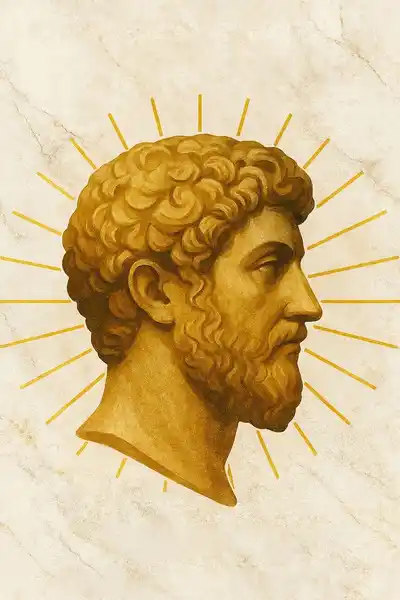
Meditations
Ancient wisdom guides modern quest for inner peace
Description
Somewhere on the northern frontier of the Roman Empire, in the cold and the mud of the Danube campaigns, the most powerful man alive sat down at the end of the day and wrote himself a note. Not a decree, not a letter, not a speech for the Senate. A reminder. Marcus Aurelius, emperor from 161 to 180, was reaching for self-control the way the rest of us reach for it: imperfectly, repeatedly, the same lessons rewritten because they kept slipping away. He never titled the book. He never published it. The Greek he scribbled in roughly translates as "things to oneself."
What survives is strange precisely because it was never meant for us. There is no argument being won, no audience being impressed. He scolds himself for losing his temper. He rehearses, again and again, how to get out of a warm bed in the morning. He talks himself down from grief, from vanity, from the fear of dying. The man at the top of the world spends most of the book reminding himself that almost nothing he commands actually belongs to him. It reads less like philosophy on a podium than like someone steadying his own hands.
That intimacy is why the book never quite goes away. Eighteen centuries later, people who could not name a single Roman law still keep it on the nightstand. It promises something we keep wanting and keep mislaying: a way to stay level when the day refuses to cooperate. The interesting thing is how plain its method turns out to be, and how hard.
The question we’re asking : How does a Roman emperor's private notebook still work as a manual for staying calm in a life he never imagined?What we’ll see : A diary written for an audience of one, the small set of ideas it keeps circling back to, and the reason strangers still reach for it.
Table of contents
01 Chapter 1 — A diary nobody was meant to read
Marcus Aurelius did not set out to write a classic. He set out to govern an empire that was, for most of his reign, on fire — wars on the Danube, a plague that emptied cities, a revolt by a trusted general. The Meditations were written in the gaps, probably during the 170s, in army camps far from Rome. The book we read is twelve short "books," though they are really clusters of jottings with no plan binding them. Thoughts repeat. Some are a single line. The first book is a list of thank-yous to the people who shaped him, which is about as warm as he ever lets himself get.
The lack of polish is the point. Because he was writing to himself, he could be honest in a way performance never allows. He admits he is irritable. He notices he is craving applause and tells himself to stop. He catches himself dreading a difficult colleague and works through it on the page. There is no reader to impress, so there is no posing — and the absence of posing is exactly what makes a stranger trust him. We are, in effect, reading someone's spiritual housekeeping.

02 Chapter 2 — What is mine, and what is not
If the Meditations have one engine, it is a single division Marcus returns to on almost every page: some things are up to us, and most things are not. Our judgments, our intentions, the way we meet what happens — these are ours. Our health, our reputation, other people, the weather, the length of our life — these are not. He inherited the distinction from Epictetus, who put it bluntly, and Marcus spends much of the book applying it to his own days, because he knows it is easy to recite and brutally hard to live.
Almost everything else follows from that one cut. Anger, for Marcus, is what happens when we demand that the uncontrollable behave. A rude man at the door, a delayed plan, an illness — none of these can disturb us directly. What disturbs us is the verdict we add: that this should not be happening, that we are owed otherwise. Take away the verdict and the event becomes just an event. "You have power over your mind," he writes, "not outside events. Realize this, and you will find strength." It sounds like a slogan until a real bad day tests it.
03 Chapter 3 — Discipline as the door to calm
The inner peace Marcus is after is not a mood that descends on you. It is the byproduct of discipline, and the Meditations are full of him drilling the discipline. The most famous instance is almost comic: a passage where he argues with himself about getting out of bed. The body wants to stay warm; he reminds it that he was made to work, that even the ants and bees are about their business, that lounging is not what a human being is for. The emperor of Rome, talking himself out from under the covers. It is the whole method in miniature.
Discipline, for him, runs along a few tracks at once. There is the discipline of judgment — checking the stories we tell about events before we believe them. There is the discipline of desire — wanting less, and wanting mainly what is actually in our power. And there is the discipline of action — doing the work in front of you, for the common good, without theatrics. Reason is the tool that runs all three. To live "in accordance with reason and virtue" is not abstract for Marcus; it means pausing long enough to see clearly, then acting well.
04 Chapter 4 — A book that keeps finding readers
The odd thing about the Meditations is that a private notebook by a second-century emperor has outlasted nearly every public work written to last. Statues of Marcus crumbled; his empire dissolved; the speeches and proclamations of his age are footnotes. The thing he wrote with no readers in mind became the thing that kept the readers. That inversion is worth sitting with, because it says something about what people actually want from a book on how to live.
What they seem not to want is a system handed down from authority. The Meditations carry no commandments, no promise of salvation, no program with steps. Marcus is not above his reader; he is visibly struggling alongside us, which is why a soldier, a prisoner, a CEO and a grieving parent have all found the same sentences useful. He offers not answers but a companion who has clearly been in the room with the same fears. The voice is intimate precisely because it was talking to itself.
05 Conclusion
Marcus Aurelius died in 180, probably of the plague that had haunted his reign, somewhere near the frontier where much of the book was written. He left an empire to a son who would squander it and a notebook he never thought anyone would read. The man is gone, the throne is gone, the wars are a paragraph in a textbook. What remains is the quiet inventory of someone trying, day after difficult day, to govern the one thing he could.
Related books