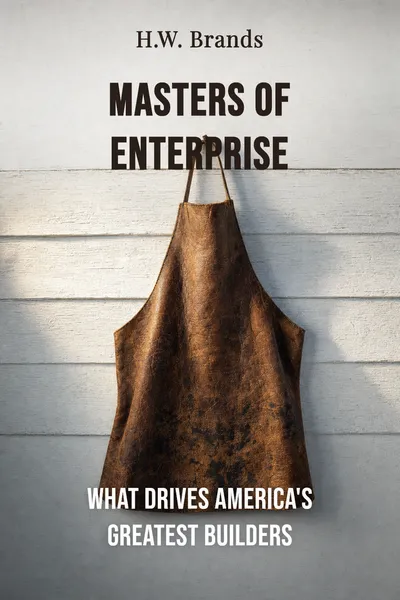
Masters of Enterprise
What drives America's greatest builders
Description
In 1999, the historian H.W. Brands published a book that did something most business writing avoids: it put America's great fortune-builders side by side, from the tanning-yard boy John Jacob Astor to the fur trade of the early republic, through Rockefeller and Carnegie and Ford, all the way to Sam Walton and Bill Gates. The title was Masters of Enterprise, and the trick was in the plural. Brands wasn't chasing one hero or one secret. He was assembling a gallery — roughly two centuries of the people who generated more wealth than anyone around them — to see what, if anything, they had in common.
The temptation with people this rich is to explain them by the money. They got up in the morning to get richer, and they got richer, and that's the story. Brands, who has written biographies of Franklin, Grant, and both Roosevelts, is too good a historian to leave it there. Read his subjects one at a time and each looks like a distinct animal — the pious Rockefeller, the showman Barnum, the tinkering Ford, the gambler Trump. Read them as a set, though, and something stranger surfaces, a pattern that has almost nothing to do with the balance sheet.
That pattern is what the book is really after. Brands treats these builders not as saints or robber barons but as a species worth studying together, the way a naturalist studies a genus. What emerges is less a moral about capitalism than a portrait of a particular kind of temperament — the drive, the focus, the total identification with the thing being built. We come to the money last, if at all.
The question we’re asking : What, across two centuries of America's biggest fortunes, actually makes the great entrepreneurs tick — and is it really the money?What we’ll see : How a historian's gallery of builders, read together, turns up a temperament that the size of the fortune never quite explains.
Table of contents
01Chapter 1 — The obsession that outruns the money
Start with the thing that surprises readers of Masters of Enterprise: how little the money seems to move Brands's subjects, at least in the way we assume it should. John D. Rockefeller assembled Standard Oil into the most complete monopoly the country had seen, and by the 1890s he had more wealth than any private American before him. He also gave much of it away with the same methodical care he brought to refining, and told anyone who asked that the accumulating had never been about comfort. The comfort had arrived early and stopped mattering.
Brands keeps returning to this gap between what his builders could have wanted and what they actually chased. Andrew Carnegie could have retired a young man on his railroad and bridge holdings alone. Instead he drove into steel, rebuilt his mills whenever a better process appeared, and scrapped equipment that still worked because something more efficient existed. That is not the behavior of a man optimizing his bank account. It is the behavior of a man who cannot leave the problem alone.

02Chapter 2 — The company as a second self
The second thread running through the gallery is identification — the way these builders fuse with the thing they build until the two are hard to separate. Brands makes the point most sharply with the figures who lost their companies and seemed to lose themselves along with them. Steve Jobs, pushed out of Apple in 1985, did not simply move on to the next investment; he spent the wilderness years at NeXT and Pixar circling back toward the company that carried his name, and when he returned in 1997 he behaved like a man reunited with part of himself.
This is not vanity, or not only vanity. It is a kind of authorship. Thomas Watson made IBM a projection of his own creed of order, dress, and discipline, down to the salesmen's white shirts and the company songs. Ray Kroc did not invent the McDonald brothers' hamburger system, but once he took it over he treated its standardization as a personal moral cause, policing the fries and the cleanliness as though each restaurant were a limb. The company was the man made visible at scale.
03Chapter 3 — Reading the moment nobody else can read
The third trait in Brands's gallery is harder to name because it looks, from outside, like luck. His builders show up at the exact moment a market is about to open, and they see the opening while everyone else sees ordinary business. The gift is not invention — most of them invented very little — but timing, and the nerve to bet everything on what the timing implies.
John Jacob Astor read the early republic correctly: fur first, then Manhattan real estate as the city swelled toward him. Cornelius Vanderbilt read the shift from steamboats to railroads and moved his capital across the gap before the old fortune cooled. Rockefeller read that the chaos of the early oil boom — wildcatters, gluts, ruinous price swings — would reward whoever imposed order on it, and he built the order himself. In each case the raw opportunity was visible to hundreds. The reading of it, and the willingness to commit, belonged to one.
04Chapter 4 — The pull that keeps outlasting the fortune
Set the portraits side by side, as Brands designed the book to be read, and the individual differences start to look like variations on one temperament. The pious accumulator and the vulgar showman, the tinkerer and the trader, the nineteenth-century monopolist and the twentieth-century software boy — strip away the industries and the manners, and the same engine is turning underneath. That engine, Brands argues across the whole gallery, is the thrill of creation itself, running well past the point where money could explain it.
This is the quiet claim that only a collective study can support. Any single biography can be told as a tale of greed, or genius, or ruthlessness, and readers will nod. It takes the full set to show that greed is a poor fit, because greed would have stopped when the fortune was made, and these people did not stop. The drive to build, to impose a shape on some corner of the economy and watch it hold, is what remains constant when everything else varies. The wealth is how you keep score, not why you play.
05Conclusion
Brands closes his gallery having answered the question he opened it with, though not in the terms most readers expect. The men and women who built America's great fortunes were driven, focused, and fused with their creations to a degree that hurt as often as it helped. They read their moments with a nerve that looked like luck and was mostly conviction, and they talked other talented people into believing the reading. The money came, enormous and real, and it turns out to have been almost beside the point.
Related books