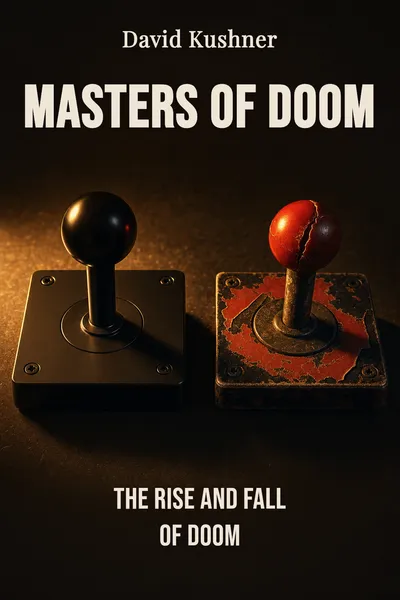
Masters of Doom
The rise and fall of Doom
Description
In December 1993, a small team in a rented office in Mesquite, Texas, uploaded a game to a university server in Wisconsin. So many people tried to download Doom at once that the network buckled. Within weeks it was on millions of machines. The men behind it — a company called id Software — had no marketing budget, no publisher, no boardroom. They had a shareware model, a mailing list, and a way of writing code that made PCs do things nobody thought PCs could do. And at the center of it were two men both named John.
David Kushner's Masters of Doom tells their story, and he tells it as a double portrait. John Carmack was the programmer, a boy who built rockets and got sent to juvenile detention for breaking into a school to steal computers. John Romero was the designer, the showman, a kid who took beatings at home and poured everything into arcade machines. Kushner casts them as the Lennon and McCartney of video games — two temperaments that should never have worked together, and for a while produced something extraordinary precisely because they didn't match.
The book follows them from broken childhoods through the invention of a genre, a national panic over game violence, tens of millions of dollars, and finally a falling-out bitter enough to end the friendship. It is a story about how much two people can build when their differences point the same direction — and what happens when they stop pointing the same way.
The question we’re asking : How did two young men from broken homes end up inventing a genre, making a fortune, and then destroying the partnership that made it possible?What we’ll see : How Kushner traces the friendship, the technology, the controversy, and the fracture behind Doom and Quake.
Table of contents
01 Chapter 1 — Two broken homes and a stolen Apple II
Kushner opens with the childhoods because he thinks they explain everything that follows. John Carmack grew up in Kansas, a strikingly logical kid who read about explosives and built rockets in the backyard. At fourteen he helped break into a school to steal Apple II computers — the machines were the target, not money — and a botched attempt landed him a stint in a juvenile home. He came out with the same single-minded focus he went in with. Computers were the thing that made sense when people didn't.
John Romero's story runs on a different current. Raised partly in California by a stepfather who hit him, Romero found refuge in arcades, memorizing patterns, chasing high scores, teaching himself to program on borrowed machines. Where Carmack was cool and internal, Romero was loud, charismatic, hungry for an audience. He wanted to make games that felt like the arcade felt to him as a kid — fast, loud, impossible to look away from.

02 Chapter 2 — The engine that changed what a computer could do
What separated id from every other studio was Carmack's engines — the underlying code that drew the world on screen. Kushner is good at making this legible without drowning the reader in technical detail: the point is that Carmack repeatedly found ways to trick ordinary hardware into rendering fast, immersive spaces that competitors couldn't match. Each breakthrough opened a door, and Romero and the team rushed through it to build something new.
Their first big hit was Wolfenstein 3D in 1992 — a game where the player moved through a castle in something that felt like three dimensions, shooting Nazis. It was crude by later standards, but nothing else on a PC moved like it. Distributed as shareware — the first episode free, the rest paid by mail order — it made id real money and proved the business model. No publisher took a cut. The players downloaded the game, played it, and sent checks.
03 Chapter 3 — Deathmatch, controversy, and the split
Doom introduced something Romero named deathmatch: players hunting each other over a network, in real time, in the same rendered space. Kushner treats it as one of the book's hinge moments. Romero was electrified by it — the yelling across the office, the trash talk, the pure competitive thrill. Multiplayer shooting, the thing that would eventually anchor a whole industry, started as a handful of guys fragging each other after midnight in Mesquite.
With the success came money on a scale that surprised everyone, and it surprised the two Johns in opposite directions. Carmack bought Ferraris but stayed the same person — code first, everything else noise. Romero leaned into the fame, the interviews, the rock-star posture of a game designer who had become genuinely famous. Kushner watches the friendship strain along that fault line. Carmack wanted to build engines and ship on time. Romero wanted to make sprawling, ambitious games and enjoy being id's public face.
04 Chapter 4 — What the two Johns actually built
Kushner keeps returning to the Lennon-McCartney comparison, and by the end it earns its weight. The thing about id wasn't Carmack alone or Romero alone — it was the collision. Carmack was the optimizer, the man who asked what the machine could actually do and refused to promise more. Romero was the dreamer, the man who looked at Carmack's engine and imagined a world worth living inside. Neither made great games without the other. The engineer needed someone to give the technology a reason to exist; the designer needed someone to make the impossible run at sixty frames a second.
That pairing is a pattern the tech world keeps reproducing — the builder and the visionary, the one who ships and the one who sells. Kushner's book is really a case study in how creative duos generate more than the sum of their parts, and why the same friction that fuels them tends to be the thing that ends them. The traits that made Carmack and Romero complementary were also the traits that made them incompatible over time. Focus versus ambition. Restraint versus spectacle. What produced Doom was the tension held in balance; what ended id, for them, was the balance tipping.
05 Conclusion
The download that crashed a Wisconsin server in December 1993 turned out to be the high point of the friendship as much as the company. Within three years the two Johns had stopped speaking, and the genre they built together kept expanding without them in the same room. Carmack stayed at id, kept optimizing, later turned to rockets and then virtual reality.
Related books