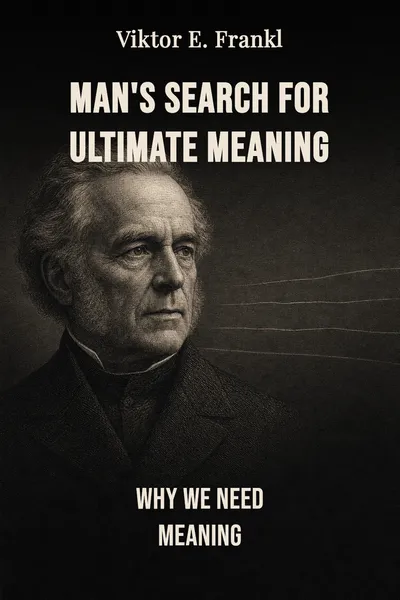
Man's Search For Ultimate Meaning
Why we need meaning
Description
In 1948, three years after walking out of the camps that had killed his wife, his parents, and his brother, Viktor Frankl earned a doctorate in philosophy from the University of Vienna. He was already a neurologist and psychiatrist, already the author of the book that would later be translated as Man's Search for Meaning. But the philosophy degree was its own statement. Frankl wanted to push past the clinical question of how people cope, and toward something older and stranger: not just meaning in the everyday sense, but ultimate meaning — the kind that holds even when nothing in a life seems to make sense from the inside.
Man's Search for Ultimate Meaning is the book where he tried to lay that out. It began life in the 1940s as a German text on what he called the unconscious God, and Frankl returned to it across decades, expanding it, arguing with the psychology of his time, until the final version appeared late in his life. It is shorter and denser than his famous memoir, and it is doing something different. It is the theoretical spine of logotherapy — Frankl's school of psychotherapy built on the idea that the drive to find meaning is the deepest motivation we have.
What makes the argument hold our attention is that Frankl is not a preacher borrowing the language of medicine. He is a clinician who watched meaning keep people alive, and who then spent the rest of his career trying to give that observation a rigorous shape — without pretending he could prove the unprovable.
The question we’re asking : If the will to meaning runs deeper than the will to pleasure or power, where does that meaning come from, and can a psychiatrist say anything serious about the ultimate kind?What we’ll see : How Frankl turned a survivor's intuition into a theory of the human person — one that reaches all the way to conscience, faith, and the limits of what science can hold.
Table of contents
01 Chapter 1 — The man who survived to ask the question
Frankl was born in Vienna in 1905, into the city that produced Freud and Adler and the whole first century of modern psychotherapy. He corresponded with Freud as a teenager and worked alongside Adler before breaking with both. By his early thirties he was running a clinic and developing his own approach, the one he would call logotherapy, from the Greek logos — meaning. The word choice mattered. Where the dominant schools traced human trouble back to repressed drives or to the struggle for superiority, Frankl kept noticing something they did not have a slot for: people who suffered because their lives felt empty of purpose.
Then came the catastrophe that would test the idea past any clinic. Deported in 1942, Frankl spent three years in Nazi concentration camps, including Auschwitz and Dachau. He lost almost everyone he loved. What he observed there became the empirical core of everything he wrote afterward. Prisoners who held onto something to live for — a person waiting, a task unfinished, a meaning that pointed beyond the barracks — tended to endure in ways that those who had given up did not. Survival was never guaranteed by it. But the absence of meaning, Frankl saw, was its own kind of death sentence.

02 Chapter 2 — Beyond pleasure and power
Frankl built his case partly by argument with the giants around him. Freud had placed the pleasure principle at the foundation of the psyche: we are creatures seeking gratification and avoiding pain. Adler had answered with the will to power, the drive toward mastery and significance. Frankl did not deny that either force operates. He argued they are not the bottom. Beneath the will to pleasure and the will to power, he placed what he called the will to meaning — the human need to find a reason that makes a life worth the trouble.
His evidence was clinical and ordinary at once. People who had pleasure and security in abundance still showed up in his office hollow, complaining of a kind of inner emptiness he named the existential vacuum. Frankl thought this vacuum was the signature ailment of the modern age — not neurosis in the classical sense, but the dull sense that nothing in particular matters. And he noticed that pleasure-seeking and power-seeking often intensified precisely where meaning had drained away, as substitutes rushing to fill the hole.
03 Chapter 3 — Conscience, religion, and the unconscious God
The original German title pointed straight at Frankl's boldest claim: the unconscious God. He took Freud's great discovery — that much of the mind operates below awareness — and argued Freud had stopped too soon. The unconscious is not only a basement of repressed drives. It also has a spiritual depth, a region from which conscience speaks and intuition rises. Frankl held that alongside an instinctual unconscious there is what he called a spiritual unconscious, and that decisions of real moral weight come not from rational calculation but from this deeper, wordless knowing.
Conscience was his way in. He described it as an organ of meaning — the faculty that senses, before any argument, what a given situation demands of us. It can err; it is not infallible. But its existence suggests that meaning is something we are attuned to, the way an ear is attuned to sound, rather than something we manufacture. And if conscience points beyond the self toward an order it did not create, Frankl thought it pointed, at least implicitly, toward an ultimate meaning he was willing to name in religious terms.
04 Chapter 4 — A defiant kind of optimism
Step back from the clinical detail and Frankl's project looks like an attempt to do something most of twentieth-century psychology had quietly given up on: to take meaning, faith, and the human spirit seriously as objects of a science of the mind, without dissolving them into chemistry or childhood. He was trying to keep two commitments at once — the rigor of the neurologist who knew the brain, and the conviction that a person is more than the sum of drives and conditioning. He called the reduction of human beings to mere mechanism nothing-but-ism, and he thought it was quietly corrosive, teaching people they were nothing but their appetites at exactly the moment they most needed a reason to live.
What Man's Search for Ultimate Meaning offers, more broadly, is a model of the person built from the top down rather than the bottom up. Where one tradition explains the higher by the lower — love as sublimated desire, conscience as internalized fear — Frankl insisted the higher is real in its own right, and that a psychology blind to it will misread the very patients it claims to help. The existential vacuum, in this light, is not a private weakness but a cultural diagnosis: a society can be materially full and spiritually starving.
05 Conclusion
Frankl returned to this book again and again across his long life, and he died in Vienna in 1997, still seeing patients into his nineties. The argument he kept polishing was, in the end, simple to state and hard to live: that the deepest human drive is not toward pleasure or power but toward meaning, that meaning is found in the world rather than invented in the head, and that even the meaning we cannot prove — the ultimate kind — is something a person can trust without surrendering their reason.
Related books