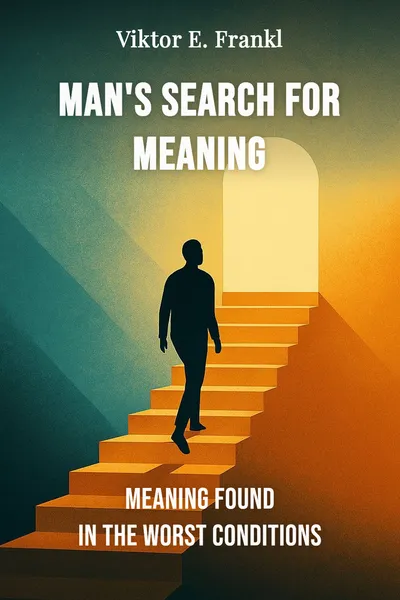
Man's Search for Meaning
Meaning found in the worst conditions
Description
In 1945, a Viennese psychiatrist named Viktor Frankl walked out of a concentration camp having lost almost everyone he loved. His wife, his parents, his brother — all dead in the Nazi machinery. He himself had spent roughly three years across several camps, including Auschwitz and a labor camp attached to Dachau. He arrived carrying nothing but a rebuilt manuscript he had once smuggled into the camp sewn into his coat, only to have it taken and destroyed. Within a year of his release he had written a new book, dictating most of it in nine days.
That book, later titled Man's Search for Meaning, has sold in the millions and been translated into dozens of languages. It is really two books stitched together. The first half is a psychiatrist's account of daily life in the camps — not the atrocities as history records them, but what happened inside the mind of a person stripped of everything. The second half lays out logotherapy, the school of psychotherapy Frankl had been developing before the war and which the camps, in the cruelest way imaginable, put to the test.
Frankl went in with a theory about human beings and came out having watched it survive conditions designed to erase every human thing. The book is his report on what he saw — in others, and in himself. It is unusually clear-eyed, and it refuses the two easy endings: neither triumphant nor despairing. Something else.
The question we’re asking : How does a person find meaning when everything that gave life meaning has been taken away?What we’ll see : A psychiatrist's account of the camps, the theory he tested there, and the one freedom he found nobody could confiscate.
Table of contents
01Chapter 1 — Auschwitz through a psychiatrist's eyes
Frankl was already a trained neurologist and psychiatrist when he was deported. So the first thing worth understanding about his camp memoir is the angle: he was not only enduring the experience, he was observing it, cataloguing the psychology of a place built to destroy psychology. He notices what a clinician notices. The book reads less like a survivor's testimony and more like a field report written from inside the specimen jar.
He describes arriving at Auschwitz and the first, absurd hope — the belief that things could not be as bad as the rumors. Then the selection at the ramp, a casual flick of a finger sending most of the transport straight to death. Then the stripping of everything: clothes, hair, names, the manuscript in his coat. Frankl calls this the loss of the whole former life, and he watches how the mind scrambles to protect itself. Prisoners developed a grim curiosity, a detachment, even a bleak gallows humor, all of it defensive.

02Chapter 2 — The prisoner who watched himself survive
The middle of the memoir turns inward. Frankl asks what kept some men going while others, apparently no weaker, simply gave up. He describes the phenomenon the prisoners knew well: a man who one morning refused to get up, lay in his own filth, and would not move. Within days he was dead. It was not the cold or the hunger that killed him first. It was that he had stopped expecting anything from the future.
Frankl finds this again and again. The prisoner who loses his grip on a future — some reason to come out the other side — loses his hold on the present too. He remembers Nietzsche's line, that a man who has a why to live can bear almost any how, and he watches it play out on a scale no philosopher intended. Those who had something waiting for them — a person, an unfinished task, a book to rewrite — proved measurably harder to break.
03Chapter 3 — Logotherapy, or the will to meaning
The second half of the book steps back from the camp to lay out the ideas the camp had confirmed. Logotherapy — from logos, meaning — was Frankl's answer to the two dominant schools of Viennese psychology. Freud had placed the will to pleasure at the center of human motivation; Adler, the will to power. Frankl proposed a third: the primary drive in a human being is not pleasure or power but the search for meaning. When that search is frustrated, he argued, people fall into a particular kind of emptiness he called the existential vacuum — a sense that life has no point, often masked by boredom, or filled with substitutes.
Crucially, Frankl insisted that meaning is not something invented or handed out. It is discovered, and it is specific to each person and each situation. There is no meaning of life in the abstract, only the meaning of your life, now, in these circumstances. He liked to reverse the usual question. It is not for us to ask what we expect from life; life is asking us, and we answer by how we respond to what it puts in front of us. Meaning is a task set, not a comfort given.
04Chapter 4 — The last of the human freedoms
The line the whole book turns on is deceptively simple: everything can be taken from a man but one thing — the last of the human freedoms, to choose one's attitude in any given set of circumstances, to choose one's own way. Frankl means it literally, and he means it as an eyewitness. The camps were an experiment in total deprivation. They took clothing, food, names, family, the future, the body's dignity, life itself. What Frankl claims they could not reliably take was the inner decision each prisoner made about how to meet all of it.
This is a large claim, and it is easy to hear it as consolation — a comforting thing to say from the safety of the outside. Frankl earns the right to say it precisely because he does not soften the picture. Most men were broken. Many became brutal. The freedom he describes was not exercised by everyone, and it did not save most who exercised it. It is not a survival strategy. It is a statement about the irreducible core of a person: that even under maximum external force, the space between what happens to you and how you respond to it does not fully close.
05Conclusion
Frankl walked out of the camps in 1945, learned soon after that his wife and parents were dead, and returned to Vienna to rebuild both his life and his manuscript. He wrote the book quickly, at first meaning to publish it anonymously, expecting little. It became one of the most widely read works of the century. He went on to practice, teach, and lecture for another fifty years, founding a school of therapy on the same idea he had carried back out through the gate: that a man is finally defined not by what is done to him but by the answer he gives.
Related books