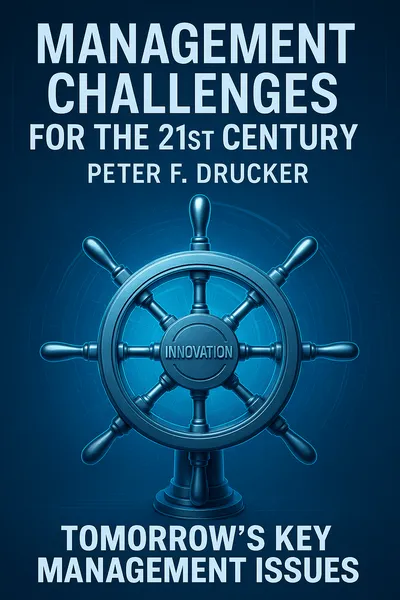
Management challenges for the 21st century
Tomorrow's key management issues
Description
Business management is undergoing significant changes, with current practices likely to become obsolete in the near future. Managers must embrace new paradigms to navigate the shifting social, economic, and demographic landscapes.
The old ways of thinking and operating won't suffice in the evolving market. Rather than resisting change, managers should see today's challenges as catalysts for progress. Bold action is required for organizations to thrive; maintaining the status quo is not an option. The future depends on managers' ability to adapt to these emerging challenges.
Table of contents
01 New management paradigm hurdles
Managed organizations, encompassing businesses, churches, universities, and more, are central to the advancement of modern society. Their success in achieving desired outcomes propels societal progress. Effective management encompasses responsibility for all factors influencing organizational performance, including those beyond direct control. Paradigms, or fundamental assumptions about reality, shape what is considered factual and what can be ignored. Historically, management paradigms before the 1980s were limited, viewing management as exclusive to businesses, advocating a singular approach to managing people and organizational structure, and focusing solely on internal issues. These paradigms have since become outdated, necessitating a shift in management thinking.

02 Business strategies and certainties
Strategies are essential for translating the foundational theories of a business into tangible outcomes. In the 21st century, effective business strategies must navigate five economic truths. Firstly, the developed world is experiencing a continuous decline in birthrates, leading to a shrinking labor pool, an aging market demographic, and pressures to reform immigration laws. This scenario is likely to cause government instability and necessitate radical changes in retirement practices. Companies that can effectively utilize knowledge workers beyond traditional retirement ages will secure a significant competitive edge.
Secondly, there will be significant shifts in the distribution of disposable income. Organizations should focus less on market share and more on the portion of disposable income spent on their products or services, and whether this share is growing. Industries poised for growth should emphasize innovation and risk-taking, while mature industries need to prioritize flexibility, cost reduction, and improvements in quality and service. Operational goals should align with changes in how disposable income is allocated within their industry.
03 Leading change successfully
Change leadership is essential for businesses navigating the ever-evolving landscape of today's market. It's not just about managing change but leading it, transforming potential disruptions into opportunities for growth and innovation. To excel as a change leader, one must be willing to forge the future, employing systematic methods to identify and anticipate changes, and implementing techniques to introduce both internal and external changes, all while maintaining a balance between change and continuity.
A change leader's mindset shifts resources from past successes to future possibilities, embracing the structured abandonment of outdated elements that no longer contribute to profits. This approach is complemented by a continuous improvement plan, ensuring all organizational processes enhance year after year. Change leaders are committed to fully exploiting new opportunities, assigning the organization's top talent to lead these ventures.
To systematically identify and anticipate changes, organizations must foster a culture of innovation, regularly scanning for "windows of opportunity" to apply creativity to their offerings. This involves recognizing unexpected successes and failures, incongruities, advancements in technology, shifts in the industry or market, demographic trends, and new information. However, it's crucial to differentiate genuine innovation from mere novelty, focusing on value-added changes that meet market demands and avoid actions without a clear, innovative direction.
04 Information availability issues
The information revolution, spanning over five decades, has primarily focused on the accumulation, storage, retrieval, transmission, and presentation of data. However, the 21st Century marks a shift towards a greater emphasis on information utilization, redefining tasks and organizational structures to leverage this wealth of information for enhanced performance.
Initially, the advent of computers in the 1950s was expected to benefit universities and the military, with some foresight into clerical applications for businesses. Yet, the most profound impact of computers has been in operational tasks. Moving forward, computer technology is poised to aid managers in decision-making processes, thereby creating value and wealth. The crux of valuable management information lies not within the internal workings of an organization but in the external market dynamics. This external information serves as the foundation for developing new products, services, and processes that generate added value.
05 Knowledge worker efficiency
The 20th century saw a remarkable fifty-fold increase in the productivity of manual workers in manufacturing, a feat largely attributed to advancements in management. This surge in productivity underpinned the economic and social advancements of developed countries, distinguishing them from underdeveloped nations that had yet to enhance their manual labor efficiency. As we navigate the 21st century, the pressing challenge for management is to replicate this success by significantly boosting the productivity of knowledge workers.
Knowledge workers differ from manual laborers in several key aspects. Their work is characterized by flexibility and a degree of ambiguity, with the primary focus being on the quality of outcomes rather than the quantity. They are tasked with determining the nature of their work, contributing innovatively, and identifying and overcoming obstacles. Unlike manual labor, where the process is paramount, knowledge work allows for multiple approaches to achieve high-quality results.
Self-management and responsibility are central to the productivity of knowledge workers. They must possess autonomy and be accountable for their output. Innovation is a constant requirement, demanding that knowledge workers continuously integrate new ideas into their work. This necessitates an environment that fosters continuous learning and teaching, ensuring that knowledge workers remain at the forefront of their fields and can impart new skills to their peers.
06 Self-management challenges
In the rapidly evolving landscape of work, knowledge workers are expected to have careers spanning over 50 years, significantly longer than the average lifespan of a business. This necessitates a shift in career management, with individuals needing to adapt to new roles and responsibilities. The traditional approach of following a set career path is no longer viable, and workers must be prepared to manage their careers actively, focusing on their unique strengths and where they can add the most value.
The concept of managing one's career involves more than just finding a job that matches one's skills and interests. It requires a deep understanding of one's unique strengths and how to leverage them to make a significant contribution. This may involve transitioning into new roles or industries, or even starting a second career. The key is to remain flexible and adaptable, constantly learning and growing in order to stay relevant in the ever-changing world of work.
Related books