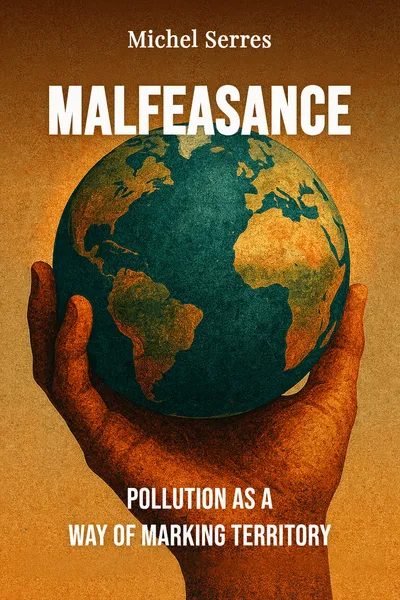
Malfeasance
Pollution as a way of marking territory
Description
A tiger walks the edge of its range and sprays the bushes. A wolf leaves its scent along a line only it can read. A songbird floods the dawn with noise that means, in effect, this branch is taken. We call this animal behavior and we file it under nature, harmless, almost charming. Michel Serres, the French philosopher who died in 2019, spent a short and startling book asking us to look again — because he thought we do exactly the same thing, only with oil slicks, jingles, billboards and landfills. His book, published in French in 2008 as Le Mal propre and in English as Malfeasance, starts from that uncomfortable rhyme between the beast's urine and our garbage.
The claim is deliberately blunt. Pollution, for Serres, is not first an accident of industry or a failure of good housekeeping. It is a gesture of appropriation. To dirty something is to make it yours. The dog fouls the corner; the corner becomes the dog's. And once you accept the parallel, a lot of things that looked like separate problems — waste in the oceans, advertising on every surface, brands stamped on every object — start to look like one continuous behavior, scaled up until it covers the earth.
Serres was a historian of science who wrote like a fabulist, and Malfeasance moves by images more than by arguments. It is less a treatise than a provocation dropped on the table between friends. The uneasy part is how well it holds once you stop laughing at the tiger.
The question we’re asking : What if pollution isn't a byproduct of ownership but the very act by which we claim things as ours?What we’ll see : How a slim, strange book turns dirt, noise and brands into a single logic of possession that now reaches the whole planet.
Table of contents
01Chapter 1 — The tiger, the diner, and the spat-in soup
Serres opens with a scene he says he watched, or could have. Two diners are eyeing the same free table at a restaurant. One of them reaches it first, and to settle the matter beyond dispute, he spits in the soup, or the plate, or the general vicinity. The table is now his. Nobody will fight him for it. The gesture is faintly disgusting and perfectly effective, and that combination is the whole point of the book. Fouling is a way of claiming, and it works precisely because the foulness repels everyone else.
From there he widens the lens to the animal world he loved to think with. The lion marks its territory with urine and scent. Birds mark theirs with song, saturating the air so no rival can mistake whose airspace this is. What we politely call communication or instinct, Serres re-describes as a technology of exclusion. The mark says: mine, keep out. And it does so not by building a wall but by leaving something of the body behind — a trace unpleasant or loud enough that others withdraw.

02Chapter 2 — Two pollutions, hard and soft
To make the case work at human scale, Serres draws a distinction that runs through the whole book. There is hard pollution and there is soft pollution. Hard pollution is the kind everyone already worries about: the oil, the plastic, the industrial effluent, the tar and residue that physically foul water, soil and air. This is the pollution of environmental law and clean-up crews, the visible mess we agree is a problem.
Soft pollution is his real quarry, and it is stranger. It is the flood of signs — advertising, logos, jingles, brand names, images plastered across every wall and screen and now every device. Serres insists this belongs to the same family as the oil slick. Both are ways of covering a surface with a mark so that it registers as occupied. The billboard on the hillside and the sludge in the river do the same work: they appropriate a shared thing by defacing it. One offends the lungs, the other the eyes and ears, but the grammar of the gesture is identical.
03Chapter 3 — The world as the thing we foul to keep
Behind the images sits Serres's deeper worry, which is about the res, the thing, and who gets to have it. Ownership, in his account, has always been parasitic on the common. The commons — water, air, the seas, the open land — belonged to no one and therefore to everyone. Appropriation is the act of tearing a piece out of that shared fund and stamping it as private. And the oldest, surest way to do that, older than any legal title, is to make the piece unusable by others: to soil it.
This is why he reaches back through the history of possession and finds the same shadow everywhere. The name written on the object, the coat of arms, the trademark, eventually the graffiti tag — these are civilized descendants of the animal's scent. They all say the same thing. Whoever leaves the most durable, most excluding trace holds the ground. Serres reads the whole apparatus of branding as a refined form of the marking he saw in the tiger, and refinement does not change the underlying logic. It only makes it harder to recognize.
04Chapter 4 — Owning the planet by dirtying it
Step back from the tigers and the jingles and Serres has quietly reframed the ecological question. The dominant way we talk about pollution treats it as a management problem: an externality, a cost, an inefficiency to be regulated, taxed or engineered away. Malfeasance refuses that framing. If dirtying is a form of possessing, then pollution is not a bug in our relationship to the world — it is the relationship. You cannot clean it up without touching the deeper appetite that produced it, the drive to make the common into the owned.
What his argument really disturbs is the innocence of property itself. We tend to treat ownership as neutral, a legal fact overlaid on things, and pollution as a separate moral lapse. Serres binds them at the root. To possess has always meant to exclude, and the surest exclusion is contamination — the mark others cannot share. Seen this way, the tidy accountant's world of titles and contracts sits on top of a very old, very physical gesture that never went away. The deed of ownership is a laundered version of the stain.
05Conclusion
Malfeasance is a small book with a large nerve, and its power is in refusing the comfortable line between the animal marking its bush and the corporation marking its billboard. Serres pulls them together and lets the reader feel the shared gesture underneath — the spit in the soup, the scent on the corner, the logo on the wall, the plastic in the sea. Once the parallel lands, the polite categories of accident and nuisance and communication start to look like disguises for one very old behavior: claiming a thing by making it ours, and making it ours by soiling it.
Related books