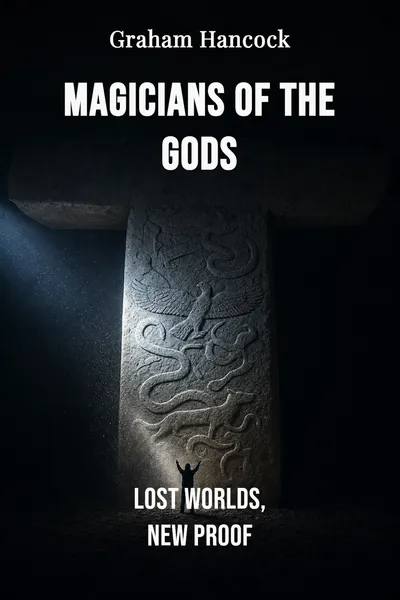
Magicians of the Gods
Lost worlds, new proof
Description
In 2007, a small group of scientists proposed something that sounded like the opening of a disaster film. Roughly 12,800 years ago, they argued, one or more fragments of a comet struck the Earth, most likely over the North American ice sheet. The impact would have triggered continent-scale wildfires, thrown enough debris into the atmosphere to darken the sky, and plunged a warming planet back into a deep freeze that lasted more than a thousand years. They called this cold snap the Younger Dryas, after a small Arctic flower whose pollen marks the sediment of the period. The hypothesis was contested from the start, and it still is. But it gave Graham Hancock the missing piece he had been circling for two decades.
Hancock is not an academic. He is a journalist who spent years travelling to ruined temples, submerged cities and sacred sites, and who became convinced that the standard story of human civilization was incomplete. His 1995 book Fingerprints of the Gods sold millions of copies and argued that a sophisticated culture had existed long before the pyramids, before Sumer, before anything the textbooks recognize — and that it had been wiped out, leaving only fragments and survivors. Mainstream archaeology dismissed the idea. For twenty years, the objection was simple: where is the evidence, and what could possibly have destroyed a whole civilization without a trace?
Magicians of the Gods, published in 2015, is Hancock's answer. The comet gave him a mechanism. New excavations gave him sites. And a body of ancient myth, read a certain way, gave him witnesses. The book is a return to the same obsession, now armed with material that did not exist when he first made the claim.
The question we’re asking : What if a real cataclysm destroyed an advanced culture at the end of the Ice Age, and the survivors seeded everything that came after?What we’ll see : We follow the comet, the temple, and the myths Hancock enlists to rebuild a story that orthodox history refuses to tell.
Table of contents
01 Chapter 1 — The comet that rewrote the timeline
The spine of Magicians of the Gods is a catastrophe. For most of the twentieth century, the end of the last Ice Age was told as a slow, uneven thaw. Then researchers noticed something strange in the record around 12,800 years ago: a sudden, violent return to cold, right when the planet had been warming. The Younger Dryas, as it is called, arrived fast and left fast, and its edges are marked in the sediment by an odd layer — traces of soot, tiny spherules of melted rock, and elevated readings that some scientists read as the signature of an impact.
The team behind the idea, led by researchers including Richard Firestone and later joined by geologists such as James Kennett, argued that a comet had broken apart and hit the northern ice sheets. Hancock seized on this. Here, finally, was a real, datable, planet-scale disaster — not a myth, not a metaphor, but a candidate event large enough to erase the coastal settlements of any culture unlucky enough to be living at the water's edge when the ice melted and the seas surged.

02 Chapter 2 — Göbekli Tepe and the memory of the sky
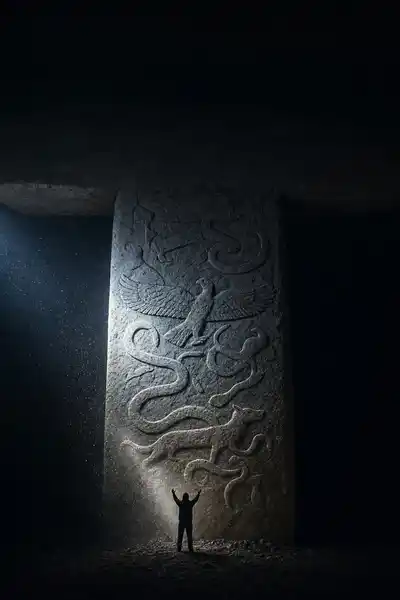
If the comet is Hancock's mechanism, Göbekli Tepe is his exhibit. In southeastern Turkey, on a hill overlooking the plains near Sanliurfa, the German archaeologist Klaus Schmidt spent years excavating a site that genuinely unsettled the profession. Massive T-shaped stone pillars, some weighing many tons, carved with foxes, boars, snakes and birds, arranged in rings — and dated to around 11,600 years ago. That is roughly seven thousand years before Stonehenge, built by people the textbooks call hunter-gatherers who were not supposed to have the organization or the tools for monumental architecture at all.
Schmidt himself never endorsed a lost civilization. But he did overturn a long-held assumption: he argued that the temple came first and farming followed, that the urge to build something sacred may have driven people to settle down, rather than the other way around. For Hancock, Göbekli Tepe is the smoking gun of sophistication in the deep past. Someone knew how to plan, quarry, carve and raise these stones with precision, at a date that lands suspiciously close to the aftermath of his comet.
03 Chapter 3 — The messengers who survived the flood
Hancock's third move is to reach for the world's oldest stories. Flood myths turn up almost everywhere — in the Mesopotamian tale of the survivor Utnapishtim, in the biblical Noah, in the Aztec accounts, in the traditions of India and the Pacific. The standard reading treats these as local memories of local disasters, or as moral fables dressed as history. Hancock reads them as garbled reports of the same global event: the meltwater floods and sudden sea-level surges that followed the end of the Ice Age.
What interests him most is a recurring character. In myth after myth, a civilizing figure appears in the wake of the disaster — a bearded stranger, a bringer of knowledge, someone who arrives among broken survivors and teaches them agriculture, law, astronomy and building. In Mesoamerica he is Quetzalcoatl and Viracocha; in Mesopotamia the sages called the Apkallu; in Egypt the gods who ruled in the mythic first time. Hancock calls them the magicians of the gods — the title of the book. He proposes they are the remnant of his lost civilization, passing on what they could save.
04 Chapter 4 — When the past refuses to stay buried
Step back from the comet and the carved pillars, and Magicians of the Gods is really a book about who gets to decide what happened. Hancock is not a lone crank shouting at a wall; he is a skilled writer who has read the same excavation reports as his critics and drawn conclusions they reject. What separates them is not always the evidence. It is the frame — the set of assumptions about what is plausible, what counts as proof, and who is allowed to make the claim in the first place.
The tension in his project outlives any single argument about a star map. Scientific consensus is not a conspiracy, but it is a human institution, with its own inertia, its own gatekeeping, its own reluctance to reopen questions it considers settled. Göbekli Tepe is a real example of the mainstream being caught out: the site forced archaeologists to admit that complex ceremonial building predated agriculture, something almost nobody predicted. Hancock points to that reversal and asks a fair question — if the timeline could be that wrong once, why treat the current version as final?
05 Conclusion
The book ends where it began, with the comet — but now the cold snap, the drowned coasts, the star-watching temple builders and the bearded survivors are woven into a single story. Hancock's wager is that the amnesia of our species is not a natural gap but the wound left by a catastrophe we half-remember in myth. Whether or not the lost civilization existed, the material he assembles is real: the Younger Dryas was real, Göbekli Tepe is real, the flood stories span the globe. What he does is refuse to let those facts sit quietly in their separate disciplines.
Related books