
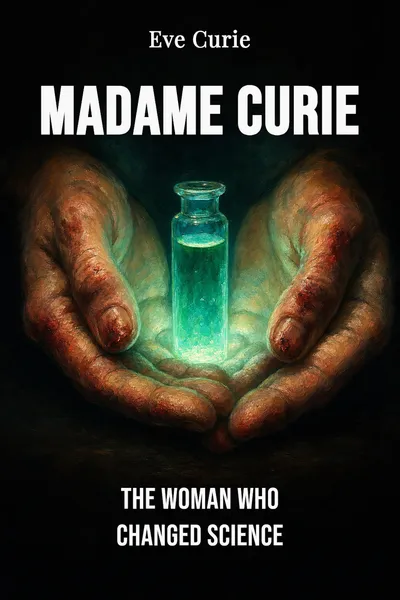
Madame Curie
The woman who changed science
Description
In July 1898, in a converted storeroom in Paris, a young physicist wrote a new word into a scientific paper. She and her husband had been grinding through tons of a black mineral called pitchblende, and they proposed the name polonium for a fresh element they had isolated — Poland, for the country that no longer appeared on the map. The physicist was Marie Sklodowska Curie, born in Warsaw in 1867, and the word she coined for the phenomenon she was chasing was radioactivity. Within months she would name a second element radium. Neither she nor anyone else yet understood what these substances would do to the century, or to her.
The story is told by someone with an unusual vantage point: her younger daughter, Eve Curie, who wrote the biography in 1937, three years after her mother's death. It is a daughter's book, and it does not pretend otherwise — but it is also unsparing, tracking the poverty, the exhaustion, the grief, and the slow poisoning that ran alongside the triumphs. Eve saw the two Nobel Prizes, the honors, the crowds. She also saw the burned fingers, the anemia nobody could explain, the plain woman in a plain dress who disliked being looked at.
What Eve Curie set out to render is not a monument but a person: a Polish girl under Russian occupation who became the most famous woman in science, and paid for it with the very element that made her name. The book keeps both halves in view at once, the discovery and its cost, and refuses to let either one soften the other.
The question we’re asking : How did a girl from occupied Warsaw become the first great woman of modern science — and what did the discovery take out of her?What we’ll see : A life traced from Poland to Paris, through a makeshift lab, two Nobels, and the substance that outlived and undid her.
Table of contents
01Chapter 1 — A girl from occupied Warsaw
Maria Sklodowska was born in Warsaw in November 1867, into a Poland that had been carved up and swallowed by its neighbors. Her corner belonged to the Russian Empire, and the occupation reached into the classroom: teaching Polish history or the Polish language could be done only in secret, under threat of the inspector's visit. Eve Curie describes a childhood where patriotism and learning were the same act of resistance. Her father taught mathematics and physics; her mother ran a boarding school before tuberculosis took her when Maria was ten.
The family was cultured and poor, and getting poorer. There was no question of a university education for a girl — the University of Warsaw did not admit women, and there was no money to send her abroad. What existed instead was the so-called Flying University, an illegal, roving network of classes held in private apartments, where young Poles studied the sciences the state would rather they ignored. Maria took part, and she made a pact with her older sister Bronya that would decide both their lives.

02Chapter 2 — The lab that was really a shed
In 1894 Marie met Pierre Curie, a physicist already known for his work on crystals and magnetism, a man as indifferent to money and reputation as she was. Eve describes a courtship conducted largely in laboratories and over scientific papers; Pierre proposed more than once before she agreed, torn between him and her intention to return to Poland. They married in 1895 in the plainest possible ceremony, and spent their honeymoon touring the French countryside on two bicycles bought as wedding gifts. It was, by every account in the book, a genuine partnership of equals.
Marie went looking for a doctoral subject and settled on a puzzle raised by Henri Becquerel: certain uranium salts emitted rays without any external energy source. She began measuring these rays precisely, using an instrument built on Pierre's earlier work, and made a decisive observation — the intensity of the radiation depended only on the amount of uranium present, not on its chemical form. The rays came from inside the atom itself. Then she found that pitchblende, a uranium ore, was far more active than its uranium content could explain. Something unknown was hiding in it.
03Chapter 3 — Two Nobels and the price attached
Recognition came, and it came awkwardly. In 1903 the Nobel Prize in Physics was to be awarded for the work on radioactivity, and the committee initially intended to honor Becquerel and Pierre alone. Pierre made clear he would not accept a prize that excluded his wife, and the citation was corrected. Marie Curie became the first woman to receive a Nobel Prize. The fame that followed was unwelcome to both of them — Eve describes her parents as bewildered by the journalists and the sudden crowds, wanting only to get back to work.
Then, in April 1906, Pierre was killed on a Paris street, crushed under the wheels of a horse-drawn wagon in the rain. Marie was thirty-eight, with two young daughters. Eve, who was not yet two, writes about this rupture with the restraint of someone reconstructing a wound she cannot remember. Her mother did not collapse. She took over Pierre's professorship at the Sorbonne — the first woman to teach there — and began her first lecture at the exact sentence where his notes had ended.
04Chapter 4 — The measure of a scientist
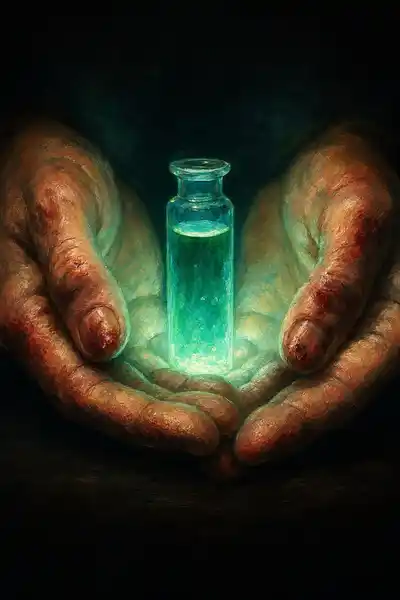
Read across its whole span, Eve Curie's biography is really about a single substance and what it did in both directions. Radium made her mother's name, cured tumors, founded a branch of medicine — and it also seeped, invisibly, into the fingers, the blood, and the bones of the people who first handled it. The same glow the Curies admired in their dark shed was quietly damaging them. For decades no one connected the burns, the fatigue, and the failing eyesight to the element they worshiped, because the danger was as new as the discovery.
What the book keeps insisting on is that this was not a story of genius rewarded. It was a story of work — sustained, physical, unglamorous work carried out in bad rooms with inadequate money, by someone who happened to be a woman in institutions built to keep women out. Marie Curie's achievement was not that she was allowed in; it was that she forced the door and then behaved, in the lab, exactly as a scientist behaves, indifferent to who was watching. The Nobels are almost incidental to the account. The evidence of the science is the shed.
05Conclusion
Marie Curie died in a sanatorium in the French Alps in July 1934, at sixty-six, her body worn out by the radiation she had spent her life measuring. Eve Curie ends where the science began: with a woman who had never wanted fame, buried at first beside Pierre, her name written into every laboratory that studies the atom. Her notebooks are still radioactive today, kept in lead-lined boxes, readable only by those willing to sign a waiver. The glow she loved has not faded.