

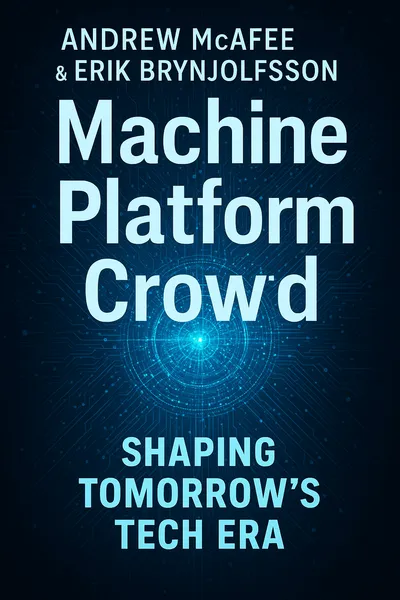
Machine platform crowd
Shaping tomorrow's tech era
Description
The traditional Minds | Products | Core dynamic driving value creation is being rapidly superseded by Machines | Platforms | Crowd. Machines are getting smarter, powered by big data and pattern finding. Platforms facilitate transactions but don't make anything. The internet enables crowds to collectively outperform experts.
This triple revolution of machines, platforms, and crowds creates opportunities. Successful companies will differently combine minds and machines to leverage automation, use platforms for efficient coordination, and tap the crowd's diverse talents.
Incumbents must adapt to avoid disruption. Crowds can accomplish much with minimal central coordination thanks to enabling technologies. Established firms are finding novel ways to engage crowds, while crowd-based startups challenge them.
Though technologies reduce production and coordination costs, companies will remain integral. The key is harnessing the digital future by taking advantage of the machine, platform, and crowd revolution. Change brings challenges but also possibilities for those who can capitalize on it.
Table of contents
01Part 1. brains vs. AI:
Initially, machines had to be explicitly programmed with rules and knowledge. Today, machines can analyze vast datasets to detect subtle patterns beyond human perception. In this way, machines are rapidly advancing to outperform humans across many domains. The combination of human and machine intelligence will grow exponentially more powerful.
When computers were first introduced into business, a logical division of labor emerged. Machines handled computation, record-keeping and data transmission while people made key decisions, exercised judgment, innovated, and interacted with customers. This partnership was sensible when hardware was limited.
However, technology has transformed this dynamic. Highly capable enterprise systems have emerged, with exponentially improved computation power and access to massive datasets. Machines can now make superior data-driven decisions across a widening range of tasks, with the margin of superiority increasing yearly. The standard human-machine partnership no longer makes sense. Where companies once valued leaders' ability to predict the future, excellent firms now use iteration, experimentation and customer analysis to invent the future. They take small steps, gather feedback, and leverage data to build what customers want.

02Part 2. sellers vs. marketplaces:
Product makers and service providers have long been the mainstream suppliers of goods and services. Now, they are being challenged by platforms that connect suppliers and users in new ways.
Platforms are poised to become formidable competitors across industries due to their ability to fundamentally shift how consumers interact with producers. Platforms leverage network effects and digital infrastructure to aggregate supply and demand. By attracting both producers and consumers, platforms can disrupt traditional supply and demand dynamics within an industry. They also stimulate demand by making complementary products cheaper or even free.
The recorded music industry showcases the transformative power of platforms. After Napster's controversial debut, Apple's iTunes store cooperated with record labels to sell individual songs rather than full albums. Then streaming services like Spotify emerged, persuading consumers to pay for unlimited on-demand access rather than downloading and owning music. Today, streaming generates around 47% of total US music revenues1.
Four key factors underpin successful platforms:
03Part 3 Internal Vs External Talent
Companies which have built up a core of valuable know-how are now being regularly outperformed by the crowd. There is a staggering amount of human knowledge, expertise, and raw enthusiasm which can now be focused online to solve complex problems.
Corporations need to start finding ways to tap into the many minds which are available online to help develop better offerings, market more efficiently, and add more value.
When General Electric was deciding whether to manufacture an ice-making machine for homes that produced nugget ice, it did something surprising. Despite having an annual research and development budget of over $5 billion, GE ran an online competition with the FirstBuild community to design and build a nugget ice machine prototype. The winner was a designer in Mexico who received $2,000, and GE produced some prototype machines based on the design.
GE then launched an Indiegogo campaign to gauge consumer demand, pricing the machines at $399. Within hours, over $300,000 worth had been pre-ordered. GE increased the price to $499, and pre-orders topped $1.3 million within a week. By the end, over 5,000 customers had placed orders totaling $2.7 million. GE manufactured and shipped the machines to customers before making them available for general sale.
As authors Andrew McAfee and Erik Brynjolfsson explained, "GE didn’t need the money from the preorders, but it desperately wanted the market intelligence. GE had found a new way to tap into the many minds that weren’t on its payroll, as well as a market for its ice machine." By crowdsourcing the design and using crowdfunding to test demand, GE leveraged the wisdom of the crowd rather than relying solely on internal experts to predict market needs.
04Implications Of The Three Trends
We stand at the precipice of a technological shift on par with the industrial revolution of the early 20th century. As machines, platforms, and crowds grow exponentially more powerful, companies must rethink their approach to leverage these resources. The key will be utilizing technology not just to optimize legacy systems, but to enable entirely new business models.
In the 1910s, electrification propelled the United States to surpass the UK as the largest economy. Early on, manufacturers simply replaced steam engines with large electric motors, keeping the same factory layout. However, the real gains came when they redesigned processes around smaller motors built into each machine, transporting electricity rather than power through belts and pulleys.
We see a similar pattern today. Many companies focus on using technology to improve efficiency. But the real impact will come from reimagining business systems and processes to capitalize on the digital economy. As computing power grows 100x in the next decade, with billions more devices connected, the possibilities remain unknown. Rather than asking "What will technology do to us?" we should ask "What can we achieve with technology?"