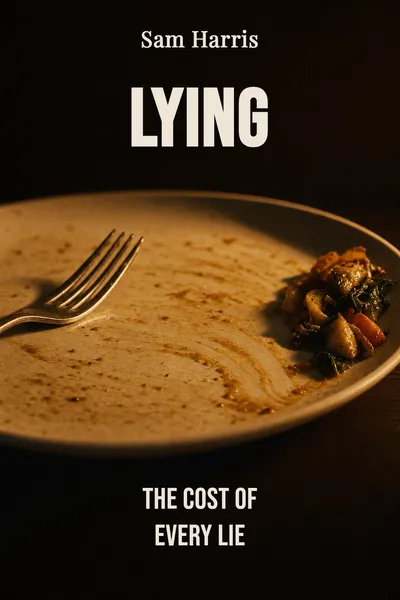
Lying
The cost of every lie
Description
In 2011, Sam Harris — the neuroscientist and philosopher better known for his books on religion and free will — published a book so short it barely qualifies as one. Lying runs to about a hundred pages, closer to a long essay than a treatise. It grew out of a seminar he took at Stanford as an undergraduate, taught by the philosopher Ronald A. Howard, on a subject nobody else seemed to be teaching: whether it is ever right to lie. The seminar stayed with Harris for decades. When he finally wrote it down, the argument turned out to be almost embarrassingly simple, and much harder to shrug off than its length suggests.
The claim is this: we should not lie. Not the big, obvious lies — those are easy to condemn. Harris goes after the ones we tell without thinking, the ones we've decided are kind. The friend who asks whether the dinner was any good. The colleague we praise to their face and doubt in private. The compliment that costs us nothing and, we assume, spares everyone the awkwardness of the truth. Harris argues these small deceptions are not the social lubricant we imagine. They are, quietly, the thing corroding the machine.
What makes the book land is that it doesn't preach abstraction. It works through the ordinary situations where honesty feels impossible, and refuses to let us off the hook. Most of us believe we're honest people who lie occasionally. Harris suspects the arithmetic runs the other way, and he wants to know what it actually costs us.
The question we’re asking : If lying is so common we barely notice it, what does each lie actually cost — to the person we deceive, and to ourselves?What we’ll see : How Harris takes apart the comforting story we tell about our small deceptions, and what he offers in its place.
Table of contents
01 Chapter 1 — The white lie that isn't harmless
Start with the case everyone thinks is settled. A friend has just made a large, irreversible decision — a haircut, a career move, a marriage — and asks what we think. We don't love it. So we say we do. We call this a white lie, and we file it under kindness. Harris wants to reopen the file. The white lie, he argues, is where the whole edifice of acceptable dishonesty rests, and it's built on sand.
His first move is to define terms precisely. To lie, in Harris's account, is to intentionally mislead someone who expects honest communication. That last clause matters. Poker isn't lying; surprise parties aren't lying; fiction isn't lying, because nobody involved expects the literal truth. The white lie is different. Your friend genuinely wants to know, and you genuinely mislead them. The kindness is doing a lot of concealing.

02 Chapter 2 — What a lie steals from the other person
Harris's deeper argument is that a lie is a theft, and the thing stolen is the other person's grip on reality. When we deceive someone, we hand them a false map and let them navigate by it. Every decision they make downstream is corrupted at the source, and they don't know it. They are, in the most literal sense, no longer dealing with the world as it is — they're dealing with the world we invented for them.
This is why Harris thinks even trivial lies do real damage. The friend who was told their business idea was solid raises money, quits a job, tells their family. The person reassured that nothing was wrong keeps living inside a false calm. Each was denied the chance to respond to the actual situation. The liar didn't merely misinform them; the liar quietly took over their agency, deciding what version of events they'd be permitted to act on.
03 Chapter 3 — The liar carries the heaviest load
The surprise of Harris's book is that the person most burdened by a lie is often the one who told it. We imagine deception as something we do to others. Harris insists it's also something we do to ourselves, and the accounting is worse than we admit. Every lie splits our world in two — the version we've told and the version we know — and we have to hold both, indefinitely, without letting them touch.
This is exhausting in a way honesty never is. An honest person, Harris notes, has almost nothing to keep track of. Their words match the world, so there's no story to maintain, no risk of contradiction, no anxiety about who was told what. A liar, by contrast, becomes a bookkeeper of fictions. They must remember which version each person received, monitor for cracks, and brace for the moment the fiction is tested against reality. The lie promised to make life easier. It made it a full-time surveillance job.
04 Chapter 4 — When honesty gets genuinely hard
Harris is not naive about the cases that resist him. The classic objection is the murderer at the door asking where your friend is hiding — the scenario philosophers have used for two centuries to argue that honesty must sometimes yield. Harris takes it seriously, and his answer reframes the whole debate. The obligation of honesty, he notes, extends to people who expect honest communication. A person threatening violence has forfeited that expectation; you are under no duty to inform them. Refusing to answer, misdirecting, or resisting are not the lies his argument condemns. The hard cases turn out to be rarer than we pretend, and they don't license the daily deceptions we actually tell.
05 Conclusion
The book that began as an undergraduate seminar arrives at a claim most of us would rather not test: that the small lies we've licensed as kindness are neither small nor kind. Harris walks the ordinary cases — the compliment, the reassurance, the plan we endorsed to avoid a scene — and shows the same cost hiding in each. The person deceived loses their grip on reality; the person deceiving loses their peace and, eventually, their credibility. Honesty, for all its friction, turns out to be the cheaper transaction.
Related books