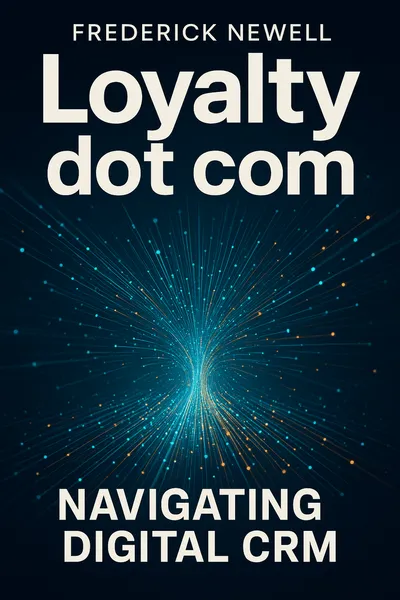
Loyalty dot com
Navigating digital crm
Description
Customer Relationship Marketing (CRM) is a strategy that simplifies the customer's interaction with a business by understanding their needs better than competitors.
This deep understanding fosters a relationship that discourages customers from seeking alternatives. Building such relationships requires a continuous, two-way dialogue. The organization must discern what the customer values and consistently deliver it. This process, while straightforward in theory, is challenging to implement effectively.
Table of contents
01Section 1 - understanding crm and its success metrics .
CRM is a strategic approach for long-term business growth that aims to persuade customers to continue their business with you based on the added value they received from past interactions.
The effectiveness of a CRM program is measured by several key elements. It is important to note that direct marketing and CRM are often mistakenly grouped together, but they are distinct disciplines. Direct marketing uses database information to elicit specific, measurable, and often immediate responses. On the other hand, CRM focuses on cultivating enduring one-on-one relationships with customers, predisposing them to engage in future business with the organization.
CRM is defined as a business strategy that actively fosters a preference for an organization among its employees, channels, and customers, leading to increased retention and performance. Essentially, CRM differentiates a "satisfied" customer from a "loyal" customer. Organizations that consistently deliver high value will cultivate loyal customers. Over time, a robust CRM program strengthens the relationship between the customer and the company.
At the core of CRM is a continuous two-way dialogue between the organization and the customer. Every potential benefit of CRM relies on the organization's ability to demonstrate credibility and build trust, which requires dialogue from the organization to the customer. Similarly, efforts to understand the customer's value perceptions stem from dialogue in the opposite direction. Without this two-way dialogue, CRM cannot exist.

02Section 2 - top tools for crm .
Customer Relationship Management (CRM) goes beyond traditional database marketing and loyalty programs like points and card systems.
In today's business landscape, CRM's success hinges on the integration of digital communication tools. These tools include email, social media, chatbots, webinars, podcasts, blogs, and newsletters, which are essential for sharing valuable content, updates, and stories to build customer loyalty.
03Customer data management
The primary tool in customer relationship management (crm) is a customer database, which contains all relevant details about customer interactions, including transactions, feedback, and personal information. Capturing and organizing this data is crucial for developing a crm blueprint, which involves collaboration between database experts and marketing professionals. This blueprint analyzes customer data to identify key factors like purchase recency, frequency, and demographics, helping calculate the customer's lifetime value and guiding crm strategies. It also predicts returns on marketing investments, essential for planning new crm initiatives. Successful crm requires a long-term budget, clear organizational goals, and the ability to launch new programs.
Internet and email
The internet is crucial for enhancing organizational customer relationships, particularly through customer relationship management (crm) systems. It provides tools like personalized messages, tailored web pages, collaborative filtering, online communities, and notably, email, to deepen customer connections. The internet's capacity for two-way communication is its most vital feature, serving as a customer-centric platform that eases relationship building for businesses. Effective business emails should be personal, timely, accurate, and concise, contributing to every aspect of relationship building, from branding to order processing. Email's adaptability ensures its central role in future online crm strategies.
04Section 3 - crm case studies .
Businesses that have effectively implemented robust CRM programs have adhered to the following strategies: 1. Utilize the Internet to stimulate in-store footfall. 2. Implement micromarketing. 3. Cultivate multiple relationships. 4. Transition from transactions to solutions. 5. Merge customer insight with brand influence. 6. Allow customers to guide the CRM program. Ultimately, your company's actions will always resonate more than its words in any CRM endeavor. Simply put, you must discover innovative ways to demonstrate your concern. Supporting Ideas: Here are some practical applications and concepts on how businesses are leveraging CRM effectively: AutoNation and the American Booksellers Association are successfully harnessing the Internet to increase in-store footfall for retail outlets, rather than creating a purely digital shopping experience. With the capacity of online booksellers to present themselves as having vast, searchable inventories, retailers are employing CRM to concentrate on delivering intelligent solutions for customers. In essence, CRM is prompting retailers to tailor their products more effectively to meet their customers' needs. Instead of becoming 'category killers', CRM retailers are evolving into 'solution killers'.
Neiman Marcus and Wal-Mart are dedicating all their company resources to CRM-inspired ideas like integrated marketing communications. By implementing these strategies at the store level and making store personnel collaborators in the CRM programs, all marketing initiatives become aligned in the same direction. Brand name manufacturers and packaged goods marketers -- from Coca-Cola and Ralston Purina to Quaker Oats, Power Bar, and Seagrams -- are employing CRM strategies in micromarketing initiatives targeting niches. They are starting to shift away from coupons and instead are learning how to establish ongoing relationships with the most profitable customers.
05Section 4 - long-term crm strategies .
Over the long term, Customer Relationship Management (CRM) transforms products into services and requires a two-way dialogue for growth and expansion. This transformation into "prodices" - entities that appear as products but function as services - is a key outcome of effective CRM. Customers today prioritize the results or services that a product can provide rather than the product itself. For example, a person buying a satellite dish is more interested in effective communication than owning the dish itself. Therefore, innovative CRM programs focus on creating prodices that cater to this customer preference.
CRM is not a one-sided interaction but a two-way dialogue that improves over time as the organization gains more insights into customer preferences. This requires the organization to maintain a balance in its communication frequency with the customer, ensuring it is not too much to become an irritant. Each interaction should add value to the relationship, convincing the customer that the organization cares about their well-being.
To achieve these objectives, each customer should have a personalized communication strategy that deepens the relationship between the organization and the customer. The organization should proactively reach out to potential or former customers. Clear and specific goals are required, along with measurements to track the achievement of these goals. The CRM program should be a learning process for the organization, enabling it to enhance and improve the program over time as it gains a deeper understanding of customer needs.
Related books