Life
A Paris apartment's infinite puzzle
Description
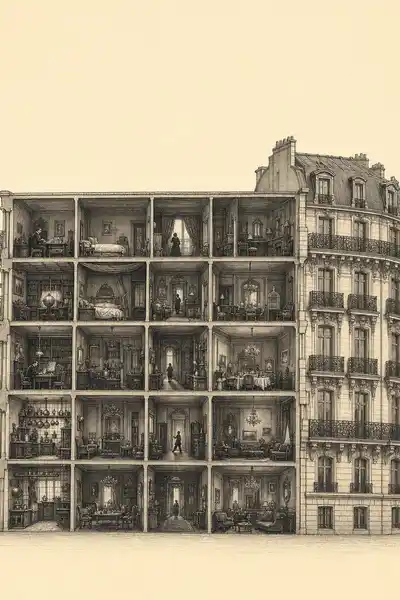
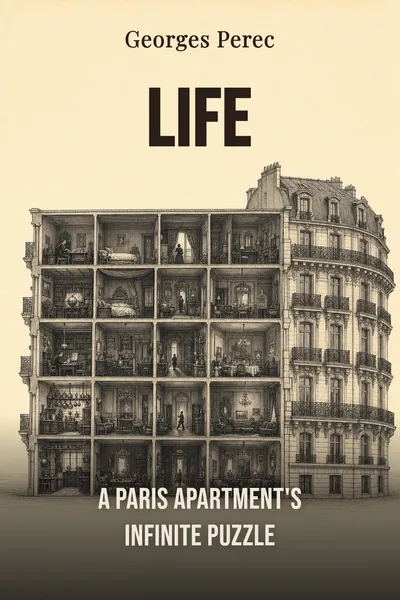
Imagine a Parisian apartment building on a quiet street called rue Simon-Crubellier — a street that, incidentally, does not exist anywhere in Paris. It is the ordinary sort of Haussmann-era block that thousands of people walk past without a second look: courtyard, staircase, stone facade, a name plate by the door. Now imagine that someone has cut away the front wall, the way a child pulls the face off a dollhouse, so that every room on every floor stands exposed at once. That is where Georges Perec begins his 1978 novel, and where he keeps us for the next six hundred pages.
He gave it a title that sounds almost defiantly modest: La Vie mode d'emploi — Life, a user's manual. It won the Prix Médicis the year it appeared, and its reputation has done nothing but climb since. Critics reached for the biggest comparisons they had — Dante's Comedy, Chaucer, the rupture of Joyce's Ulysses — and in 1985, when Le Monde polled readers at the book fair for the novel of the decade, Perec's building came out on top. Between the first flicker of the idea and the finished book, nine years had passed.
What makes the book so hard to file away is that it refuses to be one thing. It is a novel, yes, but also an inventory, a set of nested stories, a portrait of a hundred lives stacked on top of each other at a single frozen instant. Perec himself said each chapter was a fragment of an enormous, dizzying puzzle, and that the whole apartment house was its center. To read it is to watch a microcosm assemble itself, existence by existence, some lives lived and some merely dreamed.
The question we’re asking : How does a single frozen instant in a fictional Paris apartment block become a whole cosmos of lives, objects and lost time?What we’ll see : How Perec built his puzzle — the man at its heart, the hidden constraints, and the strange machine the book turns out to be.
Table of contents
01Chapter 1 — A building sliced open like a dollhouse
The premise is deceptively simple. It is a single moment — somewhere around eight in the evening, on the 23rd of June 1975 — and Perec has removed the front wall of 11 rue Simon-Crubellier so we can see into every room simultaneously. Nobody moves. Time is suspended. What Perec does across the ninety-nine chapters is move through this frozen cross-section room by room, cellar to attic, servants' quarters to grand apartments, telling us who lives there now, who lived there before, what objects sit on the shelves and what stories cling to them.
Each chapter is a piece of the puzzle, and each piece is a room. Perec fills them with an almost unhinged density of detail: a painting of a man at a market, a recipe card, a jigsaw half-finished on a table, the exact pattern of a rug, an unpaid bill. Nothing is too small. A doorknob can open onto a family saga; a photograph can pull in a whole life lived on another continent. The building becomes a filing cabinet of human experience, and Perec is the archivist who has decided, with terrifying patience, to leave nothing out.

02Chapter 2 — The man who spent his life undoing his own work
At the center of the puzzle, quite literally, sits a story that gives the whole book its melancholy engine: the life of Percival Bartlebooth. He is an Englishman of independent means who, around 1925, decides to give his existence a single, entirely self-imposed shape. The plan is baroque and useless, which is exactly the point. Bartlebooth wants a project vast enough to fill a life and pure enough to leave, at the end, no trace whatsoever.
The scheme unfolds in three acts. First, for ten years, he studies watercolor painting under a patient teacher named Valène — who lives in the building, and whose own imagined painting of the whole house shadows the novel. Then, for twenty years, Bartlebooth travels the world with his devoted servant, stopping at five hundred different ports to paint a single seascape at each. Every finished watercolor is shipped back to Paris, where a master craftsman named Gaspard Winckler glues it to a board and cuts it into a jigsaw puzzle of seven hundred and fifty pieces.
03Chapter 3 — The rules Perec never tells us he is following
What the reader feels but rarely sees is that Perec did not simply invent these stories — he generated them from a hidden scaffolding of rules. He belonged to the Oulipo, the workshop of writers and mathematicians founded by Raymond Queneau and François Le Lionnais, whose founding wager was that constraint, far from strangling invention, could set it loose. A writer given a strict formal problem, they believed, is forced past the obvious into the unexpected. Perec was the group's most dazzling practitioner, the man who once wrote an entire novel without the letter e.
For the building, he treated the exposed facade as a grid: ten rooms across, ten floors down, a chessboard of a hundred squares. To decide the order in which he would visit them, he used the knight's tour — the chess problem of moving a knight so it lands on every square exactly once, never repeating. That is why the narrative leaps from a top-floor maid's room to a ground-floor cellar and back, refusing the tidy up-or-down logic we expect. The apparent randomness is in fact the most disciplined path through the house.
04Chapter 4 — A machine for holding everything that passes
Step back from the individual stories and the building starts to look like something larger than a setting. It is an attempt to answer a question that runs under all of Perec's work: how do you hold on to the ordinary before it disappears? He came to this obsessively. His parents were lost in the Second World War — his father killed in 1940, his mother deported to Auschwitz — and much of what he wrote circles the problem of absence, of gaps that can only be described by cataloguing what surrounds them. The apartment house, crammed with objects and inhabitants, is in part a fortress built against forgetting.
This is why the novel's mania for lists and inventories is not decoration. Perec elsewhere wrote about what he called the infra-ordinary — the events so banal we never think to record them, the furniture of daily life that vanishes precisely because it seems too obvious to notice. La Vie mode d'emploi is the grand experiment in taking that stuff seriously: the recipe, the bill, the pattern of a carpet, the exact contents of a drawer, all rescued from the oblivion that normally swallows them. To describe a room completely, Perec suggests, is a form of tenderness.
05Conclusion
The novel ends the way it began, in the suspended building, but the frozen instant has quietly moved: it is now the moment of Bartlebooth's death, seated at his table, a puzzle nearly complete before him, one piece still missing — and the gap in the board is the wrong shape for the piece left in his hand. Fifty years of design, and the circle will not close. Around him the hundred rooms hold their contents, the tenants living and remembered, the objects and the stories, all of it caught at eight in the evening on a street that never existed.
Related books