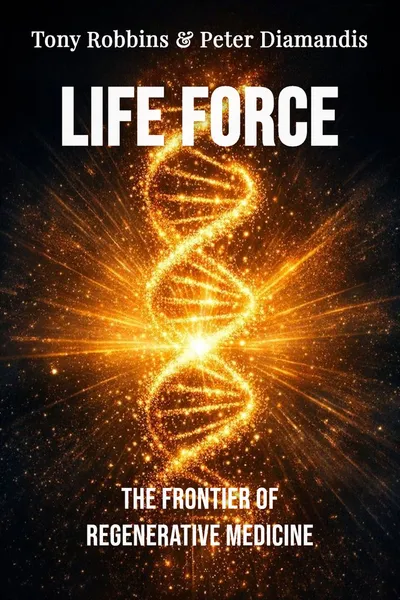
Life Force
The frontier of regenerative medicine
Description
In 2016, Tony Robbins tore the rotator cuff in his shoulder and was told he needed surgery, with a long recovery and no guarantee of full use. Instead, a friend pointed him toward a stem-cell procedure done outside the United States. Months later the shoulder worked, no scalpel involved. Robbins, who is not a scientist but has spent a career interviewing people at the top of every field, did what he tends to do: he got obsessed, and he started calling everyone. The result, written with the entrepreneur and X-Prize founder Peter Diamandis and the physician Robert Hariri, became the book Life Force, published in 2022.
The book is a tour rather than a treatise. Robbins and Diamandis go through the labs and clinics of regenerative medicine and report what they find: gene editing that can rewrite a single misspelled letter of DNA, stem cells being coaxed into repairing joints and organs, blood tests that claim to spot cancer years before a symptom appears. The tone is unmistakably enthusiastic — this is a book that wants us excited about living longer and better. And that enthusiasm is exactly what makes it worth reading carefully.
Because the frontier Robbins describes is genuinely moving, and also genuinely crowded with people selling things that don't work yet. The same clinic that restored his shoulder sits down the road, metaphorically, from a hundred others charging desperate people for injections that do nothing. A book this optimistic about a field this young has to answer a hard question, and to its credit it keeps circling back to it.
The question we’re asking : When a field is advancing this fast, how do we tell the real breakthroughs from the marketing built on top of them?What we’ll see : A walk through the tools reshaping medicine from the inside — and the harder work of deciding which promises have actually arrived.
Table of contents
01Chapter 1 — The tools that stopped waiting for the future
The through-line of Life Force is that a set of technologies people used to file under "someday" quietly became things happening now. The clearest example is gene editing. For decades, rewriting DNA was slow, expensive, and imprecise. Then, around 2012, the CRISPR system — worked out by Jennifer Doudna, Emmanuelle Charpentier and others, and later refined by researchers including Feng Zhang — gave scientists molecular scissors cheap and precise enough to cut a chosen spot in a genome. Doudna and Charpentier shared the Nobel Prize in Chemistry in 2020. Robbins and Diamandis treat this less as a lab curiosity than as the moment biology became something you could edit like text.
What makes the book land is that it doesn't stop at the abstract idea. It points to a specific result: in 2019, a woman named Victoria Gray became one of the first patients treated with a CRISPR-based therapy for sickle-cell disease, a painful inherited blood disorder. Her own cells were edited outside her body and returned to her, and the crippling pain crises largely stopped. In late 2023, regulators in the United Kingdom and then the United States approved that therapy, sold under the name Casgevy. A tool from a 2012 paper had become an approved medicine in roughly a decade.

02Chapter 2 — Cells that remember how to build you
If gene editing is the book's headline, stem cells are its heart — partly because they are where Robbins's own story began. A stem cell is a kind of biological blank slate: a cell that hasn't yet decided what to become and can, under the right conditions, turn into many other cell types or renew tissue. The promise Life Force chases is that if you can get the right stem cells to the right place, the body might repair a knee, a heart muscle, or a damaged organ instead of merely patching it.
Robert Hariri, the physician who co-wrote the book, built much of his career on cells derived from the placenta — tissue normally discarded after birth, which turns out to be rich in young, adaptable cells. Diamandis brings in his own ventures around cellular medicine. The book is candid that these authors are participants in the industry they're describing, not neutral observers, which a careful reader should hold in mind throughout. Their enthusiasm is sincere; it is also invested.
03Chapter 3 — Catching the thing before it catches us
The third pillar of Life Force is diagnostics — the argument that the biggest gains may come not from better cures but from finding disease absurdly early. The authors are drawn to the idea that most cancers are far more survivable when caught before symptoms appear, and that we've historically been terrible at looking. Their fix is a wave of new tests aimed at seeing trouble long before a patient feels anything wrong.
The centerpiece is the so-called liquid biopsy: a blood test that scans for tiny fragments of DNA shed by tumors. Companies like Grail have built multi-cancer early-detection tests around exactly this idea, offering to screen for many cancers from a single blood draw. Robbins and Diamandis are visibly thrilled by the prospect — a routine test that could catch a dozen cancers years ahead of a lump or a scan. Alongside it they champion full-body MRI scans, advanced blood panels, and continuous data from wearables as parts of a general shift toward monitoring the body constantly rather than reacting to crises.
04Chapter 4 — Where the hope ends and the pitch begins
Step back from the individual technologies and Life Force reveals its real subject, which is not any single therapy but the space between a scientific frontier and the marketing that colonizes it. Regenerative medicine is one of the few fields where the gap is dangerous, because the customers are often sick, frightened, and willing to pay anything for hope. Robbins and Diamandis are, in effect, standing in the middle of that gap holding a microphone — and how they handle it is the most interesting thing about the book.
To their credit, they issue warnings a purely promotional book wouldn't. They flag the stem-cell clinics, many offshore, that sell unproven injections for everything from arthritis to autism, sometimes causing real harm, and they urge readers to ask what evidence exists and whether a treatment is part of a regulated trial. They distinguish, imperfectly but genuinely, between therapies approved after rigorous testing and things that are merely available for a fee. A reader paying attention comes away with a rough sorting tool: proven, promising, or pitch.
05Conclusion
Robbins's shoulder still works, and it's a fair place to end, because it holds the whole book in miniature. A real technology helped a real person — and the same procedure sits in a marketplace thick with claims that haven't earned their price. Life Force never pretends the shoulder proves the field; it uses the recovery as a doorway, then spends the rest of the book walking through rooms where the evidence gets stronger or weaker depending on where you stand.
Related books