Life Ascending
The power of life's first spark
Description
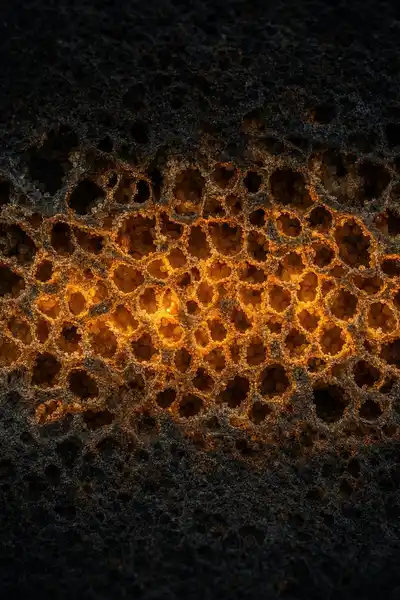
Somewhere on the floor of the early ocean, roughly four billion years ago, warm alkaline fluid met cold acidic seawater and threw up a labyrinth of tiny mineral chimneys, each pore no bigger than a cell. Nothing was alive in there. But across the thin walls of those pores ran a difference in acidity between the fluid inside and the water outside — a gradient, a voltage of sorts. Nick Lane, a biochemist at University College London, has spent his career arguing that this unglamorous chemical fact is where the story of everything living begins. Not a lightning strike, not a warm pond, but a rock that leaked energy.
Life Ascending, which Lane published in 2009 and which won the Royal Society Prize the following year, takes ten of the greatest inventions of evolution and asks how each one actually got started. The book refuses the usual tour of famous fossils and family trees. Instead it works from the bottom up — from membranes, molecules and the flow of electrons — to explain why life looks the way it does. It is science told the way a friend who has read the primary papers might tell it: the names of researchers dropped as characters, the arguments alive and sometimes unresolved.
What ties the chapters together is a single, slightly heretical idea. The features we treat as the crown jewels of biology — respiration, complex cells, sex, even death — may not have been happy genetic accidents that natural selection stumbled onto. They may have been more or less forced by the raw physics of energy. Read that way, the living world stops looking like a lucky lottery win and starts looking like the solution to a problem it could not avoid.
The question we’re asking : How did life's great inventions actually get going — and were they lucky accidents or something closer to inevitable?What we’ll see : We follow Lane down to the vents, the membranes and the molecules where the answers hide, and watch a familiar story of life get rebuilt from its energetics up.
Table of contents
01 Chapter 1 — A hot vent and the first metabolism
The oldest question in biology is also the most awkward: how do you get from lifeless chemistry to something that copies itself and burns fuel? For a long time the favourite answer was Stanley Miller's 1953 experiment, where sparks through a flask of gases produced amino acids. Lane is unimpressed. A soup of building blocks is not life, and there is no obvious way for a dilute broth to concentrate itself or to power the endless reactions a cell needs. The energy problem, he insists, comes first.
His preferred setting is the alkaline hydrothermal vent, of the kind discovered in 2000 at a site in the mid-Atlantic named the Lost City. These are not the scalding black smokers of documentary fame. They are cooler, porous mineral mounds, riddled with interconnected micro-cavities, where warm hydrogen-rich fluid seeps up into cooler ocean water. Crucially, the two fluids differ in acidity, so protons — hydrogen ions — pile up on one side of the thin mineral walls. That pile-up is a natural gradient, a ready-made source of usable energy sitting there for free.

02 Chapter 2 — The trick that lets cells breathe
Once life had left the rocks, it faced a new problem: how to keep the energy flowing without a vent to lean on. The answer was to build its own membrane and run its own proton gradient — the same principle, now portable. But the truly consequential step came later, with the invention of respiration and, before it, photosynthesis. These are the reactions that let organisms strip electrons from one molecule and hand them to another, releasing energy in controlled steps rather than a single wasteful burst.
Photosynthesis is the more astonishing feat. Green plants and cyanobacteria split water using nothing but sunlight, releasing oxygen as a by-product. Lane walks through why this is so hard: water clings to its electrons fiercely, and prising them loose requires a catalyst tuned to almost impossible precision. The engine that does it is a tiny cluster of manganese and oxygen atoms, and the way it likely evolved — borrowed and repurposed from older, simpler chemistry — is one of the book's quiet marvels. The oxygen it belched out changed the planet, poisoning much of the existing life and forcing everything that survived to adapt.
03 Chapter 3 — DNA is not where life begins
We are trained to think of DNA as the master molecule, the blueprint that runs the show. Lane gently dismantles the assumption. DNA is a magnificent archive, but on its own it does nothing — it cannot copy itself, cannot build a cell, cannot even hold together without a swarm of proteins tending it. The information matters, but information is cheap. What is expensive, and what is genuinely hard to build, is the machinery that reads and powers it.
This is where the book makes its boldest move, into the origin of the complex cell. For roughly two billion years, life on Earth stayed stubbornly simple: bacteria and their cousins, tiny and metabolically inventive but never building anything larger. Then, apparently once and only once, one cell ended up living inside another. The larger host and its internal lodger fused into a single partnership, and the lodger became the mitochondrion — the power plant that would drive all complex life. Every animal, plant and fungus descends from that single, freakish merger, an idea championed by Lynn Margulis long before it was accepted.
04 Chapter 4 — Two sexes and the bargain with death
The merger that made complex cells came with a hidden cost, and Lane uses it to explain two things that seem, at first, to need no explaining: why sex exists, and why we die. Both, he argues, trace back to the awkward marriage between a cell and its mitochondria. When two organisms swap genes at random, they risk mixing incompatible sets of mitochondrial and host DNA, with ruinous results. The tidy solution most complex life adopted was to pass mitochondria down through only one parent — which quietly forces the existence of two sexes, one that contributes the power plants and one that does not.
Sex itself, the shuffling of two parents' genes into a new combination, is a genuine puzzle because it is so wasteful. An organism that simply cloned itself would pass on all its genes, not half. Yet sex is nearly universal among complex life, and Lane surveys the leading explanations — that recombination purges harmful mutations and lets beneficial ones spread, keeping a population one step ahead of parasites and decay. The costs are real, but the alternative, a lineage slowly accumulating errors with no way to sweep them out, is worse over the long run.
05 Conclusion
The book ends more or less where it began, in the flow of energy. Consciousness, the last of Lane's ten inventions, he treats as another feat of electrochemistry — the same ion gradients that power a vent and a mitochondrion, now firing across the membranes of neurons to produce, somehow, the feeling of being someone. He does not pretend to have solved the hard problem of experience. But he insists it belongs on the same continuum as everything else, a phenomenon of charged membranes rather than a ghost added from outside.
Related books