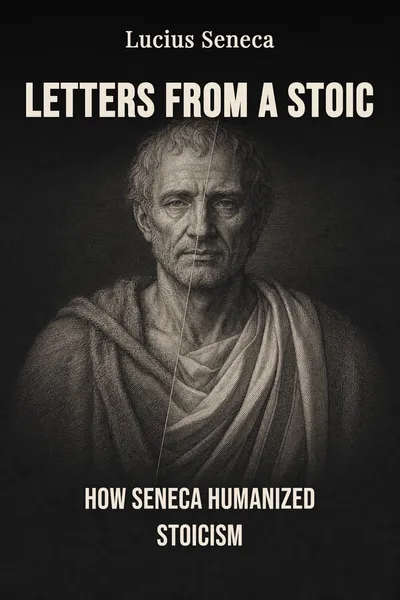
Letters from a Stoic
How Seneca humanized Stoicism
Description
Somewhere around the year 63, an old man on the edge of Rome's political world started writing letters to a friend named Lucilius, the governor of Sicily. The man was Lucius Annaeus Seneca — one of the richest people in the empire, former tutor and adviser to the emperor Nero, a playwright, a moneylender on a scale that would make a modern banker blush. He was also a Stoic, which meant he had spent his life professing that wealth, power and comfort were worth nothing next to virtue. The gap between the two was not lost on him. His enemies never stopped pointing it out.
The letters he sent Lucilius — a hundred and twenty-four of them survive — were never quite private correspondence. Seneca knew they'd be read by more than one man. They range across everything a person might actually worry about: money, illness, crowds, old age, bad company, the fear of dying, whether it's worth reading the same book twice. What they don't do is lecture from a mountaintop. Seneca writes as someone still struggling, still catching himself out, still a long way from the calm he recommends. "I am not wise," he keeps saying, "and I never shall be."
That admission is the whole trick. Stoicism, in its earlier Greek form, could sound like a doctrine for statues — a system of iron indifference that no breathing person could keep up. Seneca took it and made it something a flawed, wealthy, frightened, distracted human being could hold onto. He didn't build the philosophy. He warmed it.
The question we’re asking : How does a man so far from his own ideals end up making that philosophy livable for everyone else?What we’ll see : A wealthy insider, a set of letters that double as confession, and a cold Greek system quietly turned human.
Table of contents
01 Chapter 1 — A minister who couldn't practice what he preached
Seneca was born in Córdoba, in Roman Spain, around 4 BC, and made his name in Rome as an orator and writer good enough to make an emperor jealous — Caligula reportedly wanted him dead for it. He survived that, was exiled to Corsica by Claudius on a charge of adultery, then recalled in 49 to tutor a boy named Nero. When Nero became emperor in 54, Seneca became, in effect, the most powerful adviser in the empire. For roughly the first years of the reign, historians credit him and the praetorian prefect Burrus with keeping the young ruler more or less restrained.
The trouble is what came with the job. Seneca accumulated an enormous fortune — the ancient sources put it around three hundred million sesterces — through gifts, property and lending money across the provinces. He lived among the very comforts he told Lucilius to hold lightly. His critics, then and since, have found this hard to forgive. Here was a man preaching that the good life needs almost nothing, from inside one of the richest households in Rome.

02 Chapter 2 — Letters that weren't really letters
The Epistulae Morales, the moral letters, are addressed to Lucilius Junior, a younger friend with literary ambitions and a Stoic education of his own. On the surface they answer his questions and respond to his news. In practice, they're a philosophy course delivered in small, digestible instalments — Seneca teaching by companionship rather than by system, one theme per letter, rarely more than a few pages.
The form matters. A treatise announces its conclusions and defends them. A letter can wander, double back, start with a complaint about a noisy bathhouse below Seneca's lodgings and end somewhere near the nature of the soul. Seneca uses that freedom constantly. He'll open with a concrete irritation — travel, a crowd at the games, a friend's death, the way we waste time as if we had an endless supply — and let the philosophy grow out of it. The reader is never handed a doctrine cold; it arrives attached to something they already recognize.
03 Chapter 3 — A philosophy warmed from the inside
Stoicism began in Athens with Zeno around 300 BC, and its harder edges are famous. The sage is self-sufficient. Emotions are errors of judgment to be rooted out. Pain, exile, poverty, death — none of them are truly bad, because nothing outside your own virtue can touch you. Stated flatly, it can sound less like wisdom than like armour, a way of not feeling anything. It answers the question of how to be invulnerable, not how to be human.
Seneca kept the framework but changed the temperature. He talks less about the unreachable sage and far more about the person trying and mostly failing to get there. Progress, not perfection, is his real subject. He allows that we grieve, that we're afraid, that friendship exposes us to loss — and instead of telling us to feel nothing, he tells us how to carry the feeling without being ruled by it. When a friend dies, he writes, mourn, but don't mourn forever; the tears that keep flowing are for show.
04 Chapter 4 — The bridge Rome didn't know it was building
Step back from the individual letters and Seneca's larger achievement comes into view: he took a system built for the exceptional few and made it usable by the ordinary many. Early Stoicism set the bar at the sage, a figure so perfect that almost no one qualified. Seneca lowered his gaze to the person in the middle of the effort — inconsistent, tempted, afraid — and wrote a philosophy for them. That shift, from the ideal to the striving, is what let Stoicism survive as something people could actually practice rather than merely admire.
It also changed what the philosophy sounded like. By emphasizing conscience, inner examination, the sense of a divine reason present in each person, and the fellowship of all human beings under it, Seneca gave Stoicism a language that later readers found startlingly close to their own. Marcus Aurelius, writing his private notebooks a century on, carries the same inward, forgiving tone. The severe Greek doctrine had become, in Roman hands, a philosophy of the interior life.
05 Conclusion
The letters have a grim epilogue. In 65, Seneca was accused of joining a conspiracy against Nero — the Pisonian plot — and the emperor ordered his old tutor to kill himself. Tacitus describes the scene: Seneca opening his veins, the blood coming slowly from an aged body, dictating final words to his secretaries even as he died. He met the end he had rehearsed on paper for years, with a composure that his readers, knowing how hard-won it was for him, have never quite been able to dismiss as pose.
Related books