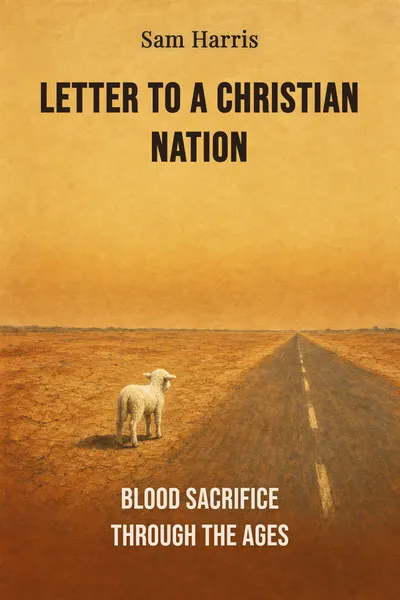
Letter to a Christian Nation
Blood sacrifice through the ages
Description
In late 2004, after the reelection of George W. Bush, a young neuroscientist named Sam Harris sat down to answer his own mail. His first book, The End of Faith, had come out that year and drawn a flood of letters — many of them furious, most of them from Christians who felt he had misread their faith and their country. Rather than reply one by one, he wrote back to all of them at once. The result, published in 2006, was a slim volume of barely a hundred pages: Letter to a Christian Nation.
The device is right there in the title. Harris writes in the second person, to a single imagined reader — a conservative American Christian who believes the Bible is the word of God and that the United States is, at heart, a Christian country. He is not trying to be fair to all religions, or to find the moderate middle. He picks the strongest version of the belief he wants to dismantle and speaks to it directly, without the usual diplomatic cushioning. The tone is cold, precise, and deliberately unsettling.
What gives the book its charge is where Harris chooses to aim. Most arguments about God get stuck on whether he exists. Harris spends surprisingly little time there. He goes instead at the moral claim — the idea that faith makes people good, and that Christianity in particular holds a monopoly on human decency. And underneath that, running through the whole letter like a dark thread, is a much older and stranger accusation about what Christians are actually asked to believe.
The question we’re asking : What is Harris really arguing against when he writes to Christian America — the existence of God, or something older and harder to see?What we’ll see : A short, furious letter that starts with morality and ends by digging up an idea far more ancient than the faith it addresses.
Table of contents
01 Chapter 1 — A little book with a single addressee
Harris built the book as a reply, and it reads like one. There is no throat-clearing, no survey of the world's religions, no attempt to hold every position in balance. He addresses one person: a Christian who takes the faith seriously, believes the Bible is divinely authored, and would describe the United States as a nation founded on Christian values. Harris is explicit that he is not interested in the liberal believer who treats scripture as metaphor. He wants the reader who means it.
The choice is strategic. Harris argues that religious moderates, however well-meaning, provide cover for the literalists — that by treating faith as beyond criticism, they make it impossible to say plainly that some beliefs are simply false and some are dangerous. So he refuses the polite exemption. If the Bible is the word of a perfect God, he reasons, then its every claim is fair game, and its silences and cruelties are God's own.

02 Chapter 2 — The morality that isn't there
The heart of Harris's case is moral, not metaphysical. The claim he wants to break is the one most believers hold most firmly: that without God there is no basis for goodness, and that Christianity is what keeps a society decent. Harris turns this around. He argues that our moral intuitions come first, and that we then judge scripture by them — quietly editing out the parts we find monstrous, and crediting the book with the compassion we brought to it ourselves.
He presses the point with the text itself. The Bible, read straight, sanctions slavery, prescribes death for working on the Sabbath, for adultery, for a child who curses a parent. Nowhere does it clearly condemn owning another human being. If we no longer stone people for gathering sticks on Saturday, Harris says, it is not because we found the loophole in scripture — it is because our morality outran the book and left it behind. We are better than the God we claim to follow, and we know it.
03 Chapter 3 — Reading the numbers, not the scripture
Harris keeps returning to the gap between what faith promises and what the evidence shows, and he does it with figures rather than sermons. This is the neuroscientist's instinct: when someone tells you belief produces a certain result, go and count. The counting, again and again in the letter, comes back against the claim.
Take the Catholic Church and the condom. In sub-Saharan Africa, where AIDS was killing on a scale hard to hold in the mind, the Church continued to teach that condom use was a sin — that it was better to risk transmitting a lethal virus to a spouse than to interfere with the natural order of sex. Harris presents this not as a caricature but as stated doctrine, faithfully applied, with a body count attached. Here, he argues, is faith producing suffering directly, in the name of an invisible good.
04 Chapter 4 — The oldest idea in the letter
Beneath the arguments about morality and evidence, Harris keeps circling a single idea, and it is the one that gives the book its darkest edge. Humanity, he observes, has had a very long fascination with blood sacrifice. It has been by no means uncommon for a child to be born into this world only to be reared by loving parents who then, in the sincerest devotion, lead him by the hand into a field or up a mountain to be buried, butchered, or burned alive — all to keep the sun on its course, or to secure a harvest, or to please a god no one has ever seen.
We tend to file this under the primitive, the safely distant, the sort of thing anthropologists find in the deep past. Harris refuses the comfort of that distance. The central Christian claim — that Jesus died for our sins, and that his death was a successful appeasement of a loving God — is, he argues, a direct and undisguised inheritance of exactly this superstition. Someone had to bleed for the crime; the debt of human wrongdoing could only be settled by a killing. Dress it in two thousand years of theology and it is still the mountaintop and the knife.
05 Conclusion
Harris ends where he began: with a reader he has never met, holding a book that refuses to flatter them. He does not expect conversion, and he does not offer consolation. The letter simply lays out, in a hundred cold pages, a case that faith is neither the source of our morality nor a private matter beyond examination — and that at its center sits an idea far older and stranger than the people who hold it tend to notice.
Related books