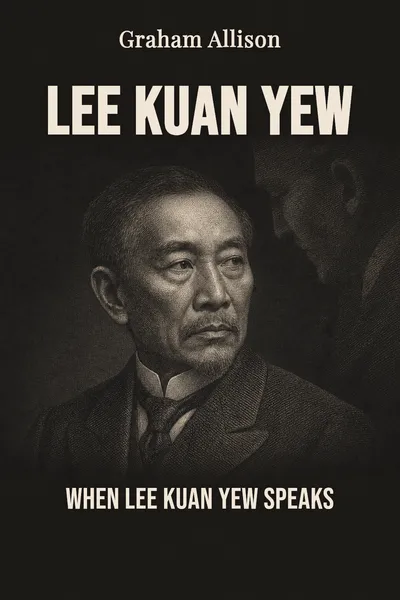
Lee Kuan Yew
When Lee Kuan Yew speaks
Description
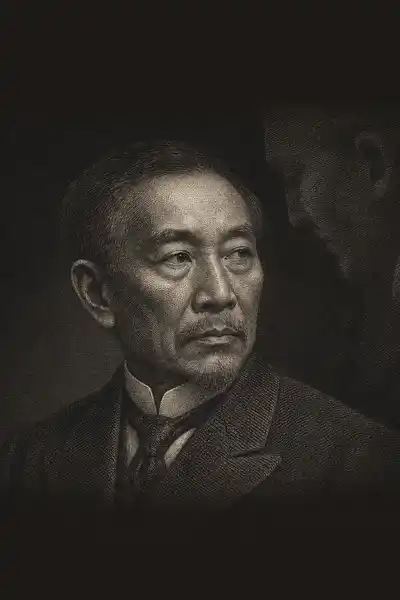
For roughly half a century, a peculiar ritual repeated itself in Washington, Beijing, London and Davos. A visiting American president, a Chinese premier, a chief executive running a company larger than most economies, would set aside an hour or an afternoon for a short, sharp man from a city-state of a few million people. Singapore had no army worth the name, no oil, no nuclear weapons, no vote at any table that decided the world's affairs. Yet Lee Kuan Yew, its founding prime minister from 1959 to 1990, was among the most sought-after people alive when it came to a single question: what happens next, and what should we do about it?
Graham Allison, the Harvard scholar who spent years collecting and organizing Lee's judgments, noticed something that struck him as almost strange. The powerful did not come to Lee for favors, contracts or votes. They came for his reading of the board. Nixon, Deng Xiaoping, both Bushes, Obama, the founders of Silicon Valley and the heads of the largest banks all treated a conversation with Lee as a resource in short supply anywhere else: unsentimental, deeply informed, willing to say the thing nobody in the room wanted said aloud.
How does a leader with almost no hard power become the interlocutor the powerful can't do without? The answer lies less in what Lee built at home, remarkable as Singapore's transformation was, than in what he became on the world stage: a diagnostician of nations, and above all of the two that would define the century.
The question we’re asking : How did a man running a tiny city-state become the confidant world leaders could not afford to skip?What we’ll see : How Lee earned that seat, what he actually told the powerful about China and America, and what his particular authority says about a kind of statesman we may not see again.
Table of contents
01Chapter 1 — The man everyone made time for
The demand for Lee's time was not vanity on anyone's part. It reflected a genuine scarcity. Most people who reached the top of governments and companies were, in Allison's telling, formidable operators inside their own systems and near-blind outside them. Lee was the opposite. He had spent decades reading everything, questioning everyone who passed through Singapore, and testing his conclusions against outcomes he could measure. He offered a rare combination: a practitioner who had actually run a country, and an analyst who thought like a strategist rather than a politician managing the next news cycle.
Part of the appeal was his refusal to flatter. Lee did not tell visitors what they hoped to hear. Asked whether democracy would flourish everywhere, he said flatly that it would not, that culture and development stage mattered more than most Western leaders wished to admit. Asked to praise a policy, he would instead diagnose why it would fail. This candor was expensive in some circles and priceless in others. A president surrounded by aides who softened every message found in Lee someone with nothing to sell and no promotion to angle for.

02Chapter 2 — China: the elephant that learned to dance
No subject occupied Lee more, and none made him more valuable, than the rise of China. He had watched it up close from the beginning, meeting Deng Xiaoping in 1978 when China was still poor and closed. Lee's Singapore, ethnically majority Chinese but resolutely its own nation, became a kind of working model that Deng studied openly. When Western leaders wanted to understand what Beijing intended, they increasingly asked the one outsider the Chinese leadership genuinely respected.
Lee's central judgment, delivered long before it was fashionable, was that China's rise was not a phase to be managed but a permanent shift in the world's center of gravity. He rejected the comforting Western assumption that economic growth would inevitably turn China into a liberal democracy that thought like the West. The Chinese, he argued, had no intention of becoming an honorary member of the Western club. They wanted to be accepted as China, on their own terms, and to reclaim what they saw as their rightful place after a century of humiliation.
03Chapter 3 — America and the balance nobody could see yet
Lee's view of the United States was neither the resentment common in much of the world nor the reverence common among its allies. He admired America with clear eyes and criticized it without malice. He thought it the most successful society in history at generating wealth and innovation, and he sent Singaporeans to study how it did so. But he also saw its weaknesses plainly, and he named them to Americans who were rarely told such things by foreigners they took seriously.
His warnings were consistent across decades. He worried about a culture that celebrated individual rights without a matching sense of duty, about the erosion of the family and the schools, about the drift toward a politics of grievance and short-term consumption. He questioned whether a system built for a comfortable superpower could summon the discipline to compete with a hungry rival. Yet he never counted America out. Its capacity for self-renewal, its ability to attract the world's most talented people, its openness to failure and reinvention, all these he judged to be advantages China could not easily replicate.
04Chapter 4 — The grand master and the limits of listening
Step back from the specific judgments and a larger question emerges: what kind of figure was Lee Kuan Yew, that heads of state treated an hour with him as a strategic asset? He belonged to a category that has grown thin, the statesman whose authority rested not on the power he wielded but on the quality of his judgment. Allison's title works in both directions. Leaders listened when Lee spoke because he had earned the right to be heard through a lifetime of being tested against reality, and because that kind of voice had become genuinely rare.
The scarcity is worth dwelling on. The modern world produces an enormous volume of commentary, forecasting and advice, most of it optimized for attention rather than accuracy. Lee represented the opposite discipline: decades of consequential decisions, each one a wager whose results he had to live with. That is what gave his analysis its weight. He was not performing insight for an audience; he had governed, and the governing had refined his seeing. Few people who reach a global platform have paid that particular price.
05Conclusion
Lee Kuan Yew died in 2015, at ninety-one, having outlived most of the leaders who once cleared their calendars to see him. By then the ritual Allison described had run for the better part of fifty years, and the questions Lee spent his life answering had only grown more urgent. The relationship between a rising China and an anxious America, the one he mapped more carefully than anyone, now sits at the center of the century he did not live to see resolved.
Related books