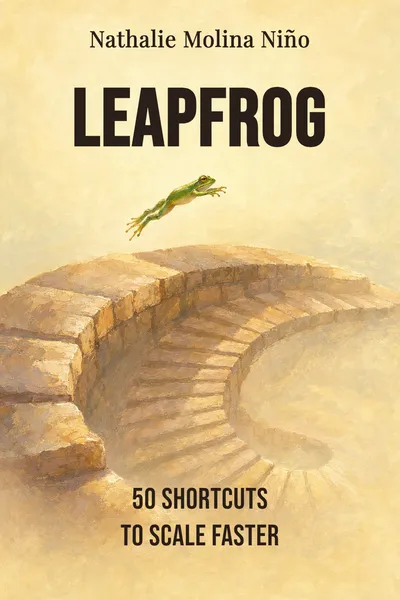
Leapfrog
50 shortcuts to scale faster
Description
Nathalie Molina Niño spent the better part of two decades building and selling tech companies before she started collecting the things nobody had told her. She had come up as a coder in the 1990s, launched a startup in her twenties, and watched founders around her raise money and open doors through moves that were never written down anywhere. Not conspiracies — just knowledge. Who introduces you to which investor. Which grant nobody bothers applying for. Which corporate contract quietly funds a young company for years. By the time she co-founded Entrepreneurs@Athena at Barnard College, she had a name for all of it: leapfrogging. Skipping the slow, sanctioned climb, because the climb was never neutral to begin with.
The book that came out of this, published in 2018, is called Leapfrog, and it does something the genre rarely does. It refuses to pretend the game is fair, then hands over fifty specific ways to play it anyway. Molina Niño writes for women and founders of color first — the people the standard startup story quietly assumes will lose — but the shortcuts work for anyone launching from scratch with more hustle than capital. The fifty hacks sit on a foundation she helped design at Barnard, the Athena Core 10, a set of leadership traits meant to describe how effective women actually build, rather than how business books say leaders should.
What makes the book worth sitting with is not the number fifty. It's the premise underneath it: that the difference between founders isn't grit, and often isn't even the idea. It's access — to money, to networks, to the unwritten rules — and access can be reverse-engineered.
The question we’re asking : If the entrepreneurial playing field is tilted from the start, what can a founder without connections or capital actually do about it?What we’ll see : How a serial founder turned two decades of unwritten rules into a toolkit for the people the system was never built to serve.
Table of contents
01Chapter 1 — The rules were written for someone else
Most business advice starts from a flattering assumption: work hard, build something good, and the market will reward you. Molina Niño's whole book starts from the opposite one. She had seen too much to believe merit was the deciding variable. The data backed her up — women founders were raising a rounding error of venture capital, founders of color less still, and the gap couldn't be explained by the quality of the companies. Something structural was filtering people out before the idea ever got a fair hearing.
Her response is not to rage against the filter, which she considers a waste of a founder's most finite resource. It's to study how it works. If a certain kind of founder gets funded because they already know the investor, then the move is not to wait for the investor to notice you — it's to go get known through some other door. She reframes disadvantage as information. Every closed door tells you where the unofficial back entrances must be, because someone is always getting in.

02Chapter 2 — Money is the least neutral thing in the room
The chapter of startup life where the fewest people tell the truth is the one about money. The dominant story says venture capital is the goal, the summit, the proof you've made it. Molina Niño treats it as one funding source among many — and often the worst one for the founders she's writing for. Venture money comes with a demand for hypergrowth and an exit, and it tends to flow toward people who look like the people already holding it. For a founder outside that circle, chasing it can burn years better spent elsewhere.
So a large share of her hacks are about the money nobody talks about at the pitch competition. Grants that go unclaimed because the paperwork scares people off. Government set-aside contracts reserved for women- and minority-owned businesses, which can fund a company's growth without diluting a single share. Corporate supplier-diversity programs, where large firms have literal quotas to spend with businesses like yours — and where a founder willing to do the certification can land a client that funds operations for years. This is capital that costs no equity and asks no board seat.
03Chapter 3 — Building an audience before building the thing
A second cluster of hacks tackles visibility, and here Molina Niño is at her most contrarian about sequence. The conventional path says you build the product, then find customers, then, if you're lucky, earn some press. She flips it. Attention, she argues, is an asset you can accumulate before you have anything finished to sell — and an audience that already trusts you is worth more than a slightly better product nobody's heard of.
Practically, this means a founder should be building a public presence, a following, a reputation for expertise well before launch. Write the thing people in your niche wish existed. Speak on the panels others avoid. Become the person a journalist calls when they need a quote in your field, so that when you do have something to announce, the relationship is already there. She's blunt that this feels uncomfortable, especially for founders taught to keep their heads down and wait to be chosen — and she treats that discomfort as another door built for someone else.
04Chapter 4 — Advantage, engineered
Step back from the fifty individual moves and a larger claim comes into focus, one Leapfrog makes without ever quite spelling it out. The founders who succeed have always used shortcuts. The person who raises a seed round from a family friend, who gets the introduction because of the school they attended, who lands the first contract through a father's business connection — they leapfrogged too. The startup mythology simply relabels their shortcuts as merit and everyone else's as cheating.
Molina Niño's real intervention is to strip that camouflage off. Once you accept that advantage is engineered rather than earned, the moral hierarchy between the well-connected founder and the one gaming a supplier-diversity program collapses. Both are working the system as it actually functions. The difference is only that one set of shortcuts was inherited and invisible, and the other has to be found and named. Her book is essentially an act of naming — publishing the private curriculum that privileged founders absorb by osmosis.
05Conclusion
Molina Niño came to the toolkit the hard way, collecting each move because she'd once needed it and nobody had offered it. The fifty hacks in Leapfrog are not aspirational; they're the accumulated field notes of someone who built companies without the map her competitors were handed at birth. That origin is why the book reads less like a lecture and more like a friend leaning across the table to tell you the thing she wishes she'd known at twenty-five.
Related books