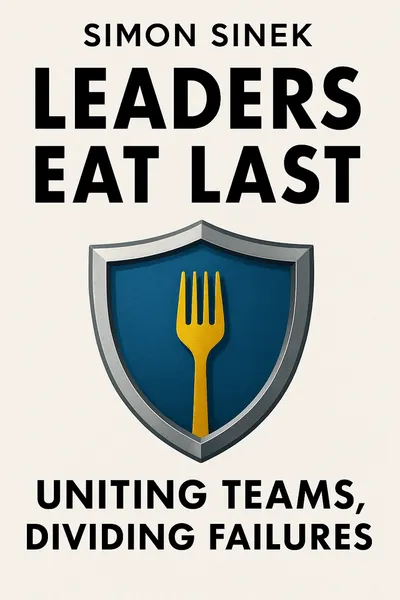
Leaders eat last
Uniting teams, dividing failures
Description
When Marines camp, the most junior members eat first. The more senior follow, with leaders eating last. If food runs out, leaders go hungry, not the rank-and-file. This exemplifies true leadership. Real leaders don't enrich themselves at the expense of others. They don't view people as resources to be casually turned on and off. Great leaders care for their people above all.
In practical terms, great leaders create a Circle of Safety around their people. In dangerous environments, leaders expand that circle repeatedly. A company's strength comes not from products, but from people working together. Every member maintains the Circle. The leader ensures they do so. This is leadership's primary role - caring for those within their Circle. People make the leader at the top look like a genius, not the other way around.
Table of contents
01 Safety - your duty is to make your people feel secure.
The most vital responsibility of leadership is to protect your people as they take risks and aim high. Safeguarding your team from harm is the foremost priority. The world poses many dangers, both literal and philosophical. Your primary duty as a leader should be establishing a Circle of Safety for your employees, then progressively expanding that circle over time.
This challenge can also be explained by basic human biology. Our bodies naturally produce four key chemicals: endorphins and dopamine motivate us to pursue goals, while serotonin and oxytocin enable teamwork and organizational commitment. In particular, serotonin drives us to seek the approval of respected colleagues. When we belong to an excellent group, oxytocin provides long-term motivation to value those connections.
Leaders must also be cognizant of cortisol, released when we feel unsafe, causing stress. Unhealthy organizational cultures elicit constant cortisol flow, preventing employees from doing their best work.

02 Integrity - have the courage to do what's right for your people.
Trust is the cornerstone of effective leadership, essential for fostering cooperation, innovation, and progress within organizations. It acts as a lubricant, ensuring the smooth operation of societal gears. Rooted in our biology, trust emerges when actions enhance our safety and security, triggering the release of oxytocin, the "trust hormone," which reinforces social bonding. Unlike technology, which we rely on to function as designed, trust involves an active, conscious concern for others' wellbeing.
Rules and procedures cannot foresee every scenario, and true leadership involves knowing when to deviate from them for the greater good. This principle was exemplified in 2012 by an air traffic controller who, facing a flight reporting smoke in the cockpit, directed it to descend immediately through other planes' altitudes, potentially saving lives by breaking protocol. Great leaders protect such necessary rule-breaking, creating environments where people feel empowered to act rightly, even at the expense of policy. Simon Sinek highlights that while weak organizations suffer from selfish rule-breaking, strong ones see rules broken for the collective benefit.
03 Individuals - never lose sight that people are real, statistics are not.
The notion of a disposable workforce has been a persistent issue throughout business history. In the 1920s, America witnessed the bloom of its consumer society, fueled by disposable incomes that led to increased spending on new technologies and luxuries. This era boosted industries such as advertising and broadcasting. However, the prosperity was short-lived as the Great Depression of the 1930s curtailed excess, turning companies' attention back to core principles.
The post-World War II economy surged, and companies offered lifetime employment in exchange for employee loyalty. The Baby Boomer generation, growing up in this era of prosperity, developed a sense of entitlement and a readiness to question established norms. In the 1970s, this generation, while advocating for civil rights, also became increasingly self-focused, partly due to disillusionment with the government over the Vietnam War. The 1980s saw economic expansion, spurred by innovations such as personal computers, which encouraged the pursuit of wealth and celebrated individualism, allowing smaller businesses to challenge larger corporations.
04 Commitment - take your duty to lead sincerely and master it.
The notion of a disposable workforce has been a persistent issue throughout business history. In the 1920s, America witnessed the bloom of its consumer society, fueled by disposable incomes that led to increased spending on new technologies and luxuries. This era boosted industries such as advertising and broadcasting. However, the prosperity was short-lived as the Great Depression of the 1930s curtailed excess, turning companies' attention back to core principles.
The post-World War II economy surged, and companies offered lifetime employment in exchange for employee loyalty. The Baby Boomer generation, growing up in this era of prosperity, developed a sense of entitlement and a readiness to question established norms. In the 1970s, this generation, while advocating for civil rights, also became increasingly self-focused, partly due to disillusionment with the government over the Vietnam War. The 1980s saw economic expansion, spurred by innovations such as personal computers, which encouraged the pursuit of wealth and celebrated individualism, allowing smaller businesses to challenge larger corporations.
05 Wisdom - don't overlook that you lead people, not the numbers.
Great leaders recognize that an organization's culture is its lifeblood. A positive and inclusive culture where employees feel safe and supported can lead to enhanced performance, innovation, and loyalty. Conversely, leaders who overlook the importance of culture risk their company's future. This was exemplified by Navy Captain David Marquet's experience on the USS Santa Fe. Despite being trained for a different submarine, Marquet took command of the Santa Fe and chose to empower the crew to make decisions based on their intimate knowledge of the ship. This shift in culture transformed the Santa Fe from the worst to the best-performing submarine in the Navy.
Marquet established a Circle of Safety, creating an environment where the crew felt valued and supported, fostering trust and collaboration. This psychological safety allowed for innovation and proactive problem-solving, contributing to the mission's success. Integrity and honesty are crucial in expanding this circle, as leaders who are transparent and admit their mistakes build trust.
06 Service - inspire your people to care for one another.
Today's business leaders are increasingly reliant on performance metrics and financial incentives, a trend that fosters short-term thinking and erodes company culture. This approach is exemplified by the story of America Online (AOL) in the 1990s, which aggressively pursued subscriber growth through unsustainable promotions, leading to high churn rates and internal misalignment. Simon Sinek highlights that rewarding individual performance over collaboration encourages employees to focus solely on their goals, neglecting the broader organizational interests. This addiction to short-term rewards can cloud judgment, promote insensitivity, and spread selfishness, replacing a commitment to shared success with a pursuit of personal gain.
07 Succession - pass it on --- cultivate more and better leaders.
Addressing the challenges of modern society requires us to be our own greatest hope, with more individuals stepping up as leaders. The motto "In oxytocin we trust" encapsulates the need to build human connections and expand Circles of Safety in our workplaces, advocating for a leadership model that prioritizes the well-being of people over mere profit. The solution to business' dire problems lies in shifting organizational chemistry so that serotonin and oxytocin outweigh endorphin and dopamine. When asked about their proudest achievements, many recall moments of overcoming hardship through teamwork rather than smooth sailing, highlighting the power of camaraderie in generating oxytocin and a sense of achievement.
This phenomenon explains why small startups often have an innovation edge over large companies. Startups consist of determined individuals who share the struggle to do something impressive with limited means, fostering a tremendous esprit de corps that is incredibly motivational. The success of startups often hinges on how well people can unite to outthink problems, emphasizing the importance of a vision that extends beyond achieving a goal. Great leaders inspire their teams by framing challenges ambitiously, pushing them to do meaningful work that exceeds available resources, as seen in the examples of Microsoft and Apple.
Related books