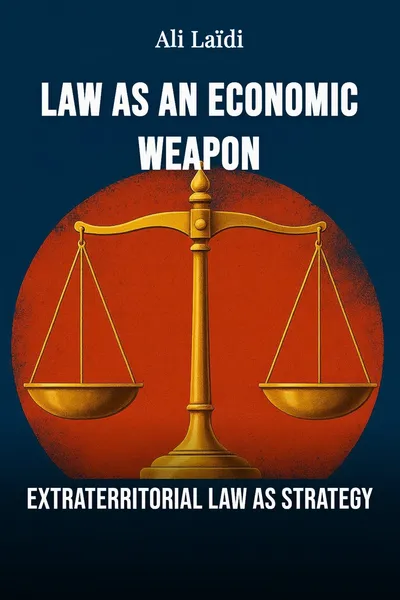
Law as an Economic Weapon
Extraterritorial law as strategy
Description
On June 30, 2014, the French bank BNP Paribas agreed to pay the United States government $8.9 billion. The charge was not fraud against American customers, nor a crime committed on American soil. The bank had processed dollar transactions for clients in Sudan, Iran and Cuba — countries under US embargo — through its own offices, under French and Swiss law, far from any American courtroom. Nobody in the chain of events had set foot in New York with criminal intent. And yet the record-breaking fine was handed down by the Manhattan District Attorney and the US Department of Justice, who had spent years assembling the file. The bank paid, pleaded guilty, and absorbed what was then the largest penalty of its kind ever levied on a foreign company.
The sum is spectacular, but the sum is not the point. The point is the mechanism. How does a national legal system reach across oceans to punish a company that broke no law where it operated? In his book Law as an Economic Weapon, the French researcher Ali Laïdi follows that question through a string of similar cases — Alstom, Siemens, Alcatel, dozens of European firms caught in the same net. What he describes is not a series of scandals but a doctrine: law deployed the way armies and tariffs once were, as an instrument of competition between states.
Laïdi's argument is uncomfortable precisely because it refuses the easy reading. These companies were not always innocent; corruption and sanctions-busting were often real. But the selective, asymmetric way the rules were enforced tells a second story underneath the first — one about who writes the rules, who prosecutes them, and who keeps paying.
The question we’re asking : How did law become a tool for one country to weaken another's companies, and why does Europe keep finding itself on the receiving end?What we’ll see : How a national legal reach turns into economic coercion — and why the continent that invented the craft now sits exposed to it.
Table of contents
01Chapter 1 — The $8.9 billion check BNP Paribas wrote
The BNP Paribas case is where Laïdi plants his flag, because it shows the full machinery at work. Between roughly 2004 and 2012, the bank cleared payments for clients in countries the United States had placed under embargo. To avoid tripping American filters, employees stripped identifying details from transactions and routed them discreetly. None of this violated French law. Processing a dollar payment for a Sudanese client was, under European rules, simply business. The trouble was the dollar itself.
Because the transactions were denominated in dollars, they passed, if only for an instant, through the American financial system — through correspondent banks in New York that clear the world's dollar flows. That fleeting passage was enough. US prosecutors treated it as the hook that pulled the entire operation under American jurisdiction. The bank had, in their reading, used the US financial system to defeat US sanctions, and that made every transaction a potential crime.

02Chapter 2 — Dollars travel, so does the law that follows them
To understand why the BNP case was not a one-off, Laïdi walks back to the legal foundations. The principle at work is extraterritoriality: the claim that a nation's law can govern acts committed abroad, by foreigners, as long as some thread connects them to its territory or interests. American law offers an unusually generous supply of such threads. A dollar transaction, an email routed through a US server, a product containing American components, a share listed on a US exchange — any of these can serve as the point of contact that drags a foreign firm into American jurisdiction.
Two statutes do most of the heavy lifting. The Foreign Corrupt Practices Act, passed in 1977, criminalizes bribery of foreign officials and reaches companies with even a loose link to the United States. And the sanctions regimes, enforced by the Treasury's Office of Foreign Assets Control, bind anyone who touches the dollar system. Neither law was invented as a trade weapon. The FCPA grew out of the post-Watergate cleanup, a genuine attempt to curb corruption. But a tool built for one purpose can be aimed at another, and over time enforcement drifted toward foreign firms.
03Chapter 3 — Compliance becomes a courtroom nobody enters
The most striking thing about these cases, in Laïdi's telling, is how rarely they reach a judge. The system runs on settlements — the deferred prosecution agreement and its cousins, arrangements in which a company admits wrongdoing, pays a fine, and agrees to be supervised, all to avoid the ruinous risk of a criminal trial. The leverage is overwhelming: for a bank or an industrial group, an actual conviction can mean losing licenses, government contracts, access to markets. Against that, almost any fine looks survivable. So companies settle, and the facts are never tested in open court.
The supervision is where the mechanism turns into something stranger. A settlement typically installs a monitor — often an American law firm — inside the company, with wide access to documents, strategy and internal communications, for years. The stated purpose is to ensure the firm reforms its conduct. The effect, Laïdi notes, is that a foreign competitor's most sensitive information can flow toward people operating under the authority of a rival state's legal system. Punishment and intelligence-gathering begin to blur.
04Chapter 4 — Europe writes the rules and forgets to wield them
Step back from the individual files and a larger irony emerges, which is where Laïdi's argument gathers its force. Europe did not stumble into this game as a latecomer. The continent has a deep legal tradition, sophisticated courts, and some of the oldest commercial law in the world. It helped build the international institutions that govern trade. Yet when law became an instrument of economic power, Europe found itself cast almost exclusively as the defendant — fined, monitored, occasionally dismembered — rather than as a player wielding the same tool.
The gap, in Laïdi's reading, is not technical but political. The United States treats its legal system as an arm of national strategy, coordinated across prosecutors, Treasury and diplomacy, and willing to project power abroad. Europe treats law as a domestic affair, fragmented across member states, each guarding its own courts and reluctant to turn justice into a weapon. That restraint is in many ways admirable. It is also, Laïdi suggests, why European firms keep writing enormous checks while few American firms face the same from Europe.
05Conclusion
BNP Paribas paid its $8.9 billion and moved on; the dollar-clearing suspension ended, the business recovered, the fine faded into the quarterly reports. The mechanism that produced it did not fade. It kept running through Alstom, through the long list of European names that followed, each settlement reinforcing the same lesson about where the law reaches and who it tends to reach for. What Laïdi documents is less a sequence of scandals than the slow normalization of a practice: the quiet conversion of legal systems into instruments of national competition.
Related books