

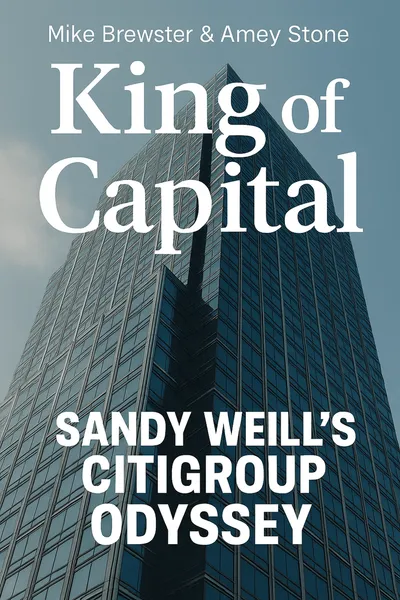
King of capital
Sandy weill's citigroup odyssey
Description
Stanford I. Weill, known as Sandy Weill, was born in Brooklyn, New York in 1933 to Polish immigrant parents. He attended Peekskill Military Academy, where he excelled academically and athletically. After graduating from Cornell University, Weill began his career in finance as a runner for Bear Stearns. He later formed a partnership with three other brokers, creating the firm Carter, Berlind, Potoma & Weill.
The firm focused on retail clients and grew rapidly, eventually acquiring Bernstein-MacCaulay, a money management firm. After a power struggle, the firm changed its name to Cogan, Berlind, Weill & Levitt. The firm continued to expand, acquiring other firms and opening new offices. In 1971, the firm went public, selling shares to raise capital for further growth.
Table of contents
01Early life and education of sandy weill
Born in Brooklyn, New York, on March 16, 1933, Sandy Weill grew up during the tail end of prohibition and the recovery from the Great Depression. His Polish immigrant grandparents had fled the Russian revolution in 1907, and his parents were part of a close-knit Jewish community. Sandy's father and grandfather started a dressmaking business that prospered for years but was later accused of wartime price gouging. After this setback, his father dabbled in steel importation with little success.
Sandy attended Peekskill Military Academy, where he excelled academically and in activities like tennis and leading the school band as drum major. Known as "Mr. Five o’Clock Shadow," he was ambitious, a trait that would serve him well in finance. Graduating third in his class in 1951, he chose Cornell over Harvard, initially studying engineering but switching to government after struggling with physics. His graduation was delayed when he missed an exam to help his parents, during which time he married Joan Mosher.

02Sandy weill's initial career and founding of cbwl
Sandy Weill, often hailed as the "Master of the Deal," has made a name for himself by specializing in the acquisition of underperforming and undervalued financial services firms. His approach to business, likened to Donald Trump's focus on luxury real estate and Don King's on boxing promotions, has been characterized by a keen eye for potential in the financial sector. Despite some viewing his skill set as narrow, Roy Smith, a former Goldman Sachs partner, acknowledges Weill's effectiveness, while Jeff Lane credits Weill's success to his perpetual self-doubt, which fuels a constant drive for questioning and improvement.
By the early 1970s, Weill's company, CBWL, had grown to a workforce of 400, with its most valuable asset being a state-of-the-art back-office system capable of efficiently processing a high volume of small transactions. This technological advantage became particularly valuable following the market downturn at the end of the 1960s, which saw many brokerage houses struggle. In 1970, the financial services sector experienced significant layoffs and the liquidation or acquisition of over 100 member firms of the New York Stock Exchange.
03Cbwl's growth and acquisitions in the 1970s
In 1972, under the leadership of Sandy Weill, Hayden-Stone had expanded significantly, boasting numerous branches and a robust back-office system. Despite these advancements, the firm faced a challenging stock market, leading to a sharp decline in earnings from $3 million to $1.7 million. To navigate these difficulties, Hayden-Stone began underwriting for smaller companies, some of questionable quality, which later caused issues for Weill. Internal disagreements emerged, particularly with co-founder Cogan, who favored large investment banking deals, in contrast to Weill's focus on retail operations and transforming branches into "investment centers," a novel approach at the time. This disagreement led to Cogan's departure in 1973, with Weill taking over as CEO and chairman.
04Weill's vision for financial services and merger with american express
Sanford "Sandy" Weill, a key player in the business realm, was always intrigued by the idea of cross-selling financial services, a concept many considered unfeasible due to the distinct skills required for selling investments and mortgages. However, Weill saw the potential in combining these services. In the 1980s, James Robinson III, CEO of American Express, recognized a similar opportunity and approached Weill with the idea of acquiring Shearson Loeb Rhoades to utilize its network of investment brokers.
The financial industry was on the cusp of deregulation, presenting a chance to create comprehensive financial products that included banking, investments, and credit cards. The merger with American Express was particularly attractive to Weill, who was promised a board seat and an executive position, along with a personal gain of about $30 million from his Shearson stock.
05Post-american express ventures and turnaround of commercial credit
Sanford I. Weill, also known as Sandy, left American Express on August 1, 1985, and established an office in New York City to explore new business opportunities.
During this period, he became the chairman of a $50 million project to renovate Carnegie Hall, contributing $2.5 million with his wife to initiate the fundraising. This involvement led to networking opportunities, through which Weill learned of BankAmerica's need for a turnaround. He rallied support from legal and banking professionals and secured a $1 billion investment from Shearson Lehman, contingent on his appointment as CEO.
Despite his proposal being rejected by BankAmerica's board as a mere job application and business solicitation, Weill persisted with a second formal proposal, which became public and boosted the company's stock price. However, the board still declined his offer.
06Acquisition of primerica and return to wall street
Eighteen months after Commercial Credit's IPO, Sanford Weill was approached by investment bankers with a proposition to acquire Primerica, a conglomerate owning various financial services firms including Smith Barney and A.L. Williams.
In August 1988, it was announced that Commercial Credit would purchase Primerica for $1.7 billion, marking Weill's return to Wall Street as Primerica's chairman and CEO. This acquisition was significant, with Commercial Credit having 3,700 employees and $4.4 billion in assets, compared to Primerica's 25,000 employees and $13.8 billion in assets. Weill, known for acquiring companies during challenging times, continued this trend and adopted the name of the larger firm, securing the assets at a bargain price.
07The historic merger of citicorp and travelers to form citigroup
Sandy Weill's vision for a comprehensive financial services empire led him to propose a merger between Citicorp and Travelers Group to Citicorp's CEO, John Reed, in February 1998.
Despite Citicorp's status as one of the world's most profitable banks in 1997, Reed was intrigued by the idea. After several meetings, preliminary terms were outlined, aiming to create a financial services supermarket that would be a formidable competitor in consumer banking, investment banking, mutual funds, credit cards, and insurance.
This merger would enable the company to compete globally, especially against banks in Asia and Europe that were not restricted from offering banking and insurance products under one roof.
08Challenges and successes of citigroup under weill's leadership
The journey of establishing Citigroup was eagerly undertaken by Reed and Weill, who initially managed a co-CEO arrangement effectively despite some key executives leaving due to management reshuffles.
The company's stock price rose steadily, attributed more to cost reduction than cross-selling. In the corporate world, where CEOs are often judged by stock price performance, Sandy Weill distinguished himself by enhancing shareholder value, even if it meant unpopular decisions like layoffs and increased fees.
However, tensions between Reed and Weill grew, leading to a division of responsibilities that ultimately saw Reed focusing on strategy and new technology, while Weill handled operations. This division made Reed's position weaker as Weill controlled the revenue-generating aspects of Citigroup.