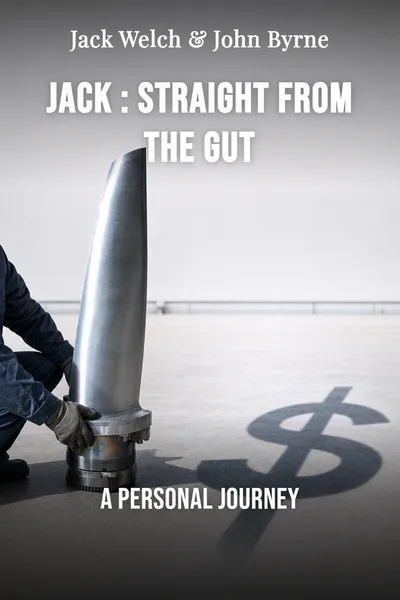
Jack : straight from the gut
A personal journey
Description
Jack Welch, born in 1935, was a second-generation American of Irish descent who grew up in Massachusetts. After graduating with a degree in chemical engineering, he pursued a Ph.D. at the University of Illinois. Welch started his career at General Electric (GE) in 1960, overseeing the development of a new thermoplastic.
Despite initial frustrations with the company's bureaucracy, he chose to stay and eventually became the general manager of a new plant manufacturing the plastic. Welch's success led to his promotion to general manager of GE's plastics business in 1968. Known for his candid and ambitious nature, Welch eventually became the CEO of GE in 1981, transforming the company into a more agile and efficient organization.
Table of contents
01 Initial stages
Jack Welch was born on November 19, 1935, in Peabody, Massachusetts, to second-generation Irish-American parents. His father was a lifelong railroad conductor for the Boston & Maine line, and his mother took on the primary role in raising Jack, their only child. After graduating from Salem High School, Jack pursued higher education at the University of Massachusetts at Amherst, attracted by the affordable tuition of fifty dollars per semester. He began his studies in 1953 and graduated in 1957 as one of the top engineering students with a degree in chemical engineering. His academic excellence led him to the University of Illinois at Champaign, where he received a fellowship to join the Ph.D. program. By 1960, Jack had earned his Ph.D. and married Carolyn Osburn.
Upon graduation, Jack Welch, at 24, had multiple job offers, but he was particularly intrigued by an opportunity from Dr. Dan Fox at General Electric in Pittsfield, Massachusetts. He was tasked with developing a new thermoplastic called PPO (polyphenylene oxide), which showed great potential. Jack joined GE on October 17, 1960, as an engineer with an annual salary of $10,500. However, within a year, he grew frustrated with the company's bureaucracy and nearly left, but a young executive convinced him to stay by offering a raise, more responsibility, and protection from bureaucratic hurdles.

02 Forming ideologies
On April 1, 1981, I experienced the sensation of a dog that had finally snagged the elusive bus—I had landed the job. Despite my extensive background, my inner confidence didn't match the bold front I put on. To the outside world, I appeared self-assured, and those acquainted with me would describe me as confident, bold, decisive, quick, and tough. Yet, beneath that exterior, I was plagued by doubts. Public speaking was a struggle due to my speech impediment. I camouflaged my receding hairline with a strategic hairstyle. And when it came to my stature, I deluded myself into believing I was taller than my actual five feet eight inches. - Jack Welch
When Jack Welch assumed leadership of General Electric (GE) in 1981, he inherited a behemoth with 404,000 employees, boasting annual revenues of $25 billion and profits of $1.5 billion from a diverse product range, including household appliances and nuclear reactors. The firm was often compared to a sturdy, unyielding "supertanker." Jack, on the other hand, saw GE as a "speedboat"—agile, quick, and ready for rapid maneuvers.
His goal was to cut through the red tape, noting the excessive layers of management that distanced the CEO from the production line. To move away from the top-down management style, Jack challenged the "superficial congeniality" prevalent among managers and staff, who were polite in public but critical behind closed doors. He eliminated the need for his approval on all spending, empowering business leaders to use their allocated capital without central oversight. Jack Welch also took aim at outdated GE customs, such as the annual board meetings to review new appliance prototypes, quickly doing away with these and other time-consuming, valueless practices.
03 Business highs and lows
Jack Welch, the former CEO of General Electric (GE), openly acknowledges his missteps alongside the company's triumphs. One notable error was the acquisition of Kidder, Peabody & Co., a venerable Wall Street investment banking firm, in April 1986. GE's ambition was to earn substantial investment banking fees, but the venture quickly became problematic. Scandals involving Marty Siegel, who traded insider stock tips with Ivan Boesky, and Joseph Jett, who was responsible for $350 million in fictitious bond trades, brought negative attention to GE. The cultural differences between GE and Kidder, Peabody were stark, leading to the sale of Kidder Peabody by GE in October 1994.
Welch reflects on the Kidder experience as a lesson in the importance of corporate culture. During the dot-com boom of the late 1990s, some GE Capital equity group members demanded equity stakes in the deals they were making with GE's funds. Welch refused, valuing the unity of GE's culture and the singular currency of GE stock, which varied only by performance levels. This principle also led him to forgo acquisitions of high-tech companies in Silicon Valley, despite their strategic potential, to preserve GE's culture and values.
04 Revolutionary shifts
General Electric (GE) is a company that stands as a paragon for those who are passionate about business and innovation. With over 300,000 employees spread across more than 20 different divisions, GE fosters a culture where ideas are freely exchanged, and creativity is encouraged. This culture, devoid of boundaries, allows for the birth of ideas at any level, creating a dynamic and synergistic environment. Operational meetings flow into one another, allowing for a seamless transition of strategies and celebrations of achievements across divisions. This approach, while sometimes chaotic, has proven to be effective in fostering continuous learning and propelling the business forward.
At GE, an initiative is more than just a fleeting trend; it is a concept that captures the company's collective imagination and has the potential to bring about transformative change. Initiatives start as small ideas and, once operationalized, can grow to have a significant impact on the company. They require the full dedication of senior leadership and the best talent, who are provided with the necessary training and resources to succeed.
05 Reflecting and projecting
Jack Welch is frequently asked what it takes to be an effective CEO. He acknowledges that there is no definitive guide or formula for being a CEO, as each individual approaches the role differently. Despite not having a magic solution, Welch offers insights from his own experience, suggesting that others may find them useful and adapt them to their own style.
A successful CEO, according to Welch, possesses integrity and communicates transparently without hidden motives. He believes that people may not always concur with his views, but they can trust in his honesty. Ensuring the company's financial prosperity is also crucial, as it allows the company to contribute positively to society by paying taxes, creating quality jobs, and investing in its workforce and facilities. Welch emphasizes that a company's social responsibility is rooted in its strength and competitiveness.
Related books